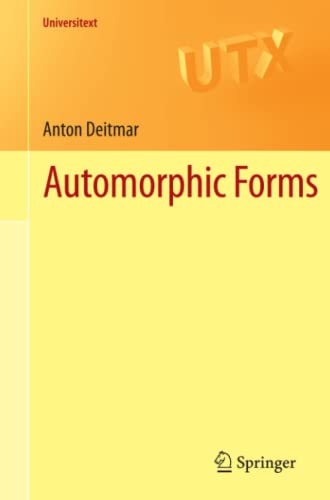
Ebook Info
- Published: 2012
- Number of pages: 261 pages
- Format: PDF
- File Size: 1.22 MB
- Authors: Anton Deitmar
Description
Automorphic forms are an important complex analytic tool in number theory and modern arithmetic geometry. They played for example a vital role in Andrew Wiles’s proof of Fermat’s Last Theorem. This text provides a concise introduction to the world of automorphic forms using two approaches: the classic elementary theory and the modern point of view of adeles and representation theory. The reader will learn the important aims and results of the theory by focussing on its essential aspects and restricting it to the ‘base field’ of rational numbers. Students interested for example in arithmetic geometry or number theory will find that this book provides an optimal and easily accessible introduction into this topic.
User’s Reviews
Editorial Reviews: Review From the reviews:“This book covers, in a readable and clear style, the main aspects of the theory of automorphic forms with minimal prerequisites. … this book would serve very well as a one-semester course on automorphic forms, representations, and L-functions. A short guide to the literature is given, which directs interested readers to more thorough (and demanding) sources. … There are also numerous well-written exercises that develop the material further.” (Dominic A. Lanphier, Mathematical Reviews, July, 2013)“This book is an elementary introduction to the realm of Automorphic forms. There are many books on Automorphic forms but this is the first book that requires only few pre-requisites and definitely is suitable for advanced undergraduate classes and for graduate students. … I would recommend this book if you are interested in starting learn Automorphic forms or you will give a first course on this subject. The book is very recent, very well-written and presents very nice exercises and remarks.” (Philosophy, Religion and Science Book Reviews, bookinspections.wordpress.com, March, 2013)“The book under review is an excellent introduction to this part of number theory, geared to graduate students or accelerated and enthusiastic advanced undergraduates … . The book comes equipped with nice exercise sets and a collection of strategically placed ‘Remarks’ which will guide the reader to more advanced sources and provide him a broader and more organic perspective on the field.” (Michael Berg, MAA Reviews, January, 2013) From the Back Cover Automorphic forms are an important complex analytic tool in number theory and modern arithmetic geometry. They played for example a vital role in Andrew Wiles’s proof of Fermat’s Last Theorem. This text provides a concise introduction to the world of automorphic forms using two approaches: the classic elementary theory and the modern point of view of adeles and representation theory. The reader will learn the important aims and results of the theory by focussing on its essential aspects and restricting it to the ‘base field’ of rational numbers. Students interested for example in arithmetic geometry or number theory will find that this book provides an optimal and easily accessible introduction into this topic.
Reviews from Amazon users which were colected at the time this book was published on the website:
⭐Eine schöne Darstellung eines interessanten Teilgebietes der Zahlentheorie.
⭐
⭐
Keywords
Free Download Automorphic Forms (Universitext) 2012th Edition in PDF format
Automorphic Forms (Universitext) 2012th Edition PDF Free Download
Download Automorphic Forms (Universitext) 2012th Edition 2012 PDF Free
Automorphic Forms (Universitext) 2012th Edition 2012 PDF Free Download
Download Automorphic Forms (Universitext) 2012th Edition PDF
Free Download Ebook Automorphic Forms (Universitext) 2012th Edition