

Ebook Info
- Published: 1988
- Number of pages:
- Format: PDF
- File Size: 5.99 MB
- Authors: Peter S. Landweber
Description
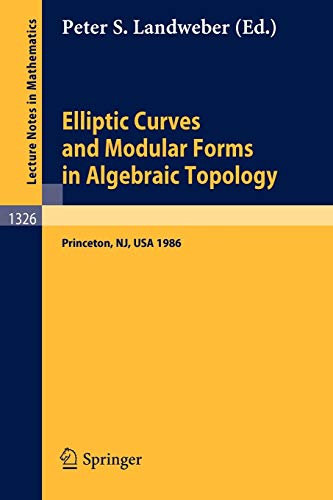
A small conference was held in September 1986 to discuss new applications of elliptic functions and modular forms in algebraic topology, which had led to the introduction of elliptic genera and elliptic cohomology. The resulting papers range, fom these topics through to quantum field theory, with considerable attention to formal groups, homology and cohomology theories, and circle actions on spin manifolds. Ed. Witten’s rich article on the index of the Dirac operator in loop space presents a mathematical treatment of his interpretation of elliptic genera in terms of quantum field theory. A short introductory article gives an account of the growth of this area prior to the conference.
User’s Reviews
Reviews from Amazon users which were colected at the time this book was published on the website:
⭐Elliptic objects or elliptic genera been of great interest to many mathematicians in the last few decades because of their connections to algebraic topology and algebraic geometry. High energy physicists may have come across elliptic objects in the context of superconformal field theory and its connection with mirror symmetry or in the context of quantum field theory when dealing with spin connections. This book deals with what was known about elliptic objects around the mid 1980’s and as gives the interested reader valuable information and insights into the origin and intuition of the The first article of this book gives a very quick introduction to elliptic genera, emphasizing the historical roots of the subject, and should be accessible to those readers who have a solid background in algebraic and differential topology. The key to understanding the early results on elliptic genera is the arithmetic form for the characteristic classes that show up in the relevant contexts. In the first article for example, the author (Peter S Landweber) discusses the case where the circle group acts on a closed connected spin manifold, and writes down an expression for the index of the Dirac operator in terms of the A-genus, with the later having a multiplicative form in terms of hyperbolic sine functions. The properties of these hyperbolic sine functions are succinctly responsible for the power of elliptic genera in giving invariants for various mathematical objects, although this is usually not expressed by many who write about elliptic objects. Landweber does however emphasize this, when he writes down the addition formula for (complex) elliptic curves, and in the process also gives a hint as to the designation of “elliptic” in the name.It was in the context of “twisted” superconformal field theory that physicists were first confronted with elliptic objects. Specifically, this is the twisting of the nonlinear sigma model that results in the now ubiquitous A and B models that have had wide impact. The partition function of the untwisted nonlinear sigma for a surface of genus one was shown to be independent of the metric and thus form a topological invariant of the target space and was called the “elliptic genus” of the target space. The restriction to genus one can be removed by the twisted supersymmetric sigma model. Landweber discusses this early work by referring to the twisted Dirac operator for spinor fields with coefficients in the tangent bundle of the closed spin manifold. The index of the (twisted) Dirac operator is now not just the A-genus but also involves the Chern character of the complexification of the tangent bundle. The challenge now is to compute this index (it was conjectured to be constant), and Landweber discusses some of the early approaches for doing so. The notion of a character-valued index played a role in Kaluza-Klein theories in determining how massless fields transform under the symmetry group of the compact internal space.Of particular importance to the understanding of elliptic genera is the presence of the (oriented) cobordism group in the early work that Landweber discusses (dealing with circle actions on spin manifolds). To remove the possibility of torsion, the oriented cobordism group was tensored with the rational numbers Q and was conjectured to be generated by CP(2), CP(4), CP(6), …., (this is sometimes called a “basic sequence” of manifolds) whereCP(n) is complex n-dimensional projective space. As Landweber explains, this conjecture was proved by the introduction of the ‘elliptic genus’, which is multiplicative (more specifically a ring homomorphism between the oriented cobordism group to a commutative Q-algebra) and whose logarithm is an elliptic integral. Since elliptic curves can be defined in terms of modular forms on the upper half plane, it is not surprising to learn that the elliptic genus can be related to modular forms. Landweber points out the connection via an elliptic genus from the oriented cobordism ring to the rational polynomial ring. This elliptic genus maps to modular forms, and is elaborated on in some detail by the mathematician Don Zagier in the last article of the book. Zagier studies this in the more general context of genera in algebraic topology, which are ring homomorphisms from the oriented cobordism ring to a Q-algebra. One of the key ideas in Landweber’s paper is that one is lead to an “extraordinary” cohomology theory, namely one with the zeroth dimension not being the coefficient group, which given its connection with elliptic curves was designated as elliptic cohomology.Also of great importance to the early work on elliptic genera is that due to the mathematical physicist Edward Witten, who has an article in this book on circle actions on spin manifolds. In some mathematical circles Witten’s work is classified as “physical mathematics” because of its lack of rigor, but it is represented in this book as of great importance to the search for a kind of “universal” elliptic curve for defining elliptic genera. Since Witten is motivated by considerations in high energy physics, namely that of quantum field theory, his article may not be appreciated by some readers who are not well-versed in quantum field theory.Witten begins by defining the character-valued index for the Dirac operator on a spin manifold M, which is a function which takes elements of the unit circle and calculates the difference between the traces of these elements over the kernel and cokernel of the Dirac operator. This is a meaningful arithmetic operation since the unit circle is compact and the kernel and cokernel can then be considered to be modules over the unit circle. Witten wants to find a fixed point formula for the character-valued index, which he does first for isolated fixed points and then generalizes to non-isolated fixed points by looking at the normal bundle to each connected component of the fixed point set of the unit circle. Witten writes down a formula for the fixed point set for each of these components and then takes the sum of each of them to get a character-valued index for the Dirac operator. Unfortunately the details of how to arrive at this formula are omitted from the paper, as are the steps taken to arrive at the formula for the fixed point set of the Dirac operator that is “twisted” by lifting the action of the unit circle to an arbitrary vector bundle over M. This twist of the Dirac operator should be familiar to those readers with knowledge of Witten’s work in superconformal conformal field theory and its use in understanding mirror manifolds. It is in generalizing this to any “Dirac-like” operator on the free loop space of maps from the unit circle to M that Witten shows a connection with a modular form for the elliptic genus. This is done for the twisted case by considering the signature operator on the free loop space of M.
⭐
Keywords
Free Download Elliptic Curves and Modular Forms in Algebraic Topology: Proceedings of a Conference held at the Institute for Advanced Study, Princeton, Sept. 15-17, … 1326) (English and French Edition) in PDF format
Elliptic Curves and Modular Forms in Algebraic Topology: Proceedings of a Conference held at the Institute for Advanced Study, Princeton, Sept. 15-17, … 1326) (English and French Edition) PDF Free Download
Download Elliptic Curves and Modular Forms in Algebraic Topology: Proceedings of a Conference held at the Institute for Advanced Study, Princeton, Sept. 15-17, … 1326) (English and French Edition) 1988 PDF Free
Elliptic Curves and Modular Forms in Algebraic Topology: Proceedings of a Conference held at the Institute for Advanced Study, Princeton, Sept. 15-17, … 1326) (English and French Edition) 1988 PDF Free Download
Download Elliptic Curves and Modular Forms in Algebraic Topology: Proceedings of a Conference held at the Institute for Advanced Study, Princeton, Sept. 15-17, … 1326) (English and French Edition) PDF
Free Download Ebook Elliptic Curves and Modular Forms in Algebraic Topology: Proceedings of a Conference held at the Institute for Advanced Study, Princeton, Sept. 15-17, … 1326) (English and French Edition)