

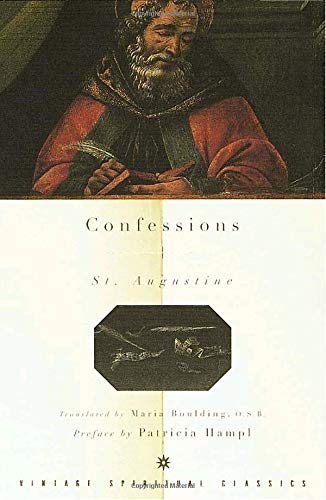
Ebook Info
- Published: 1998
- Number of pages: 400 pages
- Format: PDF
- File Size: 3.28 MB
- Authors: St. Augustine
Description
God is our home but many of us have strayed from our native land. The venerable authors of these Spiritual Classics are expert guides–may we follow their directions home. –Archbishop Desmond TutuWriting in the last years of the fourth century a.d., Saint Augustine of Hippo created what is at once the first true autobiography in Western literature and among the most sophisticated yet accessible theological arguments in the history of Christianity. With extraordinary candor and psychological acumen, Augustine recounts his passage from a life of sensuality, Manichaean superstition, and empty careerism to a genuine spiritual awakening, and he articulates views on marriage, morality, and faith that have shaped our discourse ever since. The Confessions allows us to appreciate both the startling modernity of Augustine’s insights and the imperishable poetry of his voice. With a new Preface by MacArthur Fellow Patricia Hampl, author of Virgin Time and A Romantic Education.In the annals of spirituality, certain books stand out both for their historical importance and for their continued relevance. The Vintage Spiritual Classics series offers the greatest of these works in authoritative new editions, with specially commissioned essays by noted contemporary commentators. Filled with eloquence and fresh insight, encouragement and solace, Vintage Spiritual Classics are incomparable resources for all readers who seek a more substantive understanding of mankind’s relation to the divine.
User’s Reviews
Editorial Reviews: Amazon.com Review Augustine’s Confessions is arguably the first, and unequivocally the most influential, religious autobiography in the Christian tradition. Augustine (who was a hard-core hedonist before his sudden conversion) writes about faith with the reckless abandon of a lover; his descriptions of friendship are so beautiful they’ll bring tears to your eyes; and his tributes to his mother, Monica, cast eternally fresh light on the unofficial authority of women in the early Church. –Michael Joseph Gross From the Inside Flap “God is our home but many of us have strayed from our native land. The venerable authors of these Spiritual Classics are expert guides–may we follow their directions home.” –Archbishop Desmond TutuWriting in the last years of the fourth century a.d., Saint Augustine of Hippo created what is at once the first true autobiography in Western literature and among the most sophisticated yet accessible theological arguments in the history of Christianity. With extraordinary candor and psychological acumen, Augustine recounts his passage from a life of sensuality, Manichaean superstition, and empty careerism to a genuine spiritual awakening, and he articulates views on marriage, morality, and faith that have shaped our discourse ever since. The Confessions allows us to appreciate both the startling modernity of Augustine’s insights and the imperishable poetry of his voice. With a new Preface by MacArthur Fellow Patricia Hampl, author of Virgin Time and A Romantic Education.In the annals of spirituality, certain books stand out both for their historical importance and for their continued relevance. The Vintage Spiritual Classics series offers the greatest of these works in authoritative new editions, with specially commissioned essays by noted contemporary commentators. Filled with eloquence and fresh insight, encouragement and solace, Vintage Spiritual Classics are incomparable resources for all readers who seek a more substantive understanding of mankind’s relation to the divine. From the Back Cover “God is our home but many of us have strayed from our native land. The venerable authors of these Spiritual Classics are expert guides–may we follow their directions home.” –Archbishop Desmond Tutu Writing in the last years of the fourth century a.d., Saint Augustine of Hippo created what is at once the first true autobiography in Western literature and among the most sophisticated yet accessible theological arguments in the history of Christianity. With extraordinary candor and psychological acumen, Augustine recounts his passage from a life of sensuality, Manichaean superstition, and empty careerism to a genuine spiritual awakening, and he articulates views on marriage, morality, and faith that have shaped our discourse ever since. The Confessions allows us to appreciate both the startling modernity of Augustine’s insights and the imperishable poetry of his voice. With a new Preface by MacArthur Fellow Patricia Hampl, author of Virgin Time and A Romantic Education. In the annals of spirituality, certain books stand out both for their historical importance and for their continued relevance. The Vintage Spiritual Classics series offers the greatest of these works in authoritative new editions, with specially commissioned essays by noted contemporary commentators. Filled with eloquence and fresh insight, encouragement and solace, Vintage Spiritual Classics are incomparable resources for all readers who seek a more substantive understanding of mankind’s relation to the divine. About the Author St Augustine of Hippo, the great Doctor of the Latin Church, was born at Thagaste in North Africa, in 354 CE. He was brought up as a Christian but he was soon converted to the Manichean religion. He also came under the influence of Neoplatonism. However, in 387 he renounced all his unorthodox beliefs and was baptized into Christianity. His surviving works have profoundly influenced Christian theology and the psychology and political theology of the West. Excerpt. © Reprinted by permission. All rights reserved. Book IINFANCY AND BOYHOODOpening prayer and meditation1, 1. Great are you, O Lord, and exceedingly worthy of praise, your power is immense, and your wisdom beyond reckoning. And so we humans, who are a due part of your creation, long to praise you-we who carry our mortality about with us, carry the evidence of our sin and with it the proof that you thwart the proud. Yet these humans, due part of your creation as they are, still do long to praise you. You arouse us so that praising you may bring us joy, because you have made us and drawn us to yourself, and our heart is unquiet until it rests in you.Grant me to know and understand, Lord, which comes first: to call upon you or to praise you? To know you or to call upon you? Must we know you before we can call upon you? Anyone who invokes what is still unknown may be making a mistake. Or should you be invoked first, so that we may then come to know you? But how can people call upon someone in whom they do not yet believe? And how can they believe without a preacher? But scripture tells us that those who seek the Lord will praise him, for as they seek they find him, and on finding him they will praise him. Let me seek you, then, Lord, even while I am calling upon you, and call upon you even as I believe in you; for to us you have indeed been preached. My faith calls upon you, Lord, this faith which is your gift to me, which you have breathed into me through the humanity of your Son and the ministry of your preacher.2, 2. How shall I call upon my God, my God and my Lord, when by the very act of calling upon him I would be calling him into myself? Is there any place within me into which my God might come? How should the God who made heaven and earth come into me? Is there any room in me for you, Lord, my God? Even heaven and earth, which you have made and in which you have made me-can even they contain you? Since nothing that exists would exist without you, does it follow that whatever exists does in some way contain you? But if this is so, how can I, who am one of these existing things, ask you to come into me, when I would not exist at all unless you were already in me? Not yet am I in hell, after all, but even if I were, you would be there too; for if I descend to the underworld, you are there. No, my God, I would not exist, I would not be at all, were you not in me. Or should I say, rather, that I should not exist if I were not in you, from whom are all things, through whom are all things, in whom are all things? Yes, Lord, that is the truth, that is indeed the truth. To what place can I invite you, then, since I am in you? Or where could you come from, in order to come into me? To what place outside heaven and earth could I travel, so that my God could come to me there, the God who said, I fill heaven and earth?3, 3. So then, if you fill heaven and earth, does that mean that heaven and earth contain you? Or, since clearly they cannot hold you, is there something of you left over when you have filled them? Once heaven and earth are full, where would that remaining part of you overflow? Or perhaps you have no need to be contained by anything, but rather contain everything yourself, because whatever you fill you contain, even as you fill it? The vessels which are full of you do not lend you stability, because even if they break you will not be spilt. And when you pour yourself out over us, you do not lie there spilt but raise us up; you are not scattered, but gather us together. Yet all those things which you fill, you fill with the whole of yourself. Should we suppose, then, that because all things are incapable of containing the whole of you, they hold only a part of you, and all of them the same part? Or does each thing hold a different part, greater things larger parts, and lesser things smaller parts? Does it even make sense to speak of larger or smaller parts of you? Are you not everywhere in your whole being, while there is nothing whatever that can hold you entirely?4, 4. What are you, then, my God? What are you, I ask, but the Lord God? For who else is lord except the Lord, or who is god if not our God? You are most high, excellent, most powerful, omnipotent, supremely merciful and supremely just, most hidden yet intimately present, infinitely beautiful and infinitely strong, steadfast yet elusive, unchanging yourself though you control the change in all things, never new, never old, renewing all things yet wearing down the proud though they know it not; ever active, ever at rest, gathering while knowing no need, supporting and filling and guarding, creating and nurturing and perfecting, seeking although you lack nothing. You love without frenzy, you are jealous yet secure, you regret without sadness, you grow angry yet remain tranquil, you alter your works but never your plan; you take back what you find although you never lost it; you are never in need yet you rejoice in your gains, never avaricious yet you demand profits. You allow us to pay you more than you demand, and so you become our debtor, yet which of us possesses anything that does not already belong to you? You owe us nothing, yet you pay your debts; you write off our debts to you, yet you lose nothing thereby.After saying all that, what have we said, my God, my life, my holy sweetness? What does anyone who speaks of you really say? Yet woe betide those who fail to speak, while the chatterboxes go on saying nothing.5, 5. Who will grant me to find peace in you? Who will grant me this grace, that you would come into my heart and inebriate it, enabling me to forget the evils that beset me and embrace you, my only good? What are you to me? Have mercy on me, so that I may tell. What indeed am I to you, that you should command me to love you, and grow angry with me if I do not, and threaten me with enormous woes? Is not the failure to love you woe enough in itself? Alas for me! Through your own merciful dealings with me, O Lord my God, tell me what you are to me. Say to my soul, I am your salvation. Say it so that I can hear it. My heart is listening, Lord; open the ears of my heart and say to my soul, I am your salvation. Let me run toward this voice and seize hold of you. Do not hide your face from me: let me die so that I may see it, for not to see it would be death to me indeed.6. The house of my soul is too small for you to enter: make it more spacious by your coming. It lies in ruins: rebuild it. Some things are to be found there which will offend your gaze; I confess this to be so and know it well. But who will clean my house? To whom but yourself can I cry, Cleanse me of my hidden sins, O Lord, and for those incurred through others pardon your servant? I believe, and so I will speak You know everything, Lord. Have I not laid my own transgressions bare before you to my own condemnation, my God, and have you not forgiven the wickedness of my heart ? I do not argue my case against you, for you are truth itself; nor do I wish to deceive myself, lest my iniquity be caught in its own lies. No, I do not argue the case with you, because if you, Lord, keep the score of our iniquities, then who, Lord, can bear it?Infancy6, 7. Yet allow me to speak, though I am but dust and ashes, allow me to speak in your merciful presence, for it is to your mercy that I address myself, not to some man who would mock me. Perhaps you too are laughing at me, but still you will turn mercifully toward me, for what is it that I am trying to say, Lord, except that I do not know whence I came into this life that is but a dying, or rather, this dying state that leads to life? I do not know where I came from. But this I know, that I was welcomed by the tender care your mercy provided for me, for so I have been told by the parents who gave me life according to the flesh, those parents through whose begetting and bearing you formed me within time, although I do not remember it myself. The comforts of human milk were waiting for me, but my mother and my nurses did not fill their own breasts; rather you gave me an infant’s nourishment through them in accordance with your plan, from the riches deeply hidden in creation. You restrained me from craving more than you provided, and inspired in those who nurtured me the will to give me what you were giving them, for their love for me was patterned on your law, and so they wanted to pass on to me the overflowing gift they received from you. It was a bounty for them, and a bounty for me from them; or, rather, not from them but only through them, for in truth all good things are from you, O God. Everything I need for health and salvation flows from my God. This I learned later as you cried the truth aloud to me through all you give me, both within and without. At that time I knew only how to suck and be deliciously comforted, and how to cry when anything hurt my body, but no more.8. After this I began to smile, at first only in my sleep and then when I was awake. So I have been told, and I believe it on the strength of what we see other babies doing, for I do not remember doing it myself. Little by little I began to notice where I was, and I would try to make my wishes known to those who might satisfy them; but I was frustrated in this, because my desires were inside me, while other people were outside and could by no effort of understanding enter my mind. So I tossed about and screamed, sending signals meant to indicate what I wanted, those few signs that were the best I could manage, though they did not really express my desires. Often I did not get my way, either because people did not understand or because what I demanded might have harmed me, and then I would throw a tantrum because my elders were not subject to me, nor free people willing to be my slaves; so I would take revenge on them by bursting into tears. I have learned that babies behave like this from those I have been able to watch, and they without knowing it have taught me more surely what I was like myself than did my nurses who knew me well.9. My infancy has been so long dead now, whereas I am alive. But you, O Lord, are ever living and in you nothing dies, for you exist before the dawn of the ages, before anything that can be called “before”; you are God and Lord of everything that you have created. In you stand firm the causes of all unstable things; in you the unchangeable origins of all changeable things abide; in you live the eternal ideas of all irrational and transient creatures. Tell me, I beg you, tell your miserable suppliant, O merciful God, whether my infancy was itself the sequel to some earlier age, now dead and gone. Was there nothing before it, except the life I lived in my mother’s womb? Some information about that has been given me, and I have myself seen pregnant women. But then, my God, my sweetness, what came before that? Was I somewhere else? Was I even someone? I have nobody to tell me: neither father nor mother could enlighten me, nor the experience of others, nor any memory of my own. Are you laughing at me for asking you these questions, and are you perhaps commanding me to praise you and confess to you simply about what I do know?10. Confess to you I will, Lord of heaven and earth, and praise you for my earliest days and my infancy, which I do not remember. You allow a person to infer by observing others what his own beginnings were like; we can learn much about ourselves even from the reports of womenfolk. Already I had existence and life, and as my unspeaking stage drew to a close I began to look for signs whereby I might communicate my ideas to others. Where could a living creature like this have come from, if not from you, Lord? Are any of us skillful enough to fashion ourselves? Could there be some channel hollowed out from some other source through which existence and life might flow to us, apart from yourself, Lord, who create us? Could we derive existence and life from anywhere other than you, in whom to be and to live are not two different realities, since supreme being and supreme life are one and the same? You are supreme and you do not change, and in you there is no “today” that passes. Yet in you our “today”does pass, inasmuch as all things exist in you, and would have no means even of passing away if you did not contain them. Because your years do not fail, your years are one “Today.” How many of our days and our ancestors’ days have come and gone in this “Today” of yours, have received from it their manner of being and have existed after their fashion, and how many others will likewise receive theirs, and exist in their own way? Yet you are the self-same: all our tomorrows and beyond, all our yesterdays and further back, you will make in your Today, you have made in your Today.What does it matter to me, if someone does not understand this? Let such a person rejoice even to ask the question, “What does this mean?” Yes, let him rejoice in that, and choose to find by not finding rather than by finding fail to find you. Read more
Reviews from Amazon users which were colected at the time this book was published on the website:
⭐This is best translation I’ve found after extensive research ‘A Note on This Translation’ appears on page xxxix The last sentence reads,”The debt of the present translator to this work will be evident on every page.” Ms Hampl includes background info in her preface that helps the reader to understand the period when St Augustine lived- very important for context. She also includes a Chronology of the life of St Augustine, most useful when reading. I refer back to it when reading often to get an idea of who, what, where,& when.This was my first ‘saint’ book I purchased after my conversion to Catholicism My delayed Confirmation due to Covid-19 was on Pentecost Sunday 5/31/20 I purchased this In June,2020 I’ve read it I re-read it I refer to it often I can relate to St Augustine. He is me He is you He is a Saint most of us can relate to.On this Feast day of St Augustine 8/28/21 I can tell you I’m STILL reading this book From page227 “All this I have learned, and I give thanks and praise to you, my God, my teacher, for knocking at the door of my ears and shedding your light into my heart.
⭐This is a profound book in so many ways; here are just a few. Augustine writes with a combination of confidence and humility that is not seen today. His confidence stems from faith in the God he clearly knows so well and his humility from a deep understanding of the sinfulness that dwells at the very core of his being. Worship is the purpose and attitude of the book; one can’t help but be moved to do so after reading it. This book has also stimulated me to much thought in the areas of entertainment, evangelism, conversion, and scripture. Although this book is a great classic that has influenced Christianity and beyond for many centuries and people feel like they “should” read it, I recommend reading it for the pure delight of listening to a man who lays himself bankrupt before the Almighty and sincerely asks, “Give what you command, and command what you will.”
⭐Confessions is written like Bernard Russell in Shakespearean-Socrates prose. His phrases are circular in rhetorical jargon, a lot of O thou’ & “I” use in every phrases. I don’t like how it’s written, I found it BORING. I skipped 1st half of book, got to the nitty gritty on his thoughts about evil & existence of God, but I think i’ll jump to Cliff notes to get to the point of his confessions, or issues of his life as a Bishop b/c I don’t like the constant questioning w/ in his paragraphs. How 1/2 of the readers gave this 5 stars, is unfathomable. Makes me wonder – if they really got what he was confessing?!?
⭐This book has been around for a while and has had a profound influence on Christian thought for centuries. It is distinctly Catholic and so the theology may or may not sit well with you but this is an incredible look into the life of an educated and reasonable man wrestling hard with his own iniquities and coming to the faith by being convinced of its truth through a combination of logic, passion, and revelation. I found it well worth the read but you do need to have a fairly high reading level and a tolerance to wade through a lengthy prose book.
⭐The ultimate life changing book. Speaking not only of Confession of Sin, but Confession of the Majesty of our Lord.
⭐One of the best translations out there. I have personally read bits and pieces of many of the translations available and I find this one to be the most accessible as someone new to Augustine.
⭐Difficult reading in the language and style of the time in which written. A very famous person in the annals of Christianity but one might not discern exactly why from this text. It might be better to read a biography assessing the man’s impact and summarizing his activities and their importance to his legacy.This reader is still fighting through the language and syntax. A long battle is predicted. Perhaps the work will be reassessed after the smoke clears.
⭐This book inspired and still inspiring millions of peoples through the centuries. Great book! The historical context of Augustine’s life is great help as well!
⭐A very interesting read how things used to be and properly are still today in the church a lot of details
⭐a book that is enjoyable.
Keywords
Free Download The Confessions in PDF format
The Confessions PDF Free Download
Download The Confessions 1998 PDF Free
The Confessions 1998 PDF Free Download
Download The Confessions PDF
Free Download Ebook The Confessions