

Ebook Info
- Published: 2010
- Number of pages: 241 pages
- Format: PDF
- File Size: 3.47 MB
- Authors: C. B. Martin
Description
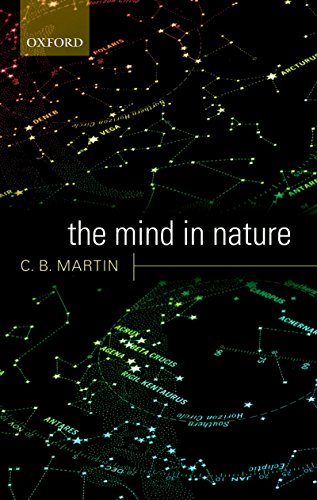
What are the most fundamental features of the world? Do minds stand outside the natural order? Is a unified picture of mental and physical reality possible? The Mind in Nature provides a staunchly realist account of the world as a unified system incorporating both the mental and the physical. C. B. Martin, an original and influential exponent of ‘ontologically serious’ metaphysics, echoes Locke’s dictum that ‘all things that exist are only particulars’, andargues that properties are powerful qualities. He also spells out the implications of this view for philosophical conceptions of causation, intentionality, consciousness, and the mind-body problem.Martin emphasizes the importance of non-conscious ‘vegetative’ systems, which provide clear examples of intentionality in the form of representational use. The slide from representational use to consciousness involves a change in the material of use, but not the form of representation. A concluding chapter provides an argument for the view that an ontology of particular substances and properties leads ineluctably to monism: the bus we board with Locke takes us directly to the world of Spinozaand Einstein. Along the way, we are led to understand the nature of minds and conscious states of mind in a way that avoids both reductionism (the idea that mental is reducible to the non-mental) and dualism (the idea that mental substances or properties differ dramatically from physical substancesand properties).
User’s Reviews
Reviews from Amazon users which were colected at the time this book was published on the website:
⭐Philosopher C.B.Martin died last year and left us a great book. In it, he summarizes his philosophy and its applications to mind, causality and more. Martin proposes an ontology featuring dispositions (sometimes referred to as powers). Notably for him, dispositions are inherently qualitative, and are also capable of producing myriad manifestations depending on the context.An attraction of starting with dispositions is their potential to support a theory of real causality and of intentionality – topics mainstream analytic philosophy has trouble with IMO. Martin adds the twist that we should consider dispositions to also be qualities, which helps solve an aspect of the mind/body problem. I found the biggest key to Martin’s ontology to be his proposal that dispositions don’t just point to one kind of manifestation, they are prolific. The fundamental units of nature have dispositions to potentially an infinite number of different manifestations depending on context. This allows the ontology to support the rich features of the world, without the notions of multiple levels of reality (or “possible worlds” modal structure).With regard to mind, Martin stresses that dispositions (which are inherently directional) give you intentionality at level below what we think of as “mental”. He also gives an account of how a natural system utilizing representation comes into being; he is inspired by results in neurobiology which he takes to show that “vegetative” (i.e. unconscious) systems of the brain effectively utilize representations already. So intentionality and representation, along with qualities, are already part of nature before we get to the human mind.So what does distinguish the mental? Here Martin builds a detailed model which says the difference between mental and non-mental lies in the kind of qualitative material used in a representation. If the material of use is appropriately sensory, we get consciousness.This book was not an easy read for this layperson, but I found it very rewarding.
⭐”The Mind in Nature” is the culmination of 40 years of work by a truly original mind, whose work is not known as widely as it should be; though Martin’s ideas have been well respected and discussed by some of the finest 20th century philosophers, including David Lewis and David Armstrong. Hopefully, this book will introduce a new generation of philosophers to Martin’s work.The book is a must read for professional philosophers, especially metaphysicians, and is far less abstruse and technical than most contemporary work in metaphysics, making it accessible, though not easily accessible, to casual readers of philosophy. (Philosophical novices might be better off reading John Heil’s “From an Ontological Point of View”, where Heil- a devotee of Martin’s metaphysics and a top-notch philosopher in his own right- presents Martin’s views while also adding explanations of philosophical concepts that Martin sometimes assumes readers know.)Martin’s book does not waste time waffling about whether metaphysical inquiry is possible. Instead, Martin lays down a rich, complete, deeply realist ontology, which draws upon- and perhaps improves upon- the ideas of Locke, Spinoza, and C.D. Broad. That is, Martin doesn’t ask questions about metaphysics; he does metaphysics, and while doing metaphysics shows how it is useful and necessary. (This attitude towards metaphysics is common amongst Martin’s “Aussie Realist,” ontologically serious compatriots, but Martin seems to be the most ontologically serious of all.)The core of Martin’s world view- as I see it- is what Martin calls the ‘Surprising Identity’ between dispositions and qualities. Without going into detail here: Martin first argues that dispositional properties- e.g. the disposition to roll, the disposition to dissolve salt, etc.- are real, but corresponding qualitative properties are also real- e.g. being spherical, being wet, etc. Then, Martin argues that every dispositional property is identifiable with, some qualitative property, e.g. the disposition to roll with being spherical. (I should note that Martin identifies qualities and dispositions without eliminating either, i.e. that on Martin’s view each sort of property is as real as the other.)With the basic ontology of dispositional and qualitative properties established, Martin is able to use his ontology to give novel solutions to big metaphysical problems, including: a novel solution to the mind body problem, an explanation of intentionality which draws heavily upon neuroscience and the notion of dispositional “for-ness”, a new model of causation which avoids problems arising from supposed gaps between causes and effects, an account of emergent properties which disavows “levels” of properties, an account of “tropes” as properties that has space-time playing the role of the ‘bearer of properties,’ a refutation of the language of thought hypothesis, an explanation of thought as imagistic which relies on what Martin calls `projection’ and `use’, a way of finding truthmakers for counterfactuals and conditionals without resorting to real, Lewis-style possible worlds, and a sometimes maddeningly hard to understand theory of the relationship between the Einsteinian warps and woofs of space-time and Martin’s dispositions.The explanations and arguments in “The Mind in Nature” are notable for a number of reasons. Martin’s work is admirably gradualistic, working up from basic simple properties to complex phenomena; Martin often explains how the complicated entities described in neuroscience and theoretical physics should be thought of as built out of more basic ontological entities. Moreover, his work on the mind is deeply phenomenological, paying heed to `the rich life of the mind.’ Martin is also a master of the philosophical thought experiment: his favorite weapon. My favorite of Martin’s thought experiments asks us to consider being `lost in thought’ as a refutation of behaviorism.Readers should be warned that “The Mind in Nature” doesn’t always read like contemporary books in metaphysics. Now, some will find Martin’s style and method refreshing. However, I worry that others might decide that Martin is not rigorous enough, or that he does not spend enough time considering opposing views. Some might even dismiss this book merely because Martin’s presentation differs from their own. (Dismissing important work in metaphysics is still en vogue; the ghosts of positivism linger still.) I only hope that when Martin’s work is discussed, philosophers remember that Lewis, Armstrong, and Broad have all been, quite wrongly, dismissed as well. Moreover, philosophers ready to dismiss Martin should remember his pedigree: Martin studied under Russell, Wisdom, and Moore; was deeply respected by Quine, Davidson, and Lewis; and is highly esteemed by David Armstrong, John Heil, E.J. Lowe, Paul Snowden, Michael Devitt, Kent Bach, Peter Unger, Kai Nielsen, and others; some of whom contributed to a book of essays in his honor.I would ask only that those who find Martin’s style or his position distasteful give `The Mind in Nature’ a thorough read, and a second thought.Those who do favor a realist approach to metaphysics, on the other hand, will find that The Mind in Nature contains a fortune of ideas to be thought about for years.
⭐
Keywords
Free Download The Mind in Nature 1st Edition in PDF format
The Mind in Nature 1st Edition PDF Free Download
Download The Mind in Nature 1st Edition 2010 PDF Free
The Mind in Nature 1st Edition 2010 PDF Free Download
Download The Mind in Nature 1st Edition PDF
Free Download Ebook The Mind in Nature 1st Edition