

Ebook Info
- Published: 2016
- Number of pages: 304 pages
- Format: PDF
- File Size: 21.56 MB
- Authors: Robert P. Kirshner
Description
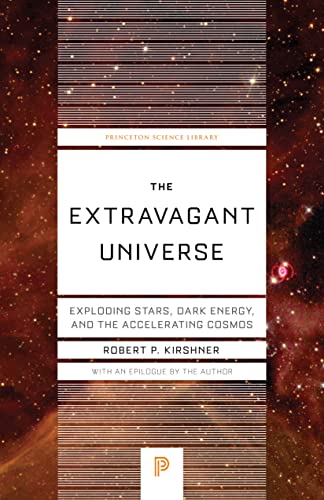
The Extravagant Universe tells the story of a remarkable adventure of scientific discovery. One of the world’s leading astronomers, Robert Kirshner, takes readers inside a lively research team on the quest that led them to an extraordinary cosmological discovery: the expansion of the universe is accelerating under the influence of a dark energy that makes space itself expand. In addition to sharing the story of this exciting discovery, Kirshner also brings the science up-to-date in a new epilogue. He explains how the idea of an accelerating universe–once a daring interpretation of sketchy data–is now the standard assumption in cosmology today. This measurement of dark energy–a quality of space itself that causes cosmic acceleration–points to a gaping hole in our understanding of fundamental physics. In 1917, Einstein proposed the “cosmological constant” to explain a static universe. When observations proved that the universe was expanding, he cast this early form of dark energy aside. But recent observations described first-hand in this book show that the cosmological constant–or something just like it–dominates the universe’s mass and energy budget and determines its fate and shape. Warned by Einstein’s blunder, and contradicted by the initial results of a competing research team, Kirshner and his colleagues were reluctant to accept their own result. But, convinced by evidence built on their hard-earned understanding of exploding stars, they announced their conclusion that the universe is accelerating in February 1998. Other lines of inquiry and parallel supernova research now support a new synthesis of a cosmos dominated by dark energy but also containing several forms of dark matter. We live in an extravagant universe with a surprising number of essential ingredients: the real universe we measure is not the simplest one we could imagine.
User’s Reviews
Editorial Reviews: Review “Winner of the 2002 Award for Best Professional/Scholarly Book in Physics and Astronomy, Association of American Publishers””Finalist for the 2003 Aventis General Prize””Kirshner is a talented writer, and both experts and general readers will find his book a consistently enjoyable read. . . . The Extravagant Universe is a personal book. . . . For the general reader interested in the excitement of how science is done, this strategy makes for a fascinating account. . . . The story . . . is irresistible in its own right, and is related with verve and good humor. . . . Books like this one will help inspire the next generation of physicists.”—Sean Carroll, Nature”An extravagant and thoroughly enjoyable account of our amazing universe.”—Michael S. Turner, Science”Robert Kirshner has written an excellent insider’s account of the race to discover the fate of the cosmos. . . . Kirshner shows an impressively deft touch with complex explanations, and he doesn’t hesitate to bridge gaps in the reader’s knowledge with an apt metaphor. . . . The Extravagant Universe delivers the promise of its subtitle extremely well, and should serve as the definitive insider’s story of how Kirshner led his motley group of astronomers to glory in their search to find the fate of the universe.”—Donald Goldsmith, Natural History”Fellow astronomers–and generations of Harvard undergraduates–have long appreciated [Kirshner] as a raconteur of exceptional eloquence, so it is hard to imagine anyone better suited to give us the inside story on the new discoveries. [He] does not disappoint. He tells, in large part, a story of how improved technology has enabled astronomers to look farther into the distance and thus further into the past.”—Laurence Marschall, Discover Magazine”The Extravagant Universe is hugely enjoyable. . . . It’s wonderful . . . an entertaining and witty account of one of the biggest scientific stories of the past 10 years: how exploding supernovae show that the expansion of the Universe is accelerating. . .. Do buy this delightful book.”—Michael Rowan-Robinson, New Scientist”More than one book already exists about this momentous discovery, but this new entry, The Extravagant Universe, by Robert Kirshner, is probably the best one to read. . . . This is an insider’s account of how the work was done. Besides giving an up-to-the-minute account of the science, Mr. Kirshner lets us share vicariously in the thrill of discovery.” ― The Economist”[A] witty new book.”—Sharon Begley, Wall Street Journal”A pleasure to read.”—Maggie McDonald, New Scientist”The Extravagant Universe isn’t the only accessible book about dark energy and cosmic acceleration on the market. However, it provides a unique behind-the-scenes feeling for the heady days leading up to the discovery. I found it ever harder to put down as I drew closer to the crucial moment when Kirshner and his colleagues found themselves staring the cosmological constant in the face.”—Joshua Roth, Sky & Telescope”Talented researcher Kirshner clearly describes the scientific detective work responsible for current ideas about the history of the universe. . . . Kirshner has been at the forefront of these developments. . . . He brings everything together using simple, effective, and often humorous analogies and anecdotes to explain how research teams interact as they built the chronology of how the universe developed and evolved to where it is today.” ― Choice”The gripping story of how two competing groups of scientists came to make, and finally believe, the surprising measurements on which a radical new view of the universe depends. . . . It is an evocative reminder that cosmology, too, is now a true observational, experimental science, securely grounded in the messy practical realities of making measurements.”—Michael Riordan, The New York Times Book Review”[A] delightful and accessible book. . . . And Kirshner’s unique combination of after-dinner-style repartee and physics-for-novices analogies makes for a very entertaining read.”—Richard Ellis, Physics World”An insider’s scoop on what is arguably the hottest astronomy story of our time. Kirshner has written a book that is not only history of modern cosmology, but also a case study in the scientific process. . . . Kirshner uses wonderfully simple and sometimes amusing analogies to explain complicated concepts.”—Jennifer Birriel, Mercury”A wonderfully informative and engaging book on one of the most exciting developments in modern cosmology.”—Alex Filippenko, Astronomy”A readable, entertaining, and informative account of an ancient and familiar–yet newly reinvigorated–branch of science.”—James Case, SIAM News”I loved this book. Kirschner writes with passion, humanity and generosity.”—Margaret Dobbins, The Daily Telegraph”Kirshner’s book represents a high point in popular science publishing. It works at several levels, especially the personal, in which he offers a well-written, even classic, account of the life of a working scientist…. The Extravagant Universe is a book that will be read for pleasure. . . . Kirshner has a real gift for visualizing the shape and structure of the universe.”—Martin Ince, Times Higher Education Supplement”The first eight chapters provide an introduction to cosmology at the level of Astronomy 101. . . . That tale is often told, but seldom so engagingly. The analogies are apt, the anecdotes are amusing, and the writing is brisk and witty–in places downright funny. . . . Kirshner succeeds in conveying the difficulty and excitement of the hunt for remote supernovae.”—David Branch, Physics Today Review ‘”This book describes a remarkable era in cosmology. Over the last three years several lines of evidence have gelled into a consistent but―to most of us―unexpected picture of what our universe consists of and how it is expanding. Told by a key participant, the story will be enjoyed by anyone with an interest in astronomy or cosmology, or even merely a general curiosity about science.”―Martin Rees, author of Our Cosmic Habitat”This is a wonderful book on one of the hottest topics in science, written by one of the main contributors to the breakthrough. It presents a history of modern cosmology written in a very lively style with amusing personal stories that make the reading easy and entertaining.”―Bohdan Paczynski, Princeton University From the Back Cover ‘”This book describes a remarkable era in cosmology. Over the last three years several lines of evidence have gelled into a consistent but–to most of us–unexpected picture of what our universe consists of and how it is expanding. Told by a key participant, the story will be enjoyed by anyone with an interest in astronomy or cosmology, or even merely a general curiosity about science.”–Martin Rees, author of Our Cosmic Habitat”This is a wonderful book on one of the hottest topics in science, written by one of the main contributors to the breakthrough. It presents a history of modern cosmology written in a very lively style with amusing personal stories that make the reading easy and entertaining.”–Bohdan Paczynski, Princeton University About the Author Robert P. Kirshner is the Clowes Professor of Science at Harvard University. Read more
Reviews from Amazon users which were colected at the time this book was published on the website:
⭐Imagine if the James Watson who wrote The Double Helix were an astrophysicist rather than a biologist and was writing about a race against another team to find the nature of the cosmos (or the expansion of the universe) rather than the nature of DNA. Now make the harder step of imagining a James Watson with a terrific sense of humor, a wry take on how science gets conducted, a tendency toward self deprecation and above all a tendency to downplay his own contributions to his project’s success while going out of his way to credit others. Add to the mix a willingness to question one’s own results and to emphasize what remains unknown and problematic rather than simply celebrating what was found, and you have Kirshner’s book. I read this book after having read Brian Greene’s marvelous book The Fabric of the Cosmos. It was a little bit like seeing a blow-up of a section of painting after having taken in and admired the entire canvass. Kirshner is at his best when he is conveying material that says as much about the sociology of the science than the science itself. The description of the competition between the Harvard high Z team led by Kushner and the Berkeley team led by Saul Perlmutter (Who along with 2 Z team members but not Kirshner received a Nobel prize for the effort – the prize can only be split 3 ways) is a bit reminiscent of Watson’s race with Pauling to find the structure of DNA, but there was more sharing and unlike DNA the convergence of results from two different approaches contributed to its almost immediate acceptance, so the zero-sum aspect to the competition to be first isn’t the same. One learns something about astronomy and cosmology along the way and even more about supernovae and the role they have played as assumed “standard cancels.” At some points,however, one wishes more had been said by way of explanation and a few matters remain murky, at least if one is reading along and not stopping to puzzle over particular points. Kirshner uses analogy effectively to communicate with non-scientists like me but his gift for analogy is not at the level of Greene’s. Nevertheless, his writing is almost always easy to comprehend. It’s strong suit is found in asides that convey the personality and style that have made Kirshner an outstanding undergraduate teacher. A trivial example is a disdainful remark about power point toward the end of the book which is followed by a footnote pointing out that a great advance in literature was the replacement of the scroll, which constrained one to read in a particular order with the codex which allowed one to flip pages. Power Point, Kushner notes, is a return to the scroll. Another personality revealing tidbit, although part of the story and not an aside, astronomers name their newly discovered supernovae before they are given their official prosaic labels based on their world-wide discovery order (2913a,2013b,etc.). The Berkeley team labeled theirs with names of composers in alphabetical order, the High Z team used cartoon characters like Skooby-Doo for theirs. One final point. Science moves fast and this book is about a decade old. An update or at least a book with a new final chapter or appendix update is in order. It should discuss how modern cosmology has been influenced by these findings, what more is known about dark energy and the inside story, that is surely there, of the Nobel Prize and thebsubsequentbcareers and discoveries of those central to the prize-winning effort.
⭐In early 1998, scientist Robert Kirshner and his team published the astonishing claim that the universe’s expansion was accelerating due to the power of dark energy. Subsequent research has not been able to disprove the results obtained by Kirshner’s “high-z supernova search team.” This book is Kirshner’s discussion of that finding and its importance to cosmology.The first half of the book is essentially a crash course in the basics of cosmology, with many anecdotes and background from earlier research since Einstein or even before. Kirshner’s witty style keeps this section entertaining even for those familiar with the information. He compares several distance indicators, such as Cepheid variables, redshifts, and supernovae. We learn how supernovae can be used to measure distances to remote galaxies due to their incredible brightness. We also become familiar with the pitfalls of using supernovae as standard candles, because there are a few different types.Then the author gets into the real purpose of his book: to describe his research team’s methods, results, and road to success with the press. The subtitle of the book is somewhat misleading; it should have been something like “The Story of the High-Z Supernova Search Team”. Though the information wasn’t presented in quite the way I was expecting, Kirshner gets the job done. He patiently educates the layman reader in many aspects of astronomy and cosmology. Towards the end it becomes a race between two supernova search teams using different methods. Though I found this yarn interesting, I would have preferred a general discourse to the narrative presented here.Overall, this book is probably one of the most well-written and absorbing reads on this specific subject. Science and astronomy buffs should enjoy it greatly.
⭐Excellent exposition of the history and raison d’etre of dark energy.Personally I believe there are far better explanations for the apparent acceleration of the rate of expansion of the universe. However, at first level this book is cuddly and accescible. And very lucid in its explanation of events.Yes…10/10, 5/5…etc!
⭐Good book written by an expert with a GSOH!
⭐Very good book
Keywords
Free Download The Extravagant Universe: Exploding Stars, Dark Energy, and the Accelerating Cosmos (Princeton Science Library, 45) in PDF format
The Extravagant Universe: Exploding Stars, Dark Energy, and the Accelerating Cosmos (Princeton Science Library, 45) PDF Free Download
Download The Extravagant Universe: Exploding Stars, Dark Energy, and the Accelerating Cosmos (Princeton Science Library, 45) 2016 PDF Free
The Extravagant Universe: Exploding Stars, Dark Energy, and the Accelerating Cosmos (Princeton Science Library, 45) 2016 PDF Free Download
Download The Extravagant Universe: Exploding Stars, Dark Energy, and the Accelerating Cosmos (Princeton Science Library, 45) PDF
Free Download Ebook The Extravagant Universe: Exploding Stars, Dark Energy, and the Accelerating Cosmos (Princeton Science Library, 45)