

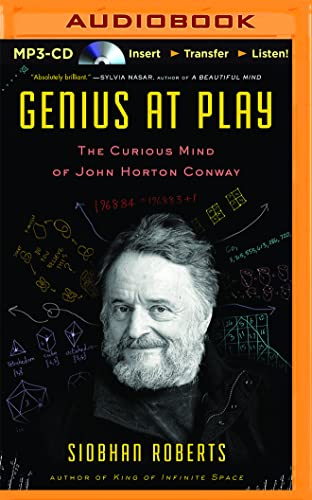
Ebook Info
- Published: 2015
- Number of pages:
- Format: PDF
- File Size: 19.89 MB
- Authors: Siobhan Roberts
Description
Conway is a creative genius. (Martin Gardner) An unabashed original, John Horton Conway is Archimedes, Mick Jagger, Salvador Dali, and Richard Feynman all rolled into one–a singular mathematician with a rock star’s charisma, a sly sense of humor, a polymath’s promiscuous curiosity, and a burning desire to explain everything about the world to everyone in it. Born in Liverpool in 1937, Conway found fame as a barefoot Cambridge professor. He discovered the Conway groups in mathematical symmetry and invented the aptly named surreal numbers as well as the cult classic Game of Life–more than a cool fad, Life demonstrates how simplicity generates complexity, and the game provides an analogy for all mathematics and the entire universe. Moving to Princeton in 1987, as a mathemagician he deployed cards, ropes, dice, coat hangers, and even the odd Slinky as props to extend his winning imagination and share his mathy obsessions with signature contagion. He is a jet-setting ambassador at large for the beauties of all things mathematical. Genius at Play is an intimate investigation into the mind of an endearing genius, laying bare Conway’s personal and professional idiosyncrasies. The intimacy comes courtesy of the man himself. He generously granted Roberts full access, though not without the occasional grudge and grumble: “Oh hell,” he’d say. “You’re not going to put that in the book. Are you?”
User’s Reviews
Editorial Reviews: About the Author Siobhan Roberts is a science writer and winner of four National Magazine Awards. While writing Genius At Play she was a Director’s Visitor at the Institute for Advanced Study in Princeton, and a fellow at the Leon Levy Center for Biography at the CUNY Graduate Center in New York. Her first book, King of Infinite Space, won the Mathematical Association of America’s Euler Prize for expanding the public’s view of mathematics. She lives in Toronto.
Reviews from Amazon users which were colected at the time this book was published on the website:
⭐A great book with just a few minor flaws. The unknotted knot on page 30 is the figure eight, not the trefoil, and the fact that Conway’s published list of 11-crossing knots omits four prime examples is beyond debate [cf. Note 30 on page 425]. Conway may well have discovered them as a teenager, but Alain Caudron was the first to write them down [STRUCTURATION DE LA CLASSIFICATION DES NOEUDS ET DES ENLACEMENTS, Notes de recherche 1976/77/78, E.N.S.E.T. de Tunis (1979), page 74]. See also MR 81k:57005.Also, the Kinoshita/Terasaka knot was discovered in 1957 (a decade before publication of Conway’s second example with trivial Alexander polynomial) and it’s the one on the right. Conway speaks only “from my point of view” when he says on page 32 “there is really no difference between these 2 knots.” Robert Riley distinguished them in Homomorphisms of Knot Groups on Finite Groups. Mathematics of Computation 25 (1971), page 615. As Conway modestly explains in Note 31 on page 425: “It’s very, very difficult to get ahold of why one knot is different from another one. The notation I invented made it a bit easier. It hasn’t solved the problem completely — not all knots are good enough to have a notation in my system, and I don’t know what to do when they are not.”
⭐Fascinating biography of a stellar mathematician. He’s infinitely talented, but seriously unbalanced. The book presents an affectionate but serious look at his career, strange habits, and obsessions, replete with quotes from the subject and entertaining opinions on being chronicled. It’s more like a conversation than a novel.Wives, heart attacks, professional jealousy, poor eating habits, strange ways to motivate himself to research and prepare for lectures, the prose is straightforward and moderately unsparing.As the one-star rating guy already said, the Kindle version loses the formatting that says whether the writer or Conway himself is talking, and about 1/4 of the book is quotes. One can more or less figure it out, but it’s a nuisance. That’s why this rating is not 5 stars.There’s maybe 1/4 of the book that is math and games, which I found more inscrutable and less amusing than the rest, despite being a scientist, although that seems par for the course in biographies of science. I picked this up because of a thorough review that I saw in Nature – http://www.nature.com/nature/journal/v523/n7561/full/523406a.html
⭐Conway is certainly one of the heroes of modern mathematics. His ingenious creations are so imaginative, and his talks and written works have inspired and delighted so many people. The nice thing about this book is that one can hear Conway’s voice clearly in it. The author conducted numerous interviews with Conway, and the book contains lots of direct quotes. As a result the book is quite fascinating. It is a tribute to Conway that he has allowed this frank, and at times unflattering exposition of his life and views. On the negative side, the book is rather shambolic; Conway’s life was notoriously chaotic, and perhaps the author consciously tried to reflect this disorganisation in the book (?). It didn’t upset me unduly, but the reader shouldn’t expect a carefully detailed work. The most disappointing aspect is the mathematics. Repeatedly throughout the book Conway’s mathematical ideas are presented without reflection or clarification. The impression one gets, for better or worse, is that the author understood precious little of the material she transcribed. The overall result is rather depressing: why is it that an award winning author, who won the Euler prize for “expanding the public’s view of mathematics”, didn’t bother to make the effort to better engage with the work she relates? A sad comment on how mathematics is perceived, even by those sympathetic to it.
⭐Roberts starts out by announcing that Conway is such a force of nature he deserves his own font…and Kindle says “Oh, no, he doesn’t”. Fortunately Conway is sufficiently distinctive that this is rarely an issue but it’s a silly oversight on Kindle’s part. I’m not entirely convinced by the structure either – by the time the opening reappears at the end you have been exposed to a significant range of intellectual material and the thread is hard to pick up.I am pretty certain that Roberts didn’t follow all the mathematical concepts – and indeed the famous prod at quantum physics (‘If you think you’ve understood it, you haven’t’) appears and is relevant – but just occasionally there isn’t quite enough groundwork to maintain the flow.However if your criterion of a good biography is that you come away with a clear view of the subject’s character and thinking style then this hits the nail on the head in all 23 dimensions.
⭐The most thoroughly intriguing biography of a mathematician I have ever read. You not only get caught up in the wonderful romp of Conway’s life, and his crazy escapades, but you are treated to largely understandable morsels of his mathematics, from his proof of Morley’s Trisector Theorem, to combinatorial game theory and the surreal numbers, to his wok on the Monster simple group. Granted the discussion of the latter is not all that understandable, but you take solace in the fact that it is not completely understandable even by Conway. Many, many more mathematical tidbits are thrown in, in between. If you are a mathematically curious person you will surely get caught up in one or another of these problems, like I did with the 3n+1 problem. You will probably also try to add some of the Conway tricks to your own repertoire. Beware though that the heads/tails mind reading trick via penny balancing does not seem to work as well with other currencies.
⭐This should be a great book. It isn’t. I gave up at half-way.I think the author really didn’t seem to get on with JHC, and this is just turgid prose.Sorry to write a negative review, but this really didn’t do it for me. Other views are available, of course.
⭐I knew John conway when he was teaching in Cambridge (UK). Always eccentric (he was the only person I knew who wore sandals when there was snow on the ground), but an outright genius, he was also very entertaining. The book does not disappoint.
⭐This book fails both to convey any consistent narrative thread and also fails to explain or intrigue the reader into Conway’s mathematics.A failed opportunity.
⭐Not very biographical or mathematical but still worth the read..
⭐There are many books that cover the lives of extraordinary scientists and mathematicians, but only a few that are engaging reads. This is one of those. Conway is known in the science world, certainly, not just for his work but also his eccentricities. Being an eccentric is often treated as a “cute” part of the lives of brilliant men and women, but that’s too glib an association. Often, there’s a good reason for these brilliant minds behaving the way they do, which acts as an entry way into understanding their life and work.Conway is quite the character, brilliant (beyond doubt), charismatic, and funny. That all comes through in this book, which is about the man and his work. There’s a massive window into his life and thoughts, which is seldom granted and even rarely used correctly. The author does a great job of taking that access and making it an interesting read without becoming sensationalized or trite, which often happens.There is math in this book, but for those who are daunted by such a prospect, don’t be: it’s explained and easy to work around if you find the subject difficult. For those of us familiar with the math, it’s not condescendingly simplified, either. There’s solid explanations of Conway’s work and insights, much better than any other work I’ve seen on the subject. And all of that wrapped into an interesting book, written well, laid out logically, and carefully balancing all the aspects of the story and the man. This is a rare combination of all elements working well, creating a synergy better than the sum of its parts.If you read on science book this year, one biography, or one tale of an interesting character, this is the book. A delightful read, for those with solid science groundings as well as those without. A lovely window into Conway’s work and mind; highly recommended for all audiences.
Keywords
Free Download Genius at Play in PDF format
Genius at Play PDF Free Download
Download Genius at Play 2015 PDF Free
Genius at Play 2015 PDF Free Download
Download Genius at Play PDF
Free Download Ebook Genius at Play