

Ebook Info
- Published: 2009
- Number of pages: 337 pages
- Format: PDF
- File Size: 3.30 MB
- Authors: Andrew Hodges
Description
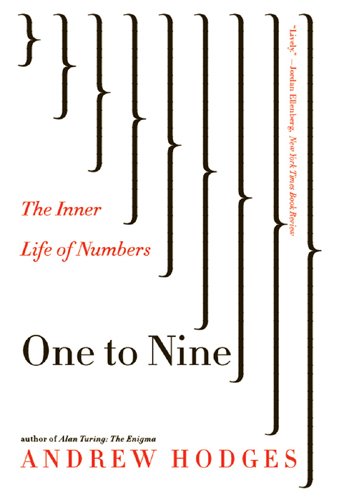
What Lynne Truss did for grammar in Eats, Shoots & Leaves, Andrew Hodges now does for mathematics.Andrew Hodges, one of Britain’s leading biographers and mathematical writers, brings numbers to three-dimensional life in this delightful and illuminating volume, filled with illustrations, which makes even the most challenging math problems accessible to the layperson. Inspired by millennia of human attempts to figure things out, this pithy book, which tackles mathematical conundrums from the ancient Greeks to superstring theory, finds a new twist to everything from musical harmony to code breaking, from the chemistry of sunflowers to the mystery of magic squares. Starting with the puzzle of defining unity, and ending with the recurring nines of infinite decimals, Hodges tells a story that takes in quantum physics, cosmology, climate change, and the origin of the computer. Hodges has written a classic work, at once playful but satisfyingly instructional, which will be ideal for the math aficionado and the Sudoku addict as well as for the life of the party.
User’s Reviews
Reviews from Amazon users which were colected at the time this book was published on the website:
⭐I am enjoying the book a lot, but bewarned–you may not get a lot of the references he makes if you don’t a some math background. I have undergraduate degrees in math and physics and I needed that to understand some of the details. Hodges discusses a lot more than just the numbers. For example he uses the number eight (one byte) as an excuse to discuss a lot about computers and computing with many (interesting) references to the ideas of Alan Turing (about whom he wrote a book). Many of the other chapters also wander into areas you might not have guessed were related to that number–but that’s not a bad thing. I recommend the book to readers who haven’t forgotten all their algebra.
⭐I enjoyed the author’s quick pace through pure and applied mathematical concepts.I suspect One to Nine’s limited appeal (several poor reviews on Amazon) may stem from the material containing a bit too much applied science for most mathematicians, and too much math theory for someone without a substantial mathematical background. As an engineer by education, I know just enough math to be dangerous and feel very comfortable with the physics, chemistry, or other applied science references in the book.The friends of mine that have read One to Nine also liked it. I would recommend it to someone with a mathematically based science degree, such as most engineering degrees.
⭐The title, One to Nine The Inner Life of Numbers, suggests a book of note. The book, though, appears to be only a mish mash of information from the author’s weekly newspaper column in the Observer on mathematical topics. The author indulges himself with comments regarding politics and society and does not appear to know his audience. His text is arrogant and wanders without direction. That is a pity, because the topic should have been an interesting one. Not only is the book poorly written, the book is also poorly typeset. Word spacing is inconsistent which makes the text difficult to read.When I completed this book, I had to ask myself why I bothered. I found this to be one of the worst books that I have read in the past 60 years. Waste neither your money nor your time on this book.Not recommended.
⭐I can’t believe this excellent book has such poor ratings! Andrew Hodges does an excellence job of bringing out how Western culture is infused with the concept of the numbers one to nine. This is far different from the lie we are told in compulsory educational classrooms “you use math everyday” which tries to force the Pythagorean theorem into every instance of a person walking under a ladder.A hugely important book for anyone interested in approaching mathematics education in a thoughtful, socially-conscious way.
⭐Not so interesting
⭐Oxford Fellow Andrew Hodges, who wrote the very well received biography, Alan Turing: The Enigma (1992), uses–rather quixotically I might say–the one to nine format to delve into the world of mathematics. His emphasis is on number theory, mathematics as applied to physics, and mathematics as applied to cryptology. The text is difficult, and the puzzles strewn throughout, whether labeled, EASY, GENTLE, TOUGH, HARD, TRICKY or DEADLY, proved mostly too difficult for this non-mathematician.For those readers versed in number theory, that branch of mathematics in which numbers are explored purely for their own sake without even the dream of a practical application, this book is probably a delight. And for cryptologists it is probably a double delight since Hodges explores in some considerable depth the delicious irony of how pure mathematics became contaminated, as it were, when it was noticed some years ago that the encryption of messages could be facilitated by using very large numbers with unique divisors. While it is easy to multiply two even very large numbers and get a unique result it is enormously difficult to find the unique factors that make up a very large number.At any rate that is my understanding. And if I have gotten it wrong it is only because I am not much of a mathematician. Which brings me to the central criticism of this book. To put it bluntly I don’t think anyone but a mathematician can fully appreciate Andrew Hodges’ text. It’s that difficult. Additionally, Hodges, who is a physicist as well as a mathematician, brings string and twistor theory into the fray further multiplying the difficulties for the general reader.But even more off-putting (and this explains some of the negative reviews this book has garnered) is the fact that the book is more than a bit self-indulgent. Hodges’s political views are a bit too obvious and gratuitous (although not necessarily disagreeable). He digresses often, sometimes whimsically, sometimes unaccountably. He employs naked jargon, insider allusions, and unexplained references. His subject matter spills over and jumps around from one chapter to another making the “One to Nine” structure seem artificial what with matter pertaining to the number six, for example, appearing in the chapter on the number seven and vice-versa.I think it’s obvious that the sort of book that Hodges has written here must needs another sort of structure, perhaps in three parts, one dealing with encryption, the second with pure number theory, and the third with mathematical physics. He is following to some extent (as he acknowledges) the structure that Constance Reid used so successfully in “From Zero to Infinity” (1956, new edition 2006) in which the chapters were entitled “Zero,” “One,” “Two,”…”Nine,” and then “e” and “Aleph Zero.” It’s too bad that Hodges didn’t emulate Reid’s reader friendly prose–and he’s a good enough writer to do it–instead of her structure.Finally I didn’t like the fact that the reader has to go to a Website to get the answers to the puzzles!
⭐In some ways this is a fairly conventional introduction to numbers, with the usual links to interesting mathematical topics. The level of mathematical sophistication included is a bit higher than usual, and this wouldn’t be good as a first book, but it you have already read a few similar texts, or if you already know a bit of formal maths, then you will find it more interesting than much of the competition.Another unusual feature is the way in which Hodges draws many of his examples from theoretical physics rather than pure maths, and this is definitely a good thing. Unfortunately he then weakens these sections by dragging climate change into every chapter, usually in an obviously contrived and unnatural fashion, and with a slightly sneering political tinge to his tone. Inserting these mini diatribes into the middle of otherwise interesting ideas weakens the text, but it is possible to skim over them and get back to more genuinely relevant topics.
⭐This was a very readable book explaining a number of fascinating mathematical concepts and relating many of them to modern day life. With a couple of exceptions all the reasoning was easy to follow, without the need for the reader to resort to pencil and paper.I enjoyed the book very much, and my reason for purachase was to give it to someone as a present.
Keywords
Free Download One to Nine: The Inner Life of Numbers in PDF format
One to Nine: The Inner Life of Numbers PDF Free Download
Download One to Nine: The Inner Life of Numbers 2009 PDF Free
One to Nine: The Inner Life of Numbers 2009 PDF Free Download
Download One to Nine: The Inner Life of Numbers PDF
Free Download Ebook One to Nine: The Inner Life of Numbers