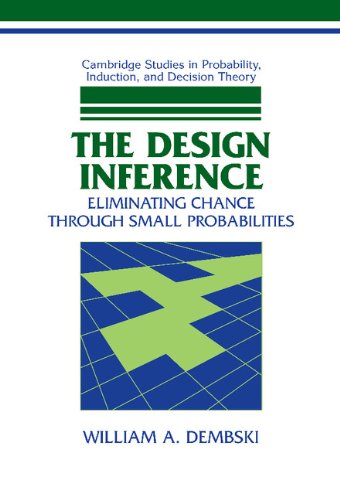
Ebook Info
- Published: 1998
- Number of pages: 259 pages
- Format: PDF
- File Size: 2.74 MB
- Authors: William A. Dembski
Description
The design inference uncovers intelligent causes by isolating their key trademark: specified events of small probability. Just about anything that happens is highly improbable, but when a highly improbable event is also specified (i.e. conforms to an independently given pattern) undirected natural causes lose their explanatory power. Design inferences can be found in a range of scientific pursuits from forensic science to research into the origins of life to the search for extraterrestrial intelligence. This challenging and provocative 1998 book shows how incomplete undirected causes are for science and breathes new life into classical design arguments. It will be read with particular interest by philosophers of science and religion, other philosophers concerned with epistemology and logic, probability and complexity theorists, and statisticians.
User’s Reviews
Reviews from Amazon users which were colected at the time this book was published on the website:
⭐_The Design Inference: Eliminating Chance Through Small Probabilities_ in the Cambridge Studies in Probability, Induction, and Decision Theory series, by mathematician and philosopher William Dembski is a fascinating book which lays out the case for the design inference attempting to show when such an inference is warranted. Dembski is currently a Fellow at the Discovery Institute, and this book was his dissertation for his doctoral degree in philosophy. The central question motivating this book is stated as “How can we identify events due to intelligent causes and distinguish them from events due to undirected natural causes?” The manner in which Dembski proposes this is done is through the design inference, which relies on uncovering intelligent causes by isolating the key trademark of intelligent causes: specified events of small probability. As Dembski shows in this book the applications of the design inference are widespread. Among other examples, Dembski considers the role of the design inference in forensic science, cryptography, the origins of life, the search for extraterrestrial intelligence, and parapsychology. Perhaps the most controversial application of the design inference occurs in the role of design in the origin of life. From this controversy, has arisen the debate between the standard Darwinian account of the origin of life and the account of life’s origins given by the Intelligent Design Movement. Unfortunately, there are profound philosophical implications underlying this debate and this has led to the politicization of the debate itself. This is an unfortunate state of affairs because rather than allowing for the subject to be debated in a rational manner, the debate has instead moved into a state where each side engages in hysterics and attempts to slander the other side. However, if one wishes to understand this debate from an objective standpoint, this book is essential. Modern Western mainstream science has long waged a war on “the design inference” (since the time of Darwin), seeing in it an appeal to the supernatural. This has led to various domains which may make use of this inference (such as parapsychology) to be stigmatized and labeled as pseudo-science. However, as this book effectively shows, it is necessary to take a new look at the role of the design inference, free from the dogmatic tendencies ensconced in scientific orthodoxy. It should also be pointed out though that this book is highly mathematical in nature, and relies on probability theory to make its case. Following the mathematics may prove at times difficult for some.In his introduction, Dembski considers the history of the idea of eliminating chance through small probabilities. One of the earliest instances of such an argument occurs in the writings of Cicero. But, later mathematicians and philosophers such as Laplace, Thomas Reid, and de Moivre appealed to this argument. From the history of science, a famous instance of the use of the design inference occurs when Ronald Fisher used it to show that Mendel’s experimental results were falsified. Dembski also notes the role of this inference in the intelligent design debate. It should be pointed out that while noted Darwinists such as Richard Dawkins allow for the possibility of this argument, they maintain that in the case of the emergence of life the probabilities involved are not small enough. The mathematician Emile Borel was the first to state a version of the Law of Small Probabilities (what he called the “Single Law of Chance”) as “Phenomenon with very small probabilities do not occur.” However, there are difficulties with Borel’s formulation, and a distinction must be made between patterns which are specified and patterns which are fabricated. As it turns out, the Law of Small Probabilities can be stated as “specified events of small probability do not occur by chance”. What constitutes a “small probability” is another question, which was considered by Borel, and Dembski elaborates on such considerations. Another question for the design inference that occurs is what is meant by an “intelligent agent”. Dembski then proceeds to give some examples of the design inference in the case of the legal system, forensic science, cryptography, and SETI. Following this, Dembski explains the design inference, proposing an explanatory filter which allows for one to determine whether an event occurs as a result of a regularity, chance, or design. Once the design inference has been written as an argument in symbolic form, the rest of this book will be devoted to showing that such an inference is valid and expounding upon the Law of Small Probability. In the case of the Creation-Evolution controversy, the design inference becomes a possibility. However, as Dembski shows the premise rejected by the evolutionist is either that “If Life is due to chance, then Life has small probability” or “Life is not due to regularity”. To get around the first premise, evolutionists such as Dawkins may attempt to appeal to greater probabilistic resources, for example invoking the fact that one must consider the possibility that life can occur on any of all the planets in the universe or even the possibility of other universes and then invoking the Anthropic Principle (as Barrow and Tipler do). Some such as Kaufman have tried to get around the second premise by maintaining that life results from regularity and “crystallizes” at a phase transition. However, as Dembski successfully shows later in the book all of these approaches by evolutionists are problematic. Dembski then considers what is meant by intelligent agency. The next two chapters are highly technical and lay the groundwork for probability theory and complexity theory. Dembski explains Bayes’ theorem, probability, background information, and likelihood. Following this, Dembski explains complexity, tractability, and randomness. In particular, applications occur in proof theory in a formal axiomatic system. Dembski also explains specification and detachability as well as prediction. Dembski then revisits the notion of randomness, showing how one can only know randomness from what it is not, and explaining the notion of Kolmogorov complexity. Following this, Dembski returns to the idea of small probability. Here, he explains what is meant by the idea of probabilistic resources. In particular, the evolutionist will attempt to invoke probabilistic resources (all the planets in the universe, the possibility of multiple universes, etc.) in his attempt to disallow the design inference. Dembski in particular regards attempts to appeal to multiple universes (or the “multiple worlds” of one interpretation of quantum mechanics or the “possible worlds” of philosophers) as being part of an “inflationary fallacy”. Such notions defy common-sense and also an appeal to Occam’s razor. Dembski ends by fully justifying the Law of Small Probability based on his foundational discussion in the past chapters. In the epilogue, Dembski argues against some of the criticisms that have been made of the design inference. In particular, it has been maintained that the design inference may amount to an appeal to the supernatural in certain cases (particularly as concerns the origin of life on earth and in certain instances in parapsychology). However, I believe this results more from a prejudice against the supernatural by scientists than any legitimate objection. Dembski also shows what is meant by coincidence (for example he considers the case of a coincidence which occurred to Carl Jung that he regarded as an instance of “synchronicity”). Finally, Dembski argues for the importance of information, maintaining along with Keith Devlin that “information should be regarded as . . . a basic property of the universe, alongside matter and energy (and being ultimately interconvertible with them).”This is perhaps one of the most important books written on the issue of the design inference. The implications of this book are far reaching. And, if one hopes to understand the current debate over the origins of life on earth, this is essential reading.
⭐The Design Inference is enormously interesting for what it is. It is an author who is careful in his thinking, has a good background in math, and is exploring what intelligence is, and how we could possibly recognize artifacts of intelligence.The book could have been written by an AI student with graduate work in Computer Science. It is something of a paradigm change, though, because Dembski unapologetically uses what is essentially abstract algorithm analysis theory, and applies it to all scientific models. And there are a lot of researchers in different scientific fields, who have not assimilated advanced CS theory, and so are shocked that someone outside their field is evaluating the expressive level of their theories, the computational intensity of their theories, and the computational feasibility of their theories.All this has to do with complex information theory, and scientific epistemology, and abstract algorithm design. Demski explores what intelligence means, in the light of these areas of interest (although he does not use CS terminology).What Demski has pointed out is that modern scientific theories/models must start to deal with the question of the nature of information they are trying to explain, and the expressive power and computational intensity of the abstract machines that the models are asserting have generated the data we see before us. This is a big step up for some scientific researchers, who don’t think that their work should be examined according to these criteria of goodness.There has been a weird response from different types of Americans:- religious fundamentalists who believe in a young earth, and who largely deny the goodness of the intellect and modern scientific epistemology, have miscontrued that Dembski wrote this book about Neodarwinism, promoting creationism. These fundamentalists, have not read the book.- evolutionary biologists seem incensed that Dembski has the gall to evaluate their evolutionary models, with an eye to computational feasibility, and point out problems (without having any alternative theory to replace theirs)- Computer Science grad students will immediately recognize a lot of Dembski’s arguments as using Kolmogorov complexity to reason about the computational feasibility of abstract machines (in this case, evolutionary models, or other scientific models, or events), and find little to be offended at- physical engineers, who have failed to assimilate the last 40 years of Computer Science theory (and its subsidiary, Artificial Intelligence) , and who have no modern theory of complex information, simply deny that there is any valid concept of higher intelligence, so why try to detect it?This book is a very good read, if you value philosophy of science, the question of intelligence, and the evaluation of abstract algorithms to produce some given data.Most of the criticism of the book is by those who have not read it (creationists), those who misconstrue that it is a tome about creationism (many of the evolutionary biologists), or those who believe that there is no such thing as higher intelligence above physics based variables (most of physical engineers).The straightforward questions that Demski generates, point to interesting future areas of research. And they are relevant to the area of Artificial Intelligence.
⭐A great book for all those who have questions on how chance or design is inferred in a given case. This clarity is welcome because “Chance” is a term commonly invoked in many contexts. It could be in predicting an event in the stock market or in evaluating phenomena found in nature. This interesting book, written in lay language, traces the thought of giants in this field from 46 BC onwards, showing us how people rule out chance in favour of design in the realm of mathematics and in existential decision making. There are a few lightly technical chapters for those who want to know the “how?” These can be skipped without losing the thread of the book which is written clearly in non technical language. The purpose of the author is to clarify the limits of chance. He does this by eliminating chance as a possibility when the possibility of an event happening by chance is astronomically huge. The author, who holds a doctorate in mathematics, is eminently qualified to write a treatise such as this and he makes a compelling scientific case (using math) for design. “The Design Inference” will predictably be rejected by those who find the implied idea of a Designer to be repugnant. But such rejection is on philosophical grounds and not on scientific grounds. Ideas from this book is developed further in another book by the same author titled “The Design Revolution.”
⭐This is a long overdue work which asks the question in a mathematical fashion, How does one infer design?. The result in conclusion is his 6 step design inference. A difficult read if you don’t have an undergraduate grounding in mathematics, but it is worth the time that you put into it.
Keywords
Free Download The Design Inference: Eliminating Chance through Small Probabilities (Cambridge Studies in Probability, Induction and Decision Theory) in PDF format
The Design Inference: Eliminating Chance through Small Probabilities (Cambridge Studies in Probability, Induction and Decision Theory) PDF Free Download
Download The Design Inference: Eliminating Chance through Small Probabilities (Cambridge Studies in Probability, Induction and Decision Theory) 1998 PDF Free
The Design Inference: Eliminating Chance through Small Probabilities (Cambridge Studies in Probability, Induction and Decision Theory) 1998 PDF Free Download
Download The Design Inference: Eliminating Chance through Small Probabilities (Cambridge Studies in Probability, Induction and Decision Theory) PDF
Free Download Ebook The Design Inference: Eliminating Chance through Small Probabilities (Cambridge Studies in Probability, Induction and Decision Theory)