Ebook Info
- Published: 2003
- Number of pages: 176 pages
- Format: PDF
- File Size: 10.30 MB
- Authors: J.P. McEvoy
Description
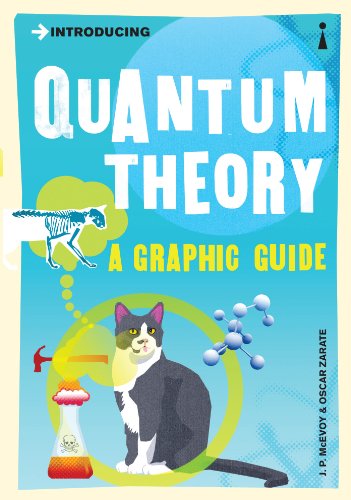
Quantum theory is one of science’s most thrilling, challenging and even mysterious areas. Scientists such as Planck, Einstein, Bohr, Heisenberg and Schrödinger uncovered bizarre paradoxes in the early 20th century that seemed to destroy the fundamental assumptions of ‘classical physics’ – the basic laws we are taught in school. Notoriously difficult, quantum theory is nonetheless an amazing and inspiring intellectual adventure, explained here with patience, wit and clarity.
User’s Reviews
Reviews from Amazon users which were colected at the time this book was published on the website:
⭐Too many times I’ve seen books heavy on illustrations simply not read well in Kindle format. This is not one of them. It explains not only quantum mechanics in very broad brushstrokes, but gives the stories behind its development, which are key to many of the illustrations. You tap one of the cartoons to enlarge, it actually enlarges to the appropriate size instead of to size huge or size text illegible, you look at it, and you x out of the illustration. It’s a pity more books can’t work as well.
⭐It is a short book, full of graphics and cartoons that tells us the story of how quantum theory was developed. It gives us a ride through history by introducing the major and most remarkable physicists of the world from the past few centuries and their most interesting discoveries, more specifically those related to quantum theory. Quite honestly, one cannot pretend to read this book and understand quantum theory (heck, one cannot pretend to read most books on quantum theory and understand it either), and a good deal of what this book explains was beyond my understanding. There are pages containing mathematical formulas or explanations of physics statements that are beyond my capacity. But even so, I could still derive a sense of wonder and a feeling of appreciation for the discoveries being made, for the curiosity of those brilliant minds, and their outstanding contributions to the knowledge of humanity. The graphics do make it fun to read, but they don’t make it at all easier to comprehend.I still believe that the material in the book may be presented in a much simpler way such that the general public can understand the principles of quantum theory and that’s the reason why I don’t give it 5 starts. However, I do think it was a fun and entertaining book and I did learn quite a few things reading it.
⭐Quantum Theory, A Graphic Guide, by McEvoy and Zarate is a short book and a small one. The graphic part of the book helps one understand the theories presented, and the math that is presented is not all that difficult (although I can’t say I understood all of it). The book follows the development of quantum theory historically. Each of the giants in the development of modern quantum theory are presented, briefly, along with their ideas about various quantum theories.The book began to lose me during the discussion of the combination of wave and particle theory. While I can understand the principle of waves and particles in isolation it seems Louis de Broglie managed to combine them and then Heisenburg, Born, and Pauli added to and somewhat tore apart de Brogie’s ideas. It was here the book began to confuse me. I wish the book would have spent a little less time on the early era of quantum theory and a little more on ideas that are nearer in time. Especially interesting was the inequality theorem by John S. Bell. How an object could communicate some kind of information over a considerable distance faster than the speed of light (instantly) is a wonder. The book mentions that their might be some holes in the experiment that seemed to prove this communication, but that was not clarified. The main objection is it violates Einstein’s theory.A good book and well worth the price and the time it takes to read.AD2
⭐Fine as a teaser. Decided to study quantum theory in spare time; one of several good places to start. My title says it, so I won’t repeat. Another, excellent book for tyros is Isaac Asimov’s classic, “Atom: Journey Across the Subatomic Cosmos,” which covers particle physics beautifully but was published in ’92, so lots of quantum advances aren’t covered. Asimov is the man! Another great source after you have some understanding of particle theory, relativity and quantum mechanics, is Carlo Robelli’s “Reality is Not What It Seems,” which goes far deeper (and is current) into one view of where quantum theory is going. Robelli covers his angle (loop quantum gravity) beautifully, and in the process also covers history and “general quantum theory,” whatever that is, beautifully as well. So…I still feel I know about 4% of what I want to know, but reading different basics like these has gotten me to the point where advanced physics doesn’t seem like an inaccessible high-priest mystery anymore. Cheap, give it a half-integer spin.
⭐Given that this is a “comic book” on quantum theory, I expected a fairly superficial treatment which I’d breeze through quickly.I was instead rather surprised and very pleased to find that this book goes into substantial depth. McEvoy presents most of the key concepts of quantum theory in their historical context, and he goes beyond typical popularized treaments by including quite a few equations (sometimes with derivations), along with topics like statistical mechanics, the Zeeman effect, links to chemistry, Dirac’s quantum algebra, Fourier series, and other important technical details. He even touches on philosophical interpretations and implications of quantum theory, though that’s not a main feature of the book.To be clear, McEvoy doesn’t provide anything resembling a comprehensive treatment of quantum theory. No one can do that in just 173 pages, with much of the space taken by cartoons. But he still packs in a lot of content by writing clearly and concisely, and organizing the book well.In short, I highly recommend this book as an effective and enjoyable resource to learn or review the basic concepts and history of quantum theory. The only caveat is that readers should preferably come to the book with at least a decent background in general physics. In other words, the ideal target audience for the book is perhaps a notch beyond the general reader and instead consists of people with a technical background, such as scientists, engineers, and mathematicians.
⭐As a poor Physics student I am still very interested in the intricacies of sub atomic physics. I have bought several books on this subject which are all good at factual content but often assume that the Greek symbols in common use by Physicists and Chemist are not otherwise widely known – and that is where I fall down in understanding. This delightful book has been the first which tells the story of Quantum Mechanics in a humorous but serious way, and fully details what the symbols in the formula actually relates to or means. This enables anyone with a moderate Mathematical education and can get by in Algebra will be able to appreciate where they are going. Plus. the storytelling is interesting and funny. A combination I like. What an amazing bunch of characters these High Energy Physicist were, and how amazing the whole subject is.
⭐Some physicist whose name I can’t remember once said: ‘if you think you know all about quantum, then you don’t know quantum at all’.The observation might well apply to this little book, one in a justifiably famous series of graphic guides notable for the quality of the artwork and the succinctness of the writing. However, you’d’ve had to have gotten to the end of this book before thinking that you knew all there was to know. Me, I didn’t get beyond the opening chapters, devoted as they were to the early founders of the theory (and their contemporaries) where the wealth of detail about who thought what and why turns out to be much too complicated to be comprehended at one sitting or even several.Had the book concentrated on one or two of the most notable advocates of the quantum theory, it would’ve been all the better for it. Trying to bring in too much, too soon, could only lead to disappointment. Back to the drawing board — literally — methinks.
⭐I am a great fan of the Graphic Guide books. They vary for me in as much as some I can grasp the basic concepts while others leave me grasping at thin air. This is one of the latter. Totally beyond me. But I’ll still give it 4 stars as I think it is my brain not the book itself at fault.
⭐This is about how and why quantum theory was invented. The story contains a lot of detail on who said or wrote what to whom, and when. That much is done in detail, and is fun to read. Heisenberg comes out as the major hero. It is not a great way to learn quantum theory because it only touches on the mathematics. This can sometimes be a bit irritating. For instance, from this book it would seem that Dirac just explained Heisenberg’s ideas more succinctly and neatly than Heisenberg did originally. It explains a bit about matrices and Fourier series, but I did not see anything about Dirac’s belief that an electron’s wave function should obey a first order differential equation, or that the coefficients in this differential equation are elements in a Clifford algebra, or that Dirac rediscovered Clifford algebras because they are needed as part of a satisfactory quantum theory.
⭐Ok. An awful lot if formula to ‘read’ and hard to read panels in white on black and small cramped drawings. Could do with being a physically bigger book.
Keywords
Free Download Introducing Quantum Theory: A Graphic Guide to Science’s Most Puzzling Discovery in PDF format
Introducing Quantum Theory: A Graphic Guide to Science’s Most Puzzling Discovery PDF Free Download
Download Introducing Quantum Theory: A Graphic Guide to Science’s Most Puzzling Discovery 2003 PDF Free
Introducing Quantum Theory: A Graphic Guide to Science’s Most Puzzling Discovery 2003 PDF Free Download
Download Introducing Quantum Theory: A Graphic Guide to Science’s Most Puzzling Discovery PDF
Free Download Ebook Introducing Quantum Theory: A Graphic Guide to Science’s Most Puzzling Discovery