Ebook Info
- Published: 2002
- Number of pages: 304 pages
- Format: PDF
- File Size: 10.07 MB
- Authors: J. Richard Gott
Description
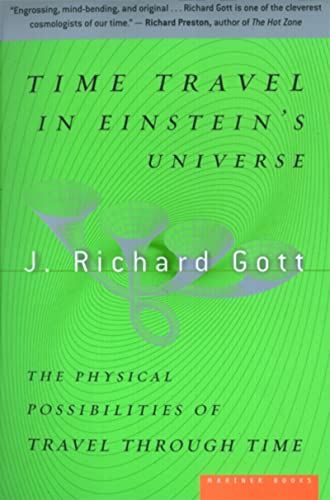
In this fascinating book, the renowned astrophysicist J. Richard Gott leads time travel out of the world of H. G. Wells and into the realm of scientific possibility. Building on theories posited by Einstein and advanced by scientists such as Stephen Hawking and Kip Thorne, Gott explains how time travel can actually occur. He describes, with boundless enthusiasm and humor, how travel to the future is not only possible but has already happened, and he contemplates whether travel to the past is also conceivable. Notable not only for its extraordinary subject matter and scientific brilliance, Time Travel in Einstein’s Universe is a delightful and captivating exploration of the surprising facts behind the science fiction of time travel.
User’s Reviews
Editorial Reviews: About the Author J. RICHARD GOTT III is a professor of astrophysical sciences at Princeton University. For fourteen years he served as the chairman of the judges of the National Westinghouse and Intel Science Talent Search, the premier science competition for high school students. The recipient of the President’s Award for Distinguished Teaching, Gott has written on time travel for Time and on other topics for Scientific American, New Scientist, and American Scientist. Excerpt. © Reprinted by permission. All rights reserved. Time Travel in Einstein’s UniverseThe Physical Possibilities of Travel Through TimeBy Gott, J. Richard, IIIMariner BooksCopyright ©2002 Gott, J. Richard, IIIAll right reserved.ISBN: 0618257357PrefaceThe neighborhood children think I have a time machine in my garage. Even mycolleagues sometimes behave as if I have one. Astrophysicist Tod Lauer once sentme a formal letter inviting me to Kitt Peak National Observatory to give a talkon time travel. He sent this invitation six months after I had already given thetalk. The invitation explained that since I was an expert in time travel, Ishould presumably have no trouble in returning to the past to make theappearance. On another occasion, at a cosmology conference in California, Ihappened to wear a turquoise sports jacket ? which I imagined might fit innicely with the California ambiance. Bob Kirshner, then chair of Harvard?sastronomy department, came up to me and said, “Richard, this is the ?Coat of theFuture?; you must have gotten this in the future and brought it back, becausethis color hasn?t been invented yet!” Since then, I?ve always worn this coatwhen giving talks on time travel.Time travel is certainly one of the most fun topics in physics, but it has aserious side as well. I have received calls from people who want to know aboutrecent developments in time travel because they wish to return to the past torescue a loved one who died under tragic circumstances. I treat such calls withgreat seriousness. I have written this book partly to answer such questions. Onereason that time travel is so fascinating is that we have such a great desire todo it.Physicists like me who are investigating time travel are not currently at thepoint of taking out patents on a time machine. But we are investigating whetherbuilding one is possible in principle, under the laws of physics. It?s ahigh-stakes game played by some of the brightest people in the world: Einsteinshowed that time travel to the future is possible and started the discussion.Kurt Gödel, Kip Thorne, and Stephen Hawking have each been interested in thequestion of whether time travel to the past is possible. The answer to thatquestion would both give new insights into how the universe works and possiblysome clues as to how it began.This book is a personal story, not a history of science. Imagine me as yourguide, taking you to the summit of Mount Everest. The climb is sometimeschallenging, sometimes easy, but I promise that we will ascend by the easiestpossible route. It?s a path of ideas I know well, having marked some of thetrail myself. Along the way, we will intersect the work of many of mycolleagues. I have mentioned many of them to give you a fair idea of the othertrailblazers of this terrain. Some contributions are emphasized and othersbriefly noted, in or out of historical sequence, as they play into telling mystory. To those whose work I?ve not mentioned ? though it may be equallyimportant but following a different route up the mountain ? I apologize inadvance.We start our journey at base camp: the dream of time travel itself and thepathbreaking science fiction of H. G. Wells.Continues…Excerpted from Time Travel in Einstein’s Universeby Gott, J. Richard, III Copyright ©2002 by Gott, J. Richard, III. Excerpted by permission. All rights reserved. No part of this excerpt may be reproduced or reprinted without permission in writing from the publisher.Excerpts are provided by Dial-A-Book Inc. solely for the personal use of visitors to this web site.
Reviews from Amazon users which were colected at the time this book was published on the website:
⭐Even though I am well into my senior years, I have had an interest in astronomy, space travel, cosmology, physics and time travel since my youth. When I saw this 291 page soft cover book on Amazon for a bargain price (Time Travel in Einstein’s Universe: The physical possibilities of travel through time by J. Richard Gott lll) I purchased it.I just finished reading this very interesting and informative volume and found it to be fascinating. Even though this book is filled with scientific complex formulas based upon physics; nevertheless, the author does an excellent job of making the various hypothesis easy to understand when it comes to the possibility of time travel.This book is organized into five detailed sections covering the following areas: Dreaming of time travel, time travel to the future, time travel to the past, time travel and the beginning of the universe, and report from the future. The end of the book is filled with notes and annotated references. There are also several illustrations showing how the various hypotheses may in time become actual working scientific theories.If you are interested in the scientific study of the possibility of traveling through time you may want to check out this intriguing book.Rating: 5 Stars. Joseph J. Truncale (Author: Tactical Principles of the most effective Combative Systems).
⭐I read a good percent of what gets published on cosmology, astrophysics and related topics. Skipped this book years ago because I guessed it was probably more hype than science. Lately I was caught up with what was published, and so for a few bucks I picked up a used copy. It was an interesting read, and I enjoyed it as a fun read. However, don’t be confused by the other reviews here. This is not a legitimate thesis on time travel. The book, enjoyable or not, is total nonsense. It is not even the equivalent of writing about the “science of Star Trek” because at least I hear that in that book they reveal why things are impossible or impractical. Not so with J. Richard Gott in his effort to popularize the possibilities of time travel. I don’t want to slam his book, but the reader should approach it in the same mind set as Alice in Wonderland. Lets begin.Gott evokes Richard Feynman’s work on page 16 and within three sentences progressed through “so perhaps”, “as far as we understand”, “if that is true” and jumps to “That’s because all the possible universes exist.” I don’t know what to say about that, I guess I am just a little dumb founded. He then starts an exploration into science fiction including Bill and Ted’s Excellent Adventure etc etc. for various purposes to support his conjectures but does give away that he knows how silly this all is with things like, “Permissible in theory, macroscopic jinn are improbable.” We should hang on to that point for later, although under his attention to “Star Trek an the Concept of Warpdrive” I think things go completely off the sanity scale. On page 31 he points out that some things are only true on the “subatomic scale”. Yup, lets hang on to that one for later too. Gott is now ready to discuss the future, and how “you” and your space ship simply need to travel at 99.995% the speed of light, saying if we can do it to a proton we can do it to an astronaut. Wow, that is so wrong on so many levels I just can’t even begin. If you young astronauts out there want to believe that, don’t. In the preceding paragraph he had pointed out there are naysayers. Gott calmly starts throwing around energies in his theories that boggle the mind and quickly deplete the stars of our galaxy. However, if you look close on page 59, he does say, “Time travel to the past would therefore imply exceeding the speed of light at some point, which is not allowed by special relativity”, but that is of course a minor point in a book about time travel and is quickly forgotten. He speaks of “ancient Aboriginal wisdom” in support of a 5 dimensional universe. (p. 63) Gott starts planning “you” taking a trip through a wormhole. One little diddy that caught my fancy was “A super civilization could always manipulate such a gravity loop by flying massive spaceships near it until it acquired the right spin and assumed the desired shape. (p110), and casually discusses a loop requiring more than half the mass of the galaxy. At page 115 we are “traveling inside such a rotating black hole” – which we might do if we tossed away all real physics. On p. 123 we are jumping into worm holes, and 127 move on to tachyons, imaginary particles that do not exist and nobody thinks they exists. Pretty much as other reviewers have commented, the remainder of the book has nothing to do with time travel. Unfortunately this book is not a book on physics. Physics requires testable theories, otherwise it is only an exercise in idle speculation. Approach this book in that way, and you’ll be satisfied. My recommendation: If you are amazed by the possibilities of time travel that are allowed by the physics in this book, read it again a little more carefully, remember that “you” are not a subatomic particle, and move on to material less speculative and actually rooted in science.
⭐I searched extensively for a book that would explain current theories of time and the implications thereof that could be understood by a non-mathematical mind and one not trained in physics, and it was extraordinarily difficult. I ended up choosing this book, which is probably as close as one will get to what I was hoping for. The first and last chapters are actually the most accessible and interesting, the first being an overview of many fictional accounts of time travel (both movies and books) and the last a treatise on future prediction and probability, which I found most interesting and consoling. The chapters inbetween were the denser material in which the author discusses whether or not time travel to the past or the future could work and, inevitably, it deals with the theory of relativity, wormholes, black holes, etc. and how all that would function, all of which is confusing for a layperson like me. Nevertheless, this is, as I mentioned, the closest thing to a non-scientific explanation of what are at base purely mathematical constructs. It does get one thinking philosophically about what “time” is and about time travel in general. For example, if one can travel to the future, doesn’t that imply that the future already “exists” as a “place” which one can visit? Mindbending reading and worth it for that reason alone.
⭐This book arrived early and in great condition.
⭐Excellent book. Detailed & well researched
⭐This was a good read. I am not a physicist, but I was able to understand Gott’s arguments well, so in that respect it was a good book, but, there were a number of formatting and spelling errors that made the reading a bit tedious in parts. If you’re interested in the physics of time, then it’s worth the money.
⭐Everything was right
⭐Pretty accessible and readable description of what forms of time travel are possible in the universe as we understand it today.None of these are practical ways to visit the Roman civilization or the year 3000 – they are more about whether you could see light from an astronomical event in a given time and place. What is interesting are the clear boundaries the author identifies on regions of time-space that can communicate.
⭐I found the book confused. The author jumps from theory to autobiographical anecdotes to moody illustrations. It is often unclear where he is going.Gott often starts a topic without really expanding on it but neither does he ever take any prior knowledge for granted. This book will thus be unsatisfactory for experts and laypeople alike.I really enjoyed ” The elegant Universe” by Brian Greene and was hoping to expand on the aspect of time (travel) but I cannot recommend Gott’s book at all.
⭐The author writes in understandable language on a fascinating subject. Excellent book.
⭐A part un petit peu d’usure, tout est parfait. Prix excellent pour ce que c’est. Livre très intéressant, et qui nous fait découvrir une autre perspective du monde.
⭐
Keywords
Free Download Time Travel in Einstein’s Universe: The Physical Possibilities of Travel Through Time in PDF format
Time Travel in Einstein’s Universe: The Physical Possibilities of Travel Through Time PDF Free Download
Download Time Travel in Einstein’s Universe: The Physical Possibilities of Travel Through Time 2002 PDF Free
Time Travel in Einstein’s Universe: The Physical Possibilities of Travel Through Time 2002 PDF Free Download
Download Time Travel in Einstein’s Universe: The Physical Possibilities of Travel Through Time PDF
Free Download Ebook Time Travel in Einstein’s Universe: The Physical Possibilities of Travel Through Time