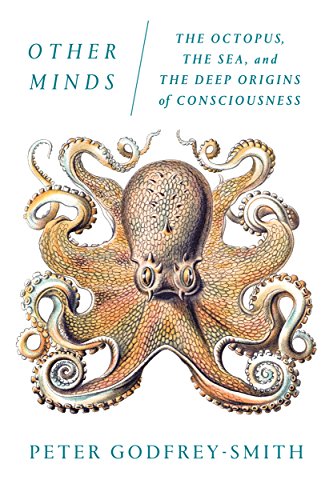
Ebook Info
- Published: 2016
- Number of pages: 272 pages
- Format: PDF
- File Size: 6.74 MB
- Authors: Peter Godfrey-Smith
Description
Philosopher Peter Godfrey-Smith dons a wet suit and journeys into the depths of consciousness in Other MindsAlthough mammals and birds are widely regarded as the smartest creatures on earth, it has lately become clear that a very distant branch of the tree of life has also sprouted higher intelligence: the cephalopods, consisting of the squid, the cuttlefish, and above all the octopus. In captivity, octopuses have been known to identify individual human keepers, raid neighboring tanks for food, turn off lightbulbs by spouting jets of water, plug drains, and make daring escapes. How is it that a creature with such gifts evolved through an evolutionary lineage so radically distant from our own? What does it mean that evolution built minds not once but at least twice? The octopus is the closest we will come to meeting an intelligent alien. What can we learn from the encounter? In Other Minds, Peter Godfrey-Smith, a distinguished philosopher of science and a skilled scuba diver, tells a bold new story of how subjective experience crept into being―how nature became aware of itself. As Godfrey-Smith stresses, it is a story that largely occurs in the ocean, where animals first appeared. Tracking the mind’s fitful development, Godfrey-Smith shows how unruly clumps of seaborne cells began living together and became capable of sensing, acting, and signaling. As these primitive organisms became more entangled with others, they grew more complicated. The first nervous systems evolved, probably in ancient relatives of jellyfish; later on, the cephalopods, which began as inconspicuous mollusks, abandoned their shells and rose above the ocean floor, searching for prey and acquiring the greater intelligence needed to do so. Taking an independent route, mammals and birds later began their own evolutionary journeys. But what kind of intelligence do cephalopods possess? Drawing on the latest scientific research and his own scuba-diving adventures, Godfrey-Smith probes the many mysteries that surround the lineage. How did the octopus, a solitary creature with little social life, become so smart? What is it like to have eight tentacles that are so packed with neurons that they virtually “think for themselves”? What happens when some octopuses abandon their hermit-like ways and congregate, as they do in a unique location off the coast of Australia?By tracing the question of inner life back to its roots and comparing human beings with our most remarkable animal relatives, Godfrey-Smith casts crucial new light on the octopus mind―and on our own.
User’s Reviews
Editorial Reviews: Review A New York Times Book Review Editors’ ChoiceOne of the Most Anticipated Books of Fall 2016 and a Top Ten Science Book of Fall 2016, Publishers Weekly”If this is philosophy, it works, because Godfrey-Smith is a rare philosopher who searches the world for clues. Knowledgeable and curious, he examines, he admires. His explorations are good-natured. He is never dogmatic, yet startlingly incisive.” ―Carl Safina, The New York Times Book Review”Entrancing and profound . . . Godfrey-Smith takes us on a philosophical journey of a quite unique kind, for its backdrop is the sea. We accompany the author, an avid diver and admirable writer, as he explores the lives of the cephalopods and the origins of consciousness . . . As is clear from the title of Godfrey-Smith’s book―as well as his enchanting descriptions of encounters with octopods―he believes these creatures have minds.” ―Stephen Cave, Financial Times”A philosopher of science and experienced deep-sea diver, Godfrey-Smith has rolled his obsessions into one book, weaving biology and philosophy into a dazzling pattern that looks a lot like the best of pop science. He peppers his latest book with vivid anecdotes from his cephalopod encounters . . . [and] relates dramatic stories of mischief made by captive octopuses . . . [but] his project is no less ambitious than to work out the evolutionary origins of subjective experience . . . The result is an incredibly insightful and enjoyable book.” ―Meehan Crist, Los Angeles Times”[Other Minds is] a terrific mix of Cousteau-esque encounters with [cephalopods] in the wild . . . wide-ranging scientific discussion, and philosophical analysis. Beautifully written, thought-provoking, and bold, this book is the latest, and most closely argued, salvo in the debate over whether octopuses and other cephalopods are intelligent, sentient beings.” ―Olivia Judson, The Atlantic”A smoothly written and captivating account of the octopus and its brethren . . . [Godfrey-Smith] stresses their dissimilarity to us and other mammals, but he also wants us to appreciate what we have in common . . . Mr. Godfrey-Smith mixes the scientific with the personal, giving us lively descriptions of his dives to ‘Octopolis,’ a site off the east coast of Australia at which octopuses gather.” ―Colin McGinn, The Wall Street Journal“The alienness of octopuses, in [Peter Godfrey-Smith’s] view, provides an opportunity to reflect on the nature of cognition and consciousness without simply projecting from the human example . . . Godfrey-Smith starts with the conviction that consciousness is an evolved thing, and accepts the conclusion that it has more primitive precursors: that it comes in degrees after all.” ―Amia Srinivasan, London Review of Books”To investigate these astonishing animals with such empathy and rigor is achievement enough. To do so while casting light on the birth and nature of consciousness, as Godfrey-Smith does here, is captivating.” ―China Miéville, author of The City & The City and Kraken”Brilliant . . . The beauty of Godfrey-Smith’s book lies in the clarity of his writing; his empathy, if you will . . . He proves that, like all aliens, these strange, beautiful creatures are more like us than our hubris allows.” ―Philip Hoare, The Guardian”Peter Godfrey-Smith’s Other Minds sells us on the sentient cephalopod and the history of our own consciousness, one tentacle at a time.” ―Sloane Crosley, Vanity Fair”Fascinating . . . After reading this book, to paraphrase Byron, you will ‘love not man the less, but cephalopods more.'” ―Callum Roberts, The Washington Post”[Other Minds’s] subject is so amazing, it’s hard not to be drawn along, just as Godfrey-Smith was when he extended a hand to an octopus and it reached out to return his touch, echoing his interest.” ―Irene Wanner, The Seattle Times”Godfrey-Smith skillfully links the details of evolutionary history and biology to broader philosophical debates about the nature and function of consciousness . . . [Other Minds] is a valuable contribution to some of the most basic questions about the origins of conscious life.” ―Nick Romeo, Chicago Tribune”Delightful . . . Godfrey-Smith explores the issue from many angles, beginning with a succinct and thoughtful discussion of the evolution of animals, and extending to a look at the octopus’ remarkable neurological systems . . . Throughout, Godfrey-Smith intertwines his own keen work observing and filming these animals at a remarkable site off of the coast of Australia he calls ‘Octopolis.'” ―Adam Gaffney, The New Republic”Such wondrous creatures deserve a remarkable chronicler. They’ve found one in Godfrey-Smith . . . Other Minds is a superb, coruscating book. It’s exciting to see bottom-up philosophy―philosophy that starts on the reef and in the sand and then crawls slowly up towards abstraction. That’s how all philosophy should be done.” ―Charles Foster, Literary Review “Fascinating and often delightful . . . This book ingeniously blends philosophy and science to trace the epic journey from single-celled organisms of 3.8 billion years ago to the awakening and development of cephalopod consciousness.” ―Damian Whitworth, The Times (London)”Peter Godfrey-Smith, a philosopher, skilfully combines science, philosophy and his experiences of swimming among these tentacled beasts to illuminate the origin and nature of consciousness.” ―The Economist”Godfrey-Smith has set himself a double challenge with this book: (i) putting together what is known about octopi behavior and cognition and (ii) showing why this information challenges our philosophical and scientific conceptions of the mind. The result is most convincing.” ―Ophelia Deroy, Science”A concise and elegant guide to evolution, consciousness, and marine biology.” ―Gary Drevitch, Psychology Today”Deftly blending philosophy and evolutionary biology . . . Godfrey-Smith couples his philosophical and scientific approach with ample and fascinating anecdotes as well as striking photography from his numerous scuba dives off the Australian coast. He makes the case that cephalopods demonstrate a type of intelligence that is largely ‘alien’ to our understanding of the concept but is no less worthy of wonder . . . [Other Minds is] thoroughly enjoyable and informative.” ―Publishers Weekly”An engrossing blend of avidly described underwater adventures . . . and a fluid inquiry into the brain-body connection . . . Godfrey-Smith performs an exceptionally revealing deep dive into the evolutionary progression from sensing to acting to remembering to the coalescence of the inner voice, thus tracking the spectrum between sentience and consciousness.” ―Donna Seaman, Booklist “I love this book, its masterful blend of natural history, philosophy, and wonder. Other Minds takes us on an extraordinary deep dive, not only beneath the waves, for a revelatory and intimate view of the mysterious and highly intelligent octopus, but also through the eons, to look at the nature of the mind and how it came about. It’s a captivating story, and Godfrey-Smith brings it alive in vivid, elegant prose. His ardent and humane passion for the octopus is present on every page. A must-read for anyone interested in what it’s like to be an octopus or in the evolution of the mind―ours and the very other, but equally sentient, minds of the cephalopods.” ―Jennifer Ackerman, author of The Genius of Birds”One of the greatest puzzles of organic life is how and why certain animals became aware of themselves. Peter Godfrey-Smith uses the octopus as a portal to enter nonhuman consciousness, doing so with great sensitivity and first-hand knowledge.” ―Frans de Waal, author of Are We Smart Enough to Know How Smart Animals Are?”Exciting, dramatic, vivid, revelatory, this book is full of jaw-dropping ideas and thrilling possibilities. In beautiful, clear, evocative writing, diver-philosopher Peter Godfrey-Smith will transform your understanding of the nature of life, the course of evolution, and the development of the mind―ours and others’. Other Minds will delight and challenge every naturalist, every diver, every person who has ever wondered about the nature of other creatures’ experience. In other words, everyone should read this book―and come away with a more complex and compassionate relationship to the other animals with whom we share both Earth and sea.” ―Sy Montgomery, author of The Soul of an Octopus, a National Book Award finalist”Godfrey-Smith delivers a revealing exploration of one―no, two!―of evolution’s most critical turns, and one remarkable creature’s trail-blazing, eight-armed foray into a mental life.” ―Jonathan Balcombe, author of What a Fish Knows”One of our species’s worst qualities is our insistence on an exclusive pathway to consciousness. Fortunately Peter Godfrey-Smith has given us a roadmap to a whole new territory of thinking. Other Minds is a gracious and generous exploration of this different land, one that will make you rethink the entire notion of sentience.” ―Paul Greenberg, New York Times bestselling author of Four Fish and American Catch About the Author Peter Godfrey-Smith is a professor in the School of History and Philosophy of Science at the University of Sydney. He is the author of the bestselling Other Minds: The Octopus, the Sea, and the Deep Origins of Consciousness, which has been published in more than twenty languages. His other books include Theory and Reality: An Introduction to the Philosophy of Science and Darwinian Populations and Natural Selection, which won the 2010 Lakatos Award.
Reviews from Amazon users which were colected at the time this book was published on the website:
⭐This was a profoundly interesting book to read. I became intrigued after seeing a review of it and had never come across the author before. It was intriguing primarily for the subject matter which I had a minor level of curiosity about. It was however, the first book I have read about cephalopods. My other experiences have been by reading articles and lately watching YouTube videos.It is not simply about octopuses and squids though. It is about using those life forms to explore bigger things like intelligence, consciousness and how animals including humans understand their environment. The author explores evolutionary possibilities about how animals come to relate to conspecifics, predators and prey. There are others which do not fit any of those categories.As a book written for a popular audience it is not replete with scientific jargon and when new words or concepts are introduced, they are explained in understandable language with very good examples to provide perspective. Maybe the thing I appreciated the most was that it was written using a lot of questions and humble suggestions rather than offering grand new theories. It made for a far more thought provoking read than some others in the genre. Those questions and suggestions are too many for a book review but below a few will be presented.It is nearly an aside here, but a philosopher who does field research by scuba diving off the coast of Australia with scientists and whose research reveals not raw data for laboratory testing but philosophical insight, makes the author himself a very interesting character. Some of his experiences can be viewed here.Early in the book the reader is introduced to cephalopods by way of the scuba diving anecdotal stories of their engagement with the humans. In particular, he means the interactions with the author. Certainly the cephalopod does not recognize that object as we do but something like a dark animal with no face, four arms and many bubbles exuding from them. Nevertheless the author experienced them reaching a tentacle or arm out to tactilely probe the object of this encounter-to the point of attempting to pull them into the lair. This behavior suggests the importance of feel to the cephalopod’s repertoire of resources that help it survive and bring forth spawn.He also observed their visual observance of everything around them. They watched the scuba divers but also their entire landscape for friend, foe and neutral bodies. Well maybe just for foe as the writer indicated often, these species are generally indifferent to their conspecifics. He did remark on variation from the rule here as he did whenever he was making a general statement about behaviors. Noting exceptions to the rule is critical to explanation and for the non-scientist reader, valuable.He brought up the fact of the elaborate nervous systems of these animals and how that plays with the brilliant abilities for the animals to shape shift as if to conform to their surroundings which included immediate color changes. It is remarkable for many reasons but a couple include the fact that the colorations do not occur as if by one mechanism but instead by many yet it occurs so quickly it appears as if by simplicity. It is a three step process since they mechanisms occur at three different layers of skins. The details are in the book but not here. They are too fascinating for my own interpretation. He does provide an image however.The other bizarre curiosity is that lab results strongly suggest that they are colorblind. Something within the nervous system that is not visual ignites the instantaneous processes that allow the color change and body morphing. He examines this through two different operations of the nervous systems one in which is the taking of sensory cues from the environment with the innate motor skills respond like autonomic reactions. The other is a simpler stimulus response action based on what occurs on the spot like the flight or fight response.In this discussion he cited other philosophers of consciousness to remind us that interpretation involves a lot of questions. There is nothing certain and plenty that may be probable. In efforts to describe animal behavior from a non-anthropomorphic perspective, the observer may not always see the forest for the trees. Yet we are thrust into a situation where it is difficult to understand information and the processing of it from other than a human perspective. We also have to treat information as a physical thing-something to be measured. Is it? Or is it reducible to a binomial sort of impulse and response an immediate (and evolutionarily adaptive) reaction? This is a debated question amongst those examining what is meant by “consciousness”. In fact it remains sort of a Gordian knot and there are dualists who consider that consciousness is made up of a “functional” quality which is the 1s and 0s of binomial information. It also has a “phenomenal” essence that involves the interpretational or conscious experience. The former is said to control behavior and the latter simply is consciousness. It is these sort of issues that the author proposes not to find concrete answers but to ask additional questions. Godfrey-Smith ponders hard on the notion of consciousness saying “It’s sometimes hard to work out how these theories relate to my own target here: subjective experience in a very broad sense. I treat subjective experience as a broad category and consciousness as a narrower category within it— not everything that an animal might feel has to be conscious.” More important than defining consciousness, the author provides much to consider and the reader can take advantage of that.Back to the animals, the author discovered several things that also make the reader think. With the knowledge that cephalopods have a very intricate nervous system it would seem that it would take years to develop and yet he informs us that these species have a very short life span. In most cases four years would be very long. He asks about the evolutionary benefit of this intricate structure to only exist for so short a time. They hardly have time to use their wondrous skills when they are replaced by the next generation.They are semelparous meaning that they only reproduce once in a lifetime and in their case, the female dies right after spawning. They also use a deimatic display which is one of complete submission and the author examined this many times and offers suggestions as to why. These beasts are so capable of camouflaging for protection as well as to predate, why would they need a passive and subordinate display? It is not used when flight would work or an attempt to startle something it would eat. There is no clear answer but he believes it is used when a more aggressive conspecific appears.There is much to learn about cephalopods and there is scarce information of them historically. Being soft bodied they do not preserve well so the fossil record is nearly non-existent. His own efforts at first hand observation are in coordination with biologists and other scientists. There is much study of them going on today. It is clear that the bounty of possible research is hindered by decreasing habitat. That is a problem that the study of any animal behavior faces. With climate change comes both a loss of habitat, but a change in behavior as well. Various species adapt differently to changing environment environments such as warming waters.This was an easy book to not put down. The pace was lively and informative yet never certain. The book makes the curious reader intent on learning more of the subject matter. He provided lots of philosophical questions for the reader to ponder.
⭐How did we become us? What makes a clear distinction between human and other creatures? It is thought we have consciousness. Doesn’t other life have mind? Peter Godfrey-Smith tries to answer these esoteric questions on “Other Minds,” shedding light on ecological aspect of octopus, using his profound knowledge on philosophy, biology, and evolution. It would’t be any use to be considerate on octopus’s feeling, like, how do they feel about their life? Reading “Other Minds” makes me feel that an octopus lives as a distant relative who came down another line of evolution, and has another tale to tell. As Godfrey-Smith says evolution might built minds twice over, and put an octopus as the closest intelligent alien around us.Octopuses sit on a very far branch on an evolutional tree from ours. Their common lifespan is said to be less than two years. Hawaiian account octopuses as lone survivors from an earlier world. Old science-fiction-novels features octopus like aliens without fail. Octopuses have lost their shell entirely during a long path of evolution, which gave them mobility, dexterity, and nervous complexity, and also a live-fast-die-young lifestyle. They have three hearts pumping blue-green blood, using copper as the oxygen-carrying molecule. Octopuses have proportionally big brains and the large nervous system, which runs all through their body. There is central control of the arm’s overall path, via the eyes, combined with a fine tuning of the search by the arm itself. Neurons in the arm have not only the sense of touch, but also the capacity to smell, or taste. The channel back to the central brain from each arm seemed pretty slim. Two forms of control, an ongoing interaction between commands from the center and decisions at the periphery, are working in tandem within their large nervous system. What is the point of building a large nervous system if the life is over in a year or two? What is all the brain power doing if you die less than two years after the birth? Godfrey-Smith sees consciousness as one form of subjective experience, even it’s not the only form. Sentience is brought into being through connection between sensing and acting, before consciousness arises. At some stage in evolution, some living groups have gradually acquired capacity to lead to subjective experience independently, perceptual constancies, integration of information, and a recognition of time and self. Ginsberg and Jablonka’s metaphor of “white noise” as the first form of subjective experience is interesting. Godfrey-Smith sees the octopus as a remarkable sentient being.Godfrey-Smith writes it has bee getting clarified very complicated matter go on inside other animals without the help of speech. Efference copy gave rise to something so powerful at some stage of evolution. Inner speech, a monologue that accompanies much of our conscious life, is a familiar tool for our making complex thought, together with spatial imaginary tool, inner pictures and shapes. We often rely on our inner selves by building inner questions, commentaries, and encouragement, which support us fulfilling things we can’t do otherwise. Godfrey-Smith says cephalopods and smart vertebrates are independent experiments in the evolution of the mind. Through observation, Godfrey-Smith found octopuses are generally more social than people understand. Octopuses are more concerned with each other than had once been believed. They have a timeserving, inquisitive style of approach to the world. They are curious, chasing after novelties, having at least some perceptual constancies, phantasmagoric in behavior as well as in body. Once there was an octopus named “Paul,” who predicted the results of association football matches. Octopuses are good swimmers and are also good at navigation. Octopuses are superb at matching the color of their surroundings, for camouflage, by producing a color reflecting it back from outside. The magic skin, a thin sheet on top of a plain white body, can both sense light and also produce a chemical that affects the skin’s color. We don’t yet know whether the skin’s sensing is fed back to their brain, or whether the information is stored in local. Cephalopod displays have enormous expressive power, controlling millions of pixel-like sacs of color, but these displays are not embedded in a lot of looping feedback, and perhaps could never be. Since, most cephalopods are said to be color-blind. Most cephalopods have only one photoreceptors, while we humans having three, to make color vision. To whom octopuses sending a message by changing their color? Does any color has special meaning? Godfrey-Smith sees an unfinished area in evolution there.Godfrey-Smith’s concern is turned to the situation of our making stress on the sea. In addition to excessive fishing, the sea faces its chemical change, acidification, and micro-plastic problem, much greater now. Our ability to manage this is hampered, Godfrey-Smith says, not just by greed and competing interests, but by the difficulty of getting a handle on the problem and understanding our own destructive capacities. Referring on Colony Collapse Disorder freshly reminds me of reading experience of Rowan Jacobsen’s “Fruitless Fall.” The mind evolved in the sea. The sea is the birth place of the minds, or at least of its first faint forms emerged in there. Before it becomes too late, we all need to consider this. His heart-rending cry, “the sea looks the same after the boats are gone,” sinks deeply into our mind.
⭐Other Minds’ can be considered essential reading, for a number of reasons. First and foremost, it is a magnificent defence of evolution, but not in the way that much of the Richard Dawkins canon is; instead, Godfrey-Smith writes from the (correct) standpoint that evolution is a fact, and considering the reality of evolution, here are some things that we can learn. Without accepting the fact of evolution, this book could not exist, and nor could our advanced understanding of other life forms on the planet that we share.Secondly, ‘Other Minds’ is the kind of book destined to become a classic of its genre, as it has a tremendous – I would say life-changing – effect on the reader. This reader included; after reading about the startlingly high level of intelligence possessed by octopuses, I cannot ever see myself ordering octopus as food in a restaurant again. It just seems wrong; they are as characterful as dogs and cats, and I think it would simply be terrible to treat these amazing creatures as a foodstuff any longer. I do hope, given my love of bacon and chorizo, that Godfrey-Smith’s next book is not on the topic of porcine intelligence…And thirdly (for the sake of brevity – I could certainly go on in praise of this book), Godfrey-Smith makes a great case for the protection of the ocean environment. Overfishing and pollution have both taken their toll, and now that we understand how much intelligence – nay, sentience – is present in the depths, we owe it to our genetic relatives (by which I mean all species, in every shape and form) to do a better job of not destroying what life there is out there.
⭐Let’s get the bad stuff out of the way first. As others have said, Peter Godfrey-Smith doesn’t come across as a particularly good writer, nor philosopher, nor subject-matter expert. The last is certainly unjustified, however you’d probably have got a more enlightening philosophy on the mind and consciousness from your late night cheese and wine (Liebfraumilch?) discussions at university.But how much do you know about octopuses (or, apparently, octopodes) and cephalopods in general?The evolutionary tree and time scales are fascinating:• 4,600 MYA: Earth formed• 3,600 MYA: First single celled organism (perhaps earlier than this)• 635 MYA, Ediacaran: Emergence first multicellular organisms and also the bilaterian body plan. Perhaps these animals also had simple light sensitive skin patches. Molluscs, the forbearers of cephalopods, split from rest of evolutionary tree during this period. ie common ancestor for humans and octopodes• 542 MYA, Cambrian: explosion of body forms we see today• 320 MYA: Bird and mammal common ancestor. A land dwelling lizard-like animal• 164 MYA: First uncontroversial octopus fossil• 6 MYA: Human and chimp common ancestor• 1 MYA: Homo sapiensNervous systems developed independently (although from the same precursor protein), as did eyes. Whereas chordates (including us) have a centralised nervous system, cephalopods have a much more widely distributed nervous system: for instance their arms have enough “intelligence” to act semi-autonomously. Whereas there are many intelligent birds and mammals, cephalopods are the only intelligent molluscs. The common octopus has 500 million neurons, (similar to cats and dogs. This is four orders of magnitude greater than other molluscs ,a garden snail for instance has about 10,000 neurons.There is an interesting discussion on the purpose of a nervous system. In simple animals it allows animals to do two things: respond to the environment (move toward food or away from pain), and to coordinate the animal’s body. Looking after four feet whilst fleeing a predator is no mean feat. With larger brains animals can start to plan their actions, coordinate within a pack, and solve problems set by animal behaviourists.Godfrey-Smith then attempts to make inroads into consciousness and self awareness. Without, I feel, much success.Birds and mammals also demonstrate parallel evolution. Our common ancestor was probably a land reptile that roamed before the dinosaurs. Yet both us (as mammals) and birds have skin covering, are warm blooded, and have developed a level of intelligence. Although anatomically our brains are similar, birds and primates use their brains differently. A raven, as well as having a large brain for its weight, also uses that brain efficiently. The result is a surprisingly clever animal.Why do cephalopods generate such fascinating skin colour displays? Especially as they’re apparently colour blind, and they are not social.Another interesting puzzle that Godfrey-Smith raises but doesn’t entirely address: octopuses and cephalopods have comparatively large brains, yet only live for a couple of years. Why do they need such large brains for such a short life span? However the associated discussion on the evolutionary theories of senescence.The book ends with a polemic on habitat destruction, which is fair enough but off-topic.So despite the book’s shortcomings, I learnt a lot. Hence a hearty 4 out 5.
⭐This is a quite short book which looks at what we can learn about our minds by looking in at the closest we have to a mind in an alien body, that of the mind of an octopus. The book starts brilliantly with a fantastic, clear introduction to evolution and how animals and our brains developed. I really loved the first two chapters. I also found other parts interesting including discovering the short life of an octopus only been 2 years (quite sad and poignant) and explanations of why that might be. But too much of this book seemed speculation and some parts were less satisfying. However, I did enjoy this book.
⭐If you are interested in the latest thinking in evolution and how evolutionary biology can underpin the seemingly imponderable understanding of what constitutes Mind and indeed how the human Mind compares with the Mind of organisms from which we diverged in evolution some 200 or 300 million years ago, then this is the book you need. Written in a superbly conversational style, this is already one of my favourite ever books.
⭐If you’ve ever been intrigued by the origins of intelligence, of minds and of subjective experience but haven’t delved into it, this is the book for you. Peter Godfrey-Smith does a superb job of summarising the evolution of life from single cell organisms into the various branches we see today. The focus on octopuses and cuttlefish – often contrasted with advanced vertebrate species such as humans, baboons and birds – is incredibly helpful in isolating specific kinds of sentience. In the book he shows how complex neural networks can emerge in response to particular evolutionary pressures, leading to enhanced cognition and a palate of richer ‘inner’ experiences. (It turns out that octopuses have more neurons in their tentacles than in their brain, that their tentacles are semi-autonomous, and that they can ‘see’ with their skin.)His passion for octopuses also shines through and contributes to the readability of the book. The only reason it doesn’t get five stars from me is that the prose is a tad try. Nevertheless, he does a great job of distilling complex concepts for the lay reader, and the book reads like a breeze, making it worthwhile for anyone with an interest in these kinds of subjects.
Keywords
Free Download Other Minds: The Octopus, the Sea, and the Deep Origins of Consciousness in PDF format
Other Minds: The Octopus, the Sea, and the Deep Origins of Consciousness PDF Free Download
Download Other Minds: The Octopus, the Sea, and the Deep Origins of Consciousness 2016 PDF Free
Other Minds: The Octopus, the Sea, and the Deep Origins of Consciousness 2016 PDF Free Download
Download Other Minds: The Octopus, the Sea, and the Deep Origins of Consciousness PDF
Free Download Ebook Other Minds: The Octopus, the Sea, and the Deep Origins of Consciousness