

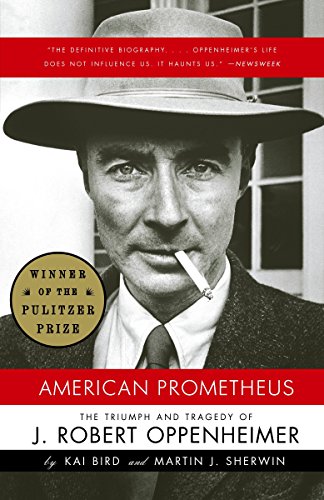
Ebook Info
- Published: 2006
- Number of pages: 721 pages
- Format: PDF
- File Size: 10.54 MB
- Authors: Kai Bird
Description
PULITZER PRIZE WINNER • The definitive biography of J. Robert Oppenheimer, one of the iconic figures of the twentieth century, a brilliant physicist who led the effort to build the atomic bomb for his country in a time of war, and who later found himself confronting the moral consequences of scientific progress.THE INSPIRATION FOR THE UPCOMING MAJOR MOTION PICTURE OPPENHEIMERIn this magisterial, acclaimed biography twenty-five years in the making, Kai Bird and Martin Sherwin capture Oppenheimer’s life and times, from his early career to his central role in the Cold War. This is biography and history at its finest, riveting and deeply informative.“A masterful account of Oppenheimer’s rise and fall, set in the context of the turbulent decades of America’s own transformation. It is a tour de force.” —Los Angeles Times Book Review“A work of voluminous scholarship and lucid insight, unifying its multifaceted portrait with a keen grasp of Oppenheimer’s essential nature…. It succeeds in deeply fathoming his most damaging, self-contradictory behavior.” —The New York Times
User’s Reviews
Editorial Reviews: Review “The definitive biography. . . . Oppenheimer’s life doesn’t influence us. It haunts us.” –Newsweek“A masterful account of Oppenheimer’s rise and fall, set in the context of the turbulent decades of America’s own transformation. It is a tour de force.” –Los Angeles Times Book Review“A work of voluminous scholarship and lucid insight, unifying its multifaceted portrait with a keen grasp of Oppenheimer’s essential nature. . . . It succeeds in deeply fathoming his most damaging, self-contradictory behavior.” –The New York Times“There have been numerous books about Oppenheimer but they can’t touch this extraordinary book’s impressive breadth and scope.” –The Miami Herald“The first biography to give full due to Oppenheimer’s extraordinary complexity . . . Stands as an Everest among the mountains of books on the bomb project and Oppenheimer, and is an achievement not likely to be surpassed or equaled.”–The Boston Globe From the Back Cover “American Prometheus is the first full-scale biography of J. Robert Oppenheimer, “father of the atomic bomb,” the brilliant, charismatic physicist who led the effort to capture the awesome fire of the sun for his country in time of war. Immediately after Hiroshima, he became the most famous scientist of his generation-one of the iconic figures of the twentieth century, the embodiment of modern man confronting the consequences of scientific progress. He was the author of a radical proposal to place international controls over atomic materials-an idea that is still relevant today. He opposed the development of the hydrogen bomb and criticized the Air Force’s plans to fight an infinitely dangerous nuclear war. In the now almost-forgotten hysteria of the early 1950s, his ideas were anathema to powerful advocates of a massive nuclear buildup, and, in response, Atomic Energy Commission chairman Lewis Strauss, Superbomb advocate Edward Teller and FBI director J. Edgar Hoover worked behind the scenes to have a hearing board find that Oppenheimer could not be trusted with America’s nuclear secrets. “American Prometheus sets forth Oppenheimer’s life and times in revealing and unprecedented detail. Exhaustively researched, it is based on thousands of records and letters gathered from archives in America and abroad, on massive FBI files and on close to a hundred interviews with Oppenheimer’s friends, relatives and colleagues. We follow him from his earliest education at the turn of the twentieth century at New York City’s Ethical Culture School, through personal crises at Harvard and Cambridge universities. Then to Germany, where he studied quantum physics with the world’s mostaccomplished theorists; and to Berkeley, California, where he established, during the 1930s, the leading American school of theoretical physics, and where he became deeply involved with social justice causes and their advocates, many of whom were communists. Then to Los Alamos, New Mexico, where he transformed a bleak mesa into the world’s most potent nuclear weapons laboratory-and where he himself was transformed. And finally, to the Institute for Advanced Study in Princeton, which he directed from 1947 to 1966. “American Prometheus is a rich evocation of America at midcentury, a new and compelling portrait of a brilliant, ambitious, complex and flawed man profoundly connected to its major events-the Depression, World War II and the Cold War. It is at once biography and history, and essential to our understanding of our recent past-and of our choices for the future. About the Author Kai Bird is the author of The Chairman: John J. McCloy, The Making of the American Establishment and The Color of Truth: McGeorge Bundy and William Bundy, Brothers in Arms. He coedited with Lawrence Lifschultz Hiroshima’s Shadow: Writings on the Denial of History and the Smithsonian Controversy. A contributing editor of The Nation, he lives in Washington, D.C., with his wife and son.Martin J. Sherwin is the Walter S. Dickson Professor of English and American History at Tufts University and author of A World Destroyed: Hiroshima and Its Legacies, which won the Stuart L. Bernath Prize, as well as the American History Book Prize. He and his wife live in Boston and Washington, D.C. Excerpt. © Reprinted by permission. All rights reserved. Chapter 1In the first decade of the twentieth century, science initiated a second American revolution. A nation on horseback was soon transformed by the internal combustion engine, manned flight and a multitude of other inventions. These technological innovations quickly changed the lives of ordinary men and women. But simultaneously an esoteric band of scientists was creating an even more fundamental revolution. Theoretical physicists across the globe were beginning to alter the way we understand space and time. Radioactivity was discovered on March 1, 1896, by the French physicist Henri Becquerel. Max Planck, Marie Curie and Pierre Curie and others provided further insights into the nature of the atom. And then, in 1905, Albert Einstein published his special theory of relativity. Suddenly, the universe appeared to have changed.Around the globe, scientists were soon to be celebrated as a new kind of hero, promising to usher in a renaissance of rationality, prosperity and social meritocracy. In America, reform movements were challenging the old order. Theodore Roosevelt was using the bully pulpit of the White House to argue that good government in alliance with science and applied technology could forge an enlightened new Progressive Era.Into this world of promise was born J. Robert Oppenheimer, on April 22, 1904. He came from a family of first- and second-generation German immigrants striving to be American. Ethnically and culturally Jewish, the Oppenheimers of New York belonged to no synagogue. Without rejecting their Jewishness they chose to shape their identity within a uniquely American offshoot of Judaism—the Ethical Culture Society—that celebrated rationalism and a progressive brand of secular humanism. This was at the same time an innovative approach to the quandaries any immigrant to America faced—and yet for Robert Oppenheimer it reinforced a lifelong ambivalence about his Jewish identity.As its name suggests, Ethical Culture was not a religion but a way of life that promoted social justice over self-aggrandizement. It was no accident that the young boy who would become known as the father of the atomic era was reared in a culture that valued independent inquiry, empirical exploration and the free-thinking mind—in short, the values of science. And yet, it was the irony of Robert Oppenheimer’s odyssey that a life devoted to social justice, rationality and science would become a metaphor for mass death beneath a mushroom cloud.Robert’s father, Julius Oppenheimer, was born on May 12, 1871, in the German town of Hanau, just east of Frankfurt. Julius’ father, Benjamin Pinhas Oppenheimer, was an untutored peasant and grain trader who had been raised in a hovel in “an almost medieval German village,” Robert later reported. Julius had two brothers and three sisters. In 1870, two of Benjamin’s cousins by marriage emigrated to New York. Within a few years these two young men—named Sigmund and Solomon Rothfeld—joined another relative, J. H. Stern, to start a small company to import men’s suit linings. The company did extremely well serving the city’s flourishing new trade in ready-made clothing. In the late 1880s, the Rothfelds sent word to Benjamin Oppenheimer that there was room in the business for his sons.Julius arrived in New York in the spring of 1888, several years after his older brother Emil. A tall, thin-limbed, awkward young man, he was put to work in the company warehouse, sorting bolts of cloth. Although he brought no monetary assets to the firm and spoke not a word of English, he was determined to remake himself. He had an eye for color and in time acquired a reputation as one of the most knowledgeable “fabrics” men in the city. Emil and Julius rode out the recession of 1893, and by the turn of the century Julius was a full partner in the firm of Rothfeld, Stern & Company. He dressed to fit the part, always adorned in a white high-collared shirt, a conservative tie and a dark business suit. His manners were as immaculate as his dress. From all accounts, Julius was an extremely likeable young man. “You have a way with you that just invites confidence to the highest degree,” wrote his future wife in 1903, “and for the best and finest reasons.” By the time he turned thirty, he spoke remarkably good English, and, though completely self-taught, he had read widely in American and European history. A lover of art, he spent his free hours on weekends roaming New York’s numerous art galleries.It may have been on one such occasion that he was introduced to a young painter, Ella Friedman, “an exquisitely beautiful” brunette with finely chiseled features, “expressive gray-blue eyes and long black lashes,” a slender figure—and a congenitally unformed left hand. To hide this deformity, Ella always wore long sleeves and a pair of chamois gloves. The glove covering her left hand contained a primitive prosthetic device with a spring attached to an artificial thumb. Julius fell in love with her. The Friedmans, of Bavarian Jewish extraction, had settled in Baltimore in the 1840s. Ella was born in 1869. A family friend once described her as “a gentle, exquisite, slim, tallish, blue-eyed woman, terribly sensitive, extremely polite; she was always thinking what would make people comfortable or happy.” In her twenties, she spent a year in Paris studying the early Impressionist painters. Upon her return she taught art at Barnard College. By the time she met Julius, she was an accomplished enough painter to have her own students and a private rooftop studio in a New York apartment building.All this was unusual enough for a woman at the turn of the century, but Ella was a powerful personality in many respects. Her formal, elegant demeanor struck some people upon first acquaintance as haughty coolness. Her drive and discipline in the studio and at home seemed excessive in a woman so blessed with material comforts. Julius worshipped her, and she returned his love. Just days before their marriage, Ella wrote to her fiancé: “I do so want you to be able to enjoy life in its best and fullest sense, and you will help me take care of you? To take care of someone whom one really loves has an indescribable sweetness of which a whole lifetime cannot rob me. Good-night, dearest.”On March 23, 1903, Julius and Ella were married and moved into a sharp-gabled stone house at 250 West 94th Street. A year later, in the midst of the coldest spring on record, Ella, thirty-four years old, gave birth to a son after a difficult pregnancy. Julius had already settled on naming his firstborn Robert; but at the last moment, according to family lore, he decided to add a first initial, “J,” in front of “Robert.” Actually, the boy’s birth certificate reads “Julius Robert Oppenheimer,” evidence that Julius had decided to name the boy after himself. This would be unremarkable—except that naming a baby after any living relative is contrary to European Jewish tradition. In any case, the boy would always be called Robert and, curiously, he in turn always insisted that his first initial stood for nothing at all. Apparently, Jewish traditions played no role in the Oppenheimer household.Sometime after Robert’s arrival, Julius moved his family to a spacious eleventh-floor apartment at 155 Riverside Drive, overlooking the Hudson River at West 88th Street. The apartment, occupying an entire floor, was exquisitely decorated with fine European furniture. Over the years, the Oppenheimers also acquired a remarkable collection of French Postimpressionist and Fauvist paintings chosen by Ella. By the time Robert was a young man, the collection included a 1901 “blue period” painting by Pablo Picasso entitled Mother and Child, a Rembrandt etching, and paintings by Edouard Vuillard, André Derain and Pierre-Auguste Renoir. Three Vincent Van Gogh paintings—Enclosed Field with Rising Sun (Saint-Remy, 1889), First Steps (After Millet) (Saint-Remy, 1889) and Portrait of Adeline Ravoux (Auvers-sur-Oise, 1890)—dominated a living room wallpapered in gold gilt. Sometime later they acquired a drawing by Paul Cézanne and a painting by Maurice de Vlaminck. A head by the French sculptor Charles Despiau rounded out this exquisite collection.*Ella ran the household to exacting standards. “Excellence and purpose” was a constant refrain in young Robert’s ears. Three live-in maids kept the apartment spotless. Robert had a Catholic Irish nursemaid named Nellie Connolly, and later, a French governess who taught him a little French. German, on the other hand, was not spoken at home. “My mother didn’t talk it well,” Robert recalled, “[and] my father didn’t believe in talking it.” Robert would learn German in school.On weekends, the family would go for drives in the countryside in their Packard, driven by a gray-uniformed chauffeur. When Robert was eleven or twelve, Julius bought a substantial summer home at Bay Shore, Long Island, where Robert learned to sail. At the pier below the house, Julius moored a forty-foot sailing yacht, christened the Lorelei, a luxurious craft outfitted with all the amenities. “It was lovely on that bay,” Robert’s brother, Frank, would later recall fondly. “It was seven acres . . . a big vegetable garden and lots and lots of flowers.” As a family friend later observed, “Robert was doted on by his parents. . . . He had everything he wanted; you might say he was brought up in luxury.” But despite this, none of his childhood friends thought him spoiled. “He was extremely generous with money and material things,” recalled Harold Cherniss. “He was not a spoiled child in any sense.”By 1914, when World War I broke out in Europe, Julius Oppenheimer was a very prosperous businessman. His net worth certainly totaled more than several hundred thousand dollars—which made him the equivalent of a multimillionaire in current dollars. By all accounts, the Oppenheimer marriage was a loving partnership. But Robert’s friends were always struck by their contrasting personalities. “He [Julius] was jolly German-Jewish,” recalled Francis Fergusson, one of Robert’s closest friends. “Extremely likeable. I was surprised that Robert’s mother had married him because he seemed such a hearty and laughing kind of person. But she was very fond of him and handled him beautifully. They were very fond of each other. It was an excellent marriage.”Julius was a conversationalist and extrovert. He loved art and music and thought Beethoven’s Eroica symphony “one of the great masterpieces.” A family friend, the anthropologist George Boas, later recalled that Julius “had all the sensitiveness of both his sons.” Boas thought him “one of the kindest men I ever knew.” But sometimes, to the embarrassment of his sons, Julius would burst out singing at the dinner table. He enjoyed a good argument. Ella, by contrast, sat quietly and never joined in the banter. “She [Ella] was a very delicate person,” another friend of Robert’s, the distinguished writer Paul Horgan, observed, “. . . highly attenuated emotionally, and she always presided with a great delicacy and grace at the table and other events, but [she was] a mournful person.”Four years after Robert’s birth, Ella bore another son, Lewis Frank Oppenheimer, but the infant soon died, a victim of stenosis of the pylorus, a congenital obstruction of the opening from the stomach to the small intestine. In her grief, Ella thereafter always seemed physically more fragile. Because young Robert himself was frequently ill as a child, Ella became overly protective. Fearing germs, she kept Robert apart from other children. He was never allowed to buy food from street vendors, and instead of taking him to get a haircut in a barber shop Ella had a barber come to the apartment.Introspective by nature and never athletic, Robert spent his early childhood in the comfortable loneliness of his mother’s nest on Riverside Drive. The relationship between mother and son was always intense. Ella encouraged Robert to paint—he did landscapes—but he gave it up when he went to college. Robert worshipped his mother. But Ella could be quietly demanding. “This was a woman,” recalled a family friend, “who would never allow anything unpleasant to be mentioned at the table.”Robert quickly sensed that his mother disapproved of the people in her husband’s world of trade and commerce. Most of Julius’s business colleagues, of course, were first-generation Jews, and Ella made it clear to her son that she felt ill-at-ease with their “obtrusive manners.” More than most boys, Robert grew up feeling torn between his mother’s strict standards and his father’s gregarious behavior. At times, he felt ashamed of his father’s spontaneity—and at the same time he would feel guilty that he felt ashamed. “Julius’s articulate and sometimes noisy pride in Robert annoyed him greatly,” recalled a childhood friend. As an adult, Robert gave his friend and former teacher Herbert Smith a handsome engraving of the scene in Shakespeare’s Coriolanus where the hero is unclasping his mother’s hand and throwing her to the ground. Smith was sure that Robert was sending him a message, acknowledging how difficult it had been for him to separate from his own mother.When he was only five or six, Ella insisted that he take piano lessons. Robert dutifully practiced every day, hating it all the while. About a year later, he fell sick and his mother characteristically suspected the worst, perhaps a case of infantile paralysis. Nursing him back to health, she kept asking him how he felt until one day he looked up from his sickbed and grumbled, “Just as I do when I have to take piano lessons.” Ella relented, and the lessons ended.In 1909, when Robert was only five, Julius took him on the first of four transatlantic crossings to visit his grandfather Benjamin in Germany. They made the trip again two years later; by then Grandfather Benjamin wasseventy-five years old, but he left an indelible impression on his grandson. “It was clear,” Robert recalled, “that one of the great joys in life for him was reading, but he had probably hardly been to school.” One day, while watching Robert play with some wooden blocks, Benjamin decided to give him an encyclopedia of architecture. He also gave him a “perfectly conventional” rock collection consisting of a box with perhaps two dozen rock samples labeled in German. “From then on,” Robert later recounted, “I became, in a completely childish way, an ardent mineral collector.” Back home in New York, he persuaded his father to take him on rock-hunting expeditions along the Palisades. Soon the apartment on Riverside Drive was crammed with Robert’s rocks, each neatly labeled with its scientific name. Julius encouraged his son in this solitary hobby, plying him with books on the subject. Long afterward, Robert recounted that he had no interest in the geological origins of his rocks, but was fascinated by the structure of crystals and polarized light.From the ages of seven through twelve, Robert had three solitary but all-consuming passions: minerals, writing and reading poetry, and building with blocks. Later he would recall that he occupied his time with these activities “not because they were something I had companionship in or because they had any relation to school—but just for the hell of it.” By the age of twelve, he was using the family typewriter to correspond with a number of well-known local geologists about the rock formations he had studied in Central Park. Read more
Reviews from Amazon users which were colected at the time this book was published on the website:
⭐It is rare to read a biography that is so rich in detail, so clear in ideas, and so beautifully written that it can be counted as literature. For the past week, I have been deliciously absorbed in this book, feeling an alternation of awe and disgust. Oppenheimer is a unique figure in American history: starting as an academic, he became a master administrator for one of the most important technological breakthroughs in the history of mankind – harnessing the atom – and then a “wise man” insider in politics, only to be cast down and ruined in the McCarthy era because his views diverged from those of the powerful. It is an amazing journey.Oppenheimer came from privilege: not only was he gifted with an absolutely first rate mind and great wealth, but he was in the right place at the right time, during a revolution in science and then in technology. He started out as a sheltered prodigy, a polymath in science and in literature, who wound up studying theoretical physics at the moment that quantum mechanics was in its final phase of development. His mentors were the discoverers themselves, and he studied alongside Heisenberg and virtually all of the greats in that field. He then went on to a professorship at Cal Tech and Berkeley, where he built the best department of physics in the US while in his 20s. Without exaggeration, I believe that this period will be regarded as profoundly influential as the Renaissance or Enlightenment.However, as the authors relate, his ascent was not at all easy. Oppenheimer suffered from some form of mental illness, either a depression or worse. Given his loving childhood background, it is hard to know what really went wrong for him, but he contemplated suicide and even poisoned an apple that he left from one of his adversaries, which almost led to his dismissal from Cambridge. Perhaps what explains part of it was that Oppenheimer was of the types whose ambitions are so monstrously huge (and completely unfathomable) that he needed to operate at the highest pinnacle to feel whole within himself, that there was not much more to him than the kind of narcissism to seek perfection. In addition to his personal charm and intellectual charisma, he had many character flaws, which engendered great resentments and even bitter hatreds throughout his career.In spite of the admiration of the authors, they are highly critical of Oppenheimer. He was too impatient to develop his ideas systematically – by means of the mathematical proofs required for a Nobel Prize in theoretical physics – so he merely contributed to the discoveries of others. In this way, he was not truly original as a scientist, but a “synthesizer”. His attention was also overly divided as he learned languages, apparently including Sanskrit so that he could read the Bhagavagita in the original as he did Dante’s Inferno in Italian and Les Fleurs du Mal in French, and during the Depression widened his concerns to politics, getting involved with communism as a possible remedy to the social ills he saw, the Spanish Revolution, and opposition to Nazism.Because of his scientific breadth, he was chosen to head the Manhattan Project. Though many predicted his abrasive behavior and arrogance would doom his leadership effort, he astounded even his critics by becoming a master administrator, getting the right person for each job, inspiring them, and keeping everything – all the myriad issues that required resolution – in his head and moving forward just at the needed time. It was perhaps here, as an administrator, that his true genius flowered. When the bomb was finally exploded, he was barely 40 years old and, after Einstein, the most famous scientist in the world. Afterwards, he took over the Institute for Advanced Study in Princeton, NJ, transforming it into a focal point of intellectual endeavor in the US.In the meantime, his enemies bided their time, compiling information about him via years of FBI surveillance and illegal wiretaps, waiting for the right moment to strike at him. Many of them bore him petty personal grudges, such as Lewis Strauss of the AEC (Atomic Energy Commission). They looked at his past communist associations, some bad judgment calls, and certain self destructive behaviors such as occasional lies as well as his marital infidelities and personality quirks. The case they built occupies an inordinate portion of the book, though it culminated in a Security Committee hearing of the AEC that stripped him of his security clearance, shutting him out of the upper circles of government and the establishment that he had come to love. The hearing was not a “trial” with due process or even constitutional guarantees, brought out nothing new that hadn’t been known when he was first given the clearance by the Army in 1943, and he was not convicted of any crime – even his loyalty to the US went unchallenged, but he was instead branded a “security risk” in a kangaroo court. Beyond his personal enemies, his real offense was his opposition to the development of the hydrogen bomb that the politicians wanted. There were lots of “bad guys” here, including even Harry Truman and J. Edgar Hoover, which made the narrative a bit too black and white for my taste, however much I agree with their portrayal.Oppenheimer emerged from this ordeal a broken man at 50, forever unable to operate at the level to which he was accustomed. The reader really gets a feel for the man, who was full of contradictions. He was a serious drinker though not as alcoholic as his troubled wife, Kitty, and was not a very good father, yet admired by millions for his wisdom and public charm. He had a knack for making powerful enemies in addition to lifelong friends and was arrogant beyond belief – I know the type from graduate school! You feel simultaneous sympathy and revulsion for him, or at least I did. It is an unusually nuanced and balanced portrait.I do have criticisms of the book. The science is not well explained, so for anyone unfamiliar with it will find it hard going – I would have liked more nutshell explanations, but instead the authors just mention theories (e.g. “quantum electrodynamics”) in passing. The management of the Manhattan Project is also glossed over, so the reader will have to go elsewhere for that. There is also far too much in the way of supporting quotes, particularly when it comes to their making a case that Oppenheimer was unfairly treated by the AEC committee but also for trivial details.This is a great bio that all atom bomb buffs, history students, and those curious about the 20C should read. Recommended with the greatest enthusiasm.
⭐Summary Thoughts1. Deserving winner of a Pulitzer Prize; a true human story of science, evolution, and conscience2. Knowledge threatens political power; especially when it has a liberal mind that doesn’t pander to government3. Respect (from practitioners) vs. Reprimand (by politicians) – Oppenheimer battled bureaucrats to his graveContent Highlights1. “Damn it, I happen to love this country.” (pg 3) #truth, Oppenheimer wasn’t the communist his haters wanted him to be2. “He received every idea as perfectly beautiful” (pg 9) #objective research defined3. “Well, neither one of us came over on the Mayflower” (pg 25) on being Jewish, Oppie to his Scotch-Irish friend at #Harvard4. “The notion that I was travelling down a clear track would be wrong” (pg 29) #honesty about learning (1922 enrolled @Harvard)5. Proust’s “A La Recherche du Temp Perdu” (pg 51) a book that left an impression on him in college #introspection6. “Becoming a scientist, Oppenheimer later remarked, is like climbing a mountain in a tunnel” (pg 67) #Gottingen 1927 Germany7. “Quantum mechanics describes nature as absurd from the point of view of common sense” -Feynman (pg 79) #Oppie liked8. “Oppie” = title of Chapter 6 (Oppenheimer’s nickname, humanizes the man as he moved on to teach in California)9. “How far is it wise to respond to a mood?” -Oppenheimer in #1930 (pg 95), we was 26 yrs old, #mentoring brother Frank10. “In 1936 my interests began to change” -Oppie (pg 111) met his 1st love, young #communist party member, Jean Tatlock11. “FBI would never resolve the question of whether or not Robert was a CP member” (pg 142) b/c he wasn’t a #communist12. “devoted to working for social and economic justice… he chose to stand with the left” (pg152) left isn’t Russian Communist13. “By the end of 1939, Oppenheimer’s often stormy relationship with Jeadn Tatlock had disintegrated” (pg 153)14. “I’d had about enough of the Spanish cause… there were more pressing crises in the world” (pg 178) #1941 post Pearl Harbor15. “Only an atomic bomb could dislodge Hitler from Europe” -Oppenheimer to #Teller in #194216. “Groves is a bastard but he’s a straightforward one” -Oppenheimer (pg 185) on his boss at #LosAlamos17. “He’s a genius, a real genius” -Groves on Oppenheimer (pg 185) #1942, peer #respect18. “Robert was beginning a new life. As the Director of a weapons laboratory…” (pg 205) #1942, he was 38 yrs old19. “No, no, you’re crazy… that’s nuts” -Dick Feynman (pg 217) Feynman, Bethe, Bohr + Oppenheimer = genius collaboration20. “Oppenheimer is telling the truth…” (pg 236) people may have not liked the #truth, but he was usually telling it; that’s life21. “I am disgusted with everything” -Jean Tatlock (pg 249), in #1944 Oppenheimer’s 1st love committed #suicide22. “December 1943, Niels Bohr arrived at Los Alamos” (pg 268) Oppie was his #prophet23. “If Bohr was convinced, then Oppenheimer must have realized that German physicists were in all likelihood far behind” (pg 276)24. “Everyone sensed Oppie’s presence. He drove himself around The Hill in an army jeep” (pg 277) #leader amongst peers25. “Well, Roosevelt was a great architect, perhaps Truman will be a good carpenter” -Oppenheimer (pg 290) he respected POTUS26. “I feel I have blood on my hands” -Oppenheimer (pg 323) October 16, #1946 to #Truman (and Truman didn’t like the honesty)27. “Oppenheimer arrived in Princeton in mid-July 1947” (pg 369) he was appointed Director of Einstein’s Institute #thinktank28. “After Einstein, Oppenheimer was undoubtedly the most renowned scientist in the country” (pg 390) #1948 (so he was a #threat)29. “Our atomic monopoly is like a cake of ice melting in the sun…” -Oppenheimer (cover of Time Magazine 1948) (pg 418)30. “The Administration now supported a program to build a bomb 1,000x as lethal as the Hiroshima weapon” (pg 430)31. “You probably don’t know to what extent you have become my intellectual conscience” -George Kennan to Oppie #1950 (pg 431)32. “We may be likened to 2 scorpions in a bottle, each capable of killing the other, but only at the risk of his own life” -Oppenheimer (pg 462)33. In 1953 Oppenheimer sent the new Eisenhower Administration a report “urging a policy of candor” (pg 463) #transparency34. “I must reveal its nature without revealing anything” -Oppenheimer on #nuclear weapons in 1953 #candor (pg 463)35. “The President had read Oppie’s essay and had found himself to be in general accord with its argument” (pg 468) #Strauss was enraged36. Strauss and the anti-Oppenheimer hawks went after Oppie (ultimately he “collapsed on his bathroom floor”) (pg 484) #pressure 195337. Einstein, not impressed, thought Oppenheimer “a man who was easily hurt and intimidated” (pg 498) #fair assessment38. “The Oppenheimer hearing thus represented … the narrowing of the public forum during the early Cold War” (pg 550)39. “It achieved just what his opponents wanted to achieve; it destroyed him” -I.I. Rabi (pg 551) #195440. “How can the independent experimental mind survive in such an atmosphere?” -The New Statesman (pg 556) #195441. “By the early 1960s, with the return of Democrats… Oppenheimer was no longer a political pariah” (pg 574) #JFK42. “I think it is just possible Mr. President that is has taken some charity and some courage to make his award” (pg 574)43. “In 1963, Oppenheimer learned that President Kennedy gave him the prestigious Fermi Prize” (pg 575) #validation44. “In 1965, Oppie visited his doctor for a physical… 2 months later his smoker’s cough became noticeably worse” (pg 581)45. “Robert has cancer” -Kitty (pg 582) #196646. Oppenheimer’s Memorial Service was in Princeton on February 25, 1967 (pg 588)47. “Kitty took her husband’s ashes in an urn to Hawksnest Bay… and dropped the urn overboard” (pg 588) #St.John48. “That’s where he wanted to be” -Kitty (pg 588)This book typifies the complexity of the human mind but, at the same time, simplifies the predictable behavior of politicians. In many ways Oppenheimer’s story reminds us how fragile our freedoms can become.KM
⭐Arguably the ‘tell’ in this admirable and epic inquiry into the enigma that was Robert Oppenheimer comes early. “My life as a child did not prepare me for the fact that the world is full of cruel and bitter things”, he reminisces, and his sheltered home life offered him “no healthy way to be a bastard.” If only the boy ‘Oppie’ had got more dirt under his finger nails and learned to be that ‘bastard’! Then he might have foreseen the high probability that his delivery of the first atomic bomb would open a Pandora’s Box to the scary but so far futile nuclear arms race we’ve survived these last near 80 years. And then he might have been prepared for, or at least grown a thicker skin against the character assassination that almost tarnished his entire reputation. For no less brilliant Los Alamos amigos like John Von Neumann and Edward Teller ‘got it’. The former partly by applying his game theory to global politics; the latter, well, because he appears to have been pretty much a ‘bastard’.Charitably, it appears Oppie’s real world naivety might be excused in two ways. First, he was as much a man of theory not practice in physics (the opposite of his nemesis Ernest Lawrence) as he was in politics (admiring the ideals of communism despite the mounting evidence of despicable practice in the USSR he can hardly have not known about). He was, if you like, the apocryphal ‘absent minded professor’ (so long as you forget that almost everyone who knew him, including his enemies, rated him as a polymath unique in science). Second, because the boy blinkered by that ‘sheltered home life’ grew into the Brahmin floating above the grubby concerns of mere mortals. There’s a long quote near the end from an essay published about a year after his security ‘trial’ which exposes this other-worldliness, or patronising default position. It’s about “the problem about doing justice to the implicit, the imponderable, and the unknown” in politics and science. Oppenhiemer claims “the means by which it is solved is sometimes called style.” It’s style, he argues, that “makes it possible to act effectively, but not absolutely…it is style which is the deference that action pays to uncertainty; it is above all style through which power defers to reason.” Replace ‘style’ with ‘class’ and I think you’d be nearer the essence of Oppenheimer.Since ‘Oppenheimer: American Prometheus’ was first published in 2005 fears of existential threat have come to dominate our lives perhaps more thoroughly than even the Russian atomic menace during the Cold War. Whether it’s terrorism, distant climate apocalypse, epidemics, the common thread in the response of policy and elites to these ‘unknowns’ has been the so-called ‘precautionary principle’. Ie that attempted prevention at almost any cost is justified. Strange then, from today’s vantage point, how someone as visionary as Oppenheimer never once, it appears, was troubled by the risk that ‘doing nothing’ while the Soviets (in all likelihood) built up their atomic cache might be fatal, literally.And again with hindsight, you might ask whether the McCarthy ‘witch hunts’ of the 1950s, which claimed Oppenheimer as trophy-sized collateral damage, have anything on the cancelling today of anyone evincing a view of history, sociology, the arts, even science which does not adhere to the single acceptable narrative. In his summation, Oppenheimer’s lawyer Garrison might have been surveying the current censorious orthodoxy: the security apparatus was now behaving “like some monolithic kind of machine that will result in the destruction of men of great gifts…America must not devour her own children.” Perhaps it’s this time bomb we have most to fear?
⭐If you buy this book, and I recommend that you do, to complete your coffee table design. Make sure its a strong one. This is one big book, not only in size but in its wealth of fact. It`s a journey through the ignorance of political and social leader and the struggle of knowledge held and understood by only a few. In favour one minute then discarded the next and labelled a evil man.Fascinating book, of an extraordinary time and person.It was too big a book to carry around so I bought the kindle version as well.A fine investment.
⭐A very insightful and well researched book, that presents itself as exciting and interesting, pulling in various aspects of the time. Always coming across as fresh and interesting. I would classify this as not just a book, but a tome. It is a rather large book, and I’m not as far as I would like to be. I’m sure other reviewers have done the book more justice than I can here, but if you are interested in Physics and that time period, this is definitely a book worth reading!
⭐A well written account of the father of the Atom Bomb. I enjoyed it although the big tragedy is all about how he was put before a commission and then had his security clearance revoked. The most interesting bit is that Einstein told him the best thing to do was to take his bat home and not play ball with the boys again. If he had listened then the tragedy would have been averted. Once again, Einstein comes across as the genius he truly was.
⭐The best book on the life and work of one of the 20th century’s greatest scientific Giants
Keywords
Free Download American Prometheus: The Triumph and Tragedy of J. Robert Oppenheimer in PDF format
American Prometheus: The Triumph and Tragedy of J. Robert Oppenheimer PDF Free Download
Download American Prometheus: The Triumph and Tragedy of J. Robert Oppenheimer 2006 PDF Free
American Prometheus: The Triumph and Tragedy of J. Robert Oppenheimer 2006 PDF Free Download
Download American Prometheus: The Triumph and Tragedy of J. Robert Oppenheimer PDF
Free Download Ebook American Prometheus: The Triumph and Tragedy of J. Robert Oppenheimer