

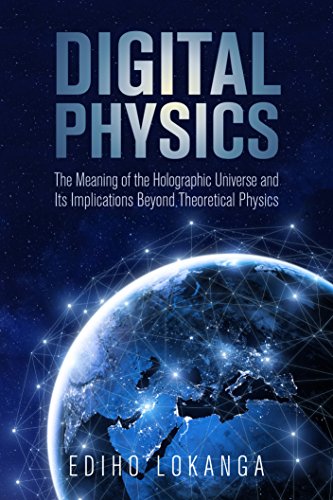
Ebook Info
- Published: 2018
- Number of pages: 207 pages
- Format: PDF
- File Size: 2.75 MB
- Authors: Ediho Lokanga
Description
This book is an impeccably crafted, beautifully written piece of work. It is a powerful treatise that looks at the deeper meaning of the word holography, its association with the universe, and its impact on physics and beyond. In a nutshell, it explores the old conundrum of whether we are living in a holographic universe (HU) and its possible consequences. The author attempts to convey to the wider audience insights emerging from the forefront of theoretical physics research, which are accessible to a broad spectrum of readers, especially those with no training in physics or mathematics. Dr. Lokanga tells us that the holographic model of the universe, teaches us that every individual point in the universe contains the whole universe itself. As a result, every point in space is connected to another point further away in space, and every subatomic particle comprises a web of interconnections by which it becomes intertwined with other parts of the universe. This view opens possible avenues of understanding the universe in a way we never suspected before. The discoveries of non-locality and wave-particle duality suggest that everything in the universe is joined or connected. Most basic atomic particles comprise the very fabric of the material universe.
User’s Reviews
Reviews from Amazon users which were colected at the time this book was published on the website:
⭐Digital Physics discusses the Holographic Universe theory in all its manifestations. A hologram encodes 3 dimensional optical information as a 2 dimensional recording of an wave interference pattern on a holographic plate. The 3 dimensional information is encoded so that the information on the plate is stored “non-locally” or across the entire plate. This means that in a hologram, the whole is contained or encoded within the parts, as well as the parts being contained within the whole. The book outlines how the hologram model has been used for Quantum physics, in the work of David Bohm; for neuroscience, in the work of Karl Pribram and in Quantum Gravity, in the work Leonard Susskind and Gerard ‘t Hooft. The book gives a history of the conceptual development of the theory of gravity from the ancient times, to Isaac Newtown, to Albert Einstein and finally, to speculations that attempt to marry gravity to quantum theory. One hope for me in purchasing this book would be to get an understanding of Eric Verlinde’s Entropic Theory of Gravity, since it is a theory that I have had some difficulty in getting a clear, non-superficial account of. Unfortunately, this book is more of an introduction to various ideas, and does not explore any particular theory to any great depth, so I am only marginally more wiser about the Entropic Theory of Gravity. The book also explores fractal geometry and its relation to the holographic universe theory. This is a short read, and seems to be aimed at readers who may be interested in getting an introductory idea of how some scholars are thinking about the nature of the universe, life, consciousness and information. One technical detail that frustrates me with many of these types of ‘theory of everything’ books is the grab-all term “information.” Although modern physics suggests a close correspondence between Boltzmann Entropy as used in Thermodynamics and Shannon Entropy as used in Information theory. I believe that this loose equivalency between the two types of entropy has led some theorists to lose sight of the fact that information as we understand it in everyday language in not synonymous with how it is used in physics. Leaving aside the fact that Shannon entropy is not information per se, but a measure of information, the more important issue is that the relationship between consciousness and the term information as it is currently used both in physics and in information theory is a long way from being clearly understood.
⭐This is a well written, timely book explaining the intricacies of holography a new paradigm that is emerging as a vital characteristic of quantum mechanics (QM) and the universe itself. The growing theme in physics today is that information is fundamental to the structure and function of the universe. There is also growing support for the idea that the universe is holographic in that every particle is connected to every other particle and consequently everything is an intimately linked web including information. This means that communications between particles everywhere is instantaneous; separateness is an illusion. Wholeness and one-ness are all there is.The concepts of consciousness, spirit, and soul are ideas physics now has to deal with in this new world view of the universe. There is no separation between matter and spirit. The brain is thought to beholographic as well. The mind uses the brain and body to express itself. Consciousness is built from information transmitted to the mind by the holographic universe where it is stored. Further, consciousness creates our external, physical world. The brain stores an incredible amount of information but can draw upon the holographic universe for all information; information is non-local. This all takes place outside spacetime. Each particle in the universe contains all the information in the universe. These little tidbits of information are only the beginning of what this text offers.Wow! Is reality this weird? The whole shebang reads like science fiction, fantasy, and magic rolled into one. The details of all of this are clearly explained in general terms; no math needed. The reader will be spell-bound and awed by this material. This little 131 page book is chock full of incredible cutting-edge science. The ideas expressed in this this gem are supported by theory and empirical evidence. Sources are provided.In summary, this material links the relationships between mind, brain, entropy, holography, consciousness, information, matter, energy, non-locality, gravity, QM, fractals, and the universe; quite an accomplishment for one volume. If you like ideas surrounding QM, holography, and spiritual/consciousness sciences, this book belongs in your library.Rich
⭐This book is a big soup where the author throws in every theory and every paper he knows about. There is no effort to explain any of the theories or to prove his reasoning. From an unexplained theory of the Holographic universe there is a direct jump to the holographic brain: all memories are actually stored outside the human body. (???)I have the impression the author has a very superficial understanding of currently accepted theories.Naming Einstein and other Nobels is not exactly enough to give credibility to new theories and the logic provided by the author is sometimes appalling.For example (p.115): “What we think of as a solid object is merely an illusion, because”…”Our human eyes are designed to see continuous lines even though the objects we see are made up of atoms…”I am undecided what I should make of this: that reality does not exist or that nature was unfair to us by not gifting us with a pair of scanning tunneling microscopes instead of our eyeballs, enabling us to see atoms?Another example: to stress the importance of fractals, (fractals are infinitely complex patterns that are self-similar across different scales) the author asks: “Is it possible to live in a universe without fractals?” p.116Which is like asking if it’s possible to live in a universe without straight lines. Maybe yes or maybe no, but what’s the point of asking? Just accept the fact that straight lines exist.Another thing I find very annoying is the large number of errors throughout the book, making entire sentences meangingless.Where the author gives real proof of incomprehension is on p.109: “Since Einstein’s relativity work, the concept of four dimensions (four-dimensional space-time) has gained acceptance, so that time, for instance, is accepted as the fourth dimension.”This is wrong, wrong, wrong. No one has accepted time as being the fourth dimension.Einstein’s four dimensional space-time is a valid and useful mathematical method for describing physical phenomena. ( To lay bare in simple terms the Author’s fallacy, let’s imagine that I have 5 oranges and that I eat 3 of them. I can mathematically express this by adding 5 and a negative number 3. This does not imply that negative oranges really exist ! It’s a useful mathematical trick. )My final thought is that this book will do you more harm than good if your objective is some kind of better understanding of physical reality.
⭐I have been for quite sometimes looking for a Digital Physics book, when I came across the two newly published books by Ediho Lokanga. I was captivated by the contents of Digital Physics: The Meaning of the Holographic Universe and Its Implications Beyond Theoretical Physics, particularly fascinated by the chapter where he discusses and argues that our brain is similar to a hologram. In addition, I loved the way he combines physics, computer science, biology, and psychology… to come up with a wonderful statement that our universe behaves like a hologram.
⭐I love physics, exactly what i am looking for.
⭐Extraordinary… this book is a must read. Lokanga outlines a new view of physics drawn partly from the world of computers, biology, psychology, holography, and quantum gravity – a fabulous book.
Keywords
Free Download Digital Physics:The Meaning of the Holographic Universe and Its Implications Beyond Theoretical Physics in PDF format
Digital Physics:The Meaning of the Holographic Universe and Its Implications Beyond Theoretical Physics PDF Free Download
Download Digital Physics:The Meaning of the Holographic Universe and Its Implications Beyond Theoretical Physics 2018 PDF Free
Digital Physics:The Meaning of the Holographic Universe and Its Implications Beyond Theoretical Physics 2018 PDF Free Download
Download Digital Physics:The Meaning of the Holographic Universe and Its Implications Beyond Theoretical Physics PDF
Free Download Ebook Digital Physics:The Meaning of the Holographic Universe and Its Implications Beyond Theoretical Physics