

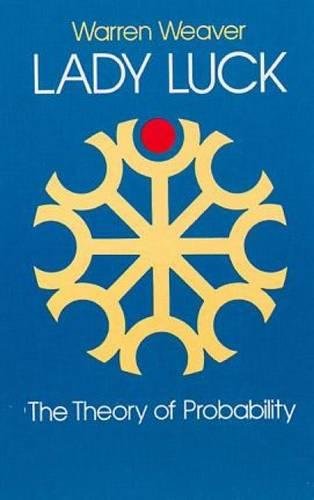
Ebook Info
- Published: 1982
- Number of pages: 400 pages
- Format: PDF
- File Size: 22.34 MB
- Authors: Warren Weaver
Description
Should I take my umbrella? “Should I buy insurance?” “Which horse should I bet on?” Every day ― in business, in love affairs, in forecasting the weather or the stock market questions arise which cannot be answered by a simple “yes” or “no.” Many of these questions involve probability. Probabilistic thinking is as crucially important in ordinary affairs as it is in the most abstruse realms of science. This book is the best nontechnical introduction to probability ever written. Its author, the late Dr. Warren Weaver, was a professor of mathematics, active in the Rockefeller and Sloan foundations , an authority on communications and probability, and distinguished for his work at bridging the gap between science and the average citizen. In accessible language and drawing upon the widely diverse writings of thinkers like Kurt Godel, Susanne K.Langer, and Nicholas Bernoulli, Dr. Weaver explains such concepts as permutations, independent events, mathematical expectation, the law of averages, Chebychev’s theorem, the law of large numbers, and probability distributions. He uses a probabilistic viewpoint to illuminate such matters as rare events and coincidences, and also devotes space to the relations of probability and statistics, gambling, and modern scientific research. Dr. Weaver writes with wit, charm and exceptional clarity. His mathematics is elementary, grasp of the subject profound, and examples fascinating. They are complemented by 49 delightful drawings by Peg Hosford. 13 tables. 49 drawings. Foreword. Index.
User’s Reviews
Editorial Reviews: About the Author Warren Weaver: A Prolific Mind Warren Weaver (1894–1978) was an engineer, mathematician, administrator, public advocate for science, information age visionary, and author or co-author of many books including the one on which his authorial fame mostly rests, his and Claude Shannon’s epoch-making 1949 work, The Mathematical Theory of Communication.A man with a restless intelligence, he also wrote an early seminal work on the theory of machine translation, a unique work on the publishing history of Alice in Wonderland in the many languages into which it has been translated, Alice in Many Tongues, and the book which introduced the Sputnik generation and their followers to the intricacies and enjoyment of the basic concepts of probability, Lady Luck: The Theory of Probability. This book, first published in 1963, has been a fixture on the Dover list since 1982. From the Book:”I say that you may at the moment be almost bored at the prospect of thinking about thinking. But this book is going to introduce you to a special way of thinking, a special brand of reasoning, which, I am confident, you will find not only useful, but fun as well. It will be about a type of thinking that, when stated boldly, seems a little strange. For we often suppose that we think with the purpose of coming to definite and sure conclusions. This book, on the contrary, deals with thinking about uncertainty.” In the Author’s Own Words:”We keep, in science, getting a more and more sophisticated view of our essential ignorance.” — Warren Weaver
Reviews from Amazon users which were colected at the time this book was published on the website:
⭐This is a very good book for learning probability
⭐I did not buy this book as an introduction into probability but because it was recommended to me as an entertaining and very well written book that has a lot of charm.This may be true for the first 150 pages but I had to force myself to keep reading and finally stopped on page 278. I admit that the book has a lot of charm in the early chapters and it makes fun to follow his examples and explanations.However, after a certain time he gets lost in the same kind of examples and details again and again and again. Frankly speaking, all textbooks about statistics and probability that I read like 15 years ago as a student were better written, more precise, would make their point in just a few (clear) sentence, and provide more than just one kind of examples (gambling). Warren, instead, will go on and on and on and finally finish his thought five pages later just to explain that a coin has 2 sides.
⭐This book is an entertaining reading about the history of modern probability theory. I recommend it to everyone interested in learning about history of mathematical knowledge. It goes all the way from ancient Romans up to De Moivre, etc. Its reading is soft and terse since it is intended to the laymen audience. After this book, which is conveniently cheap, I recommend reading Ian Hacking’s “An Emergence of Probability”, which treats the topic in a more formal way than Weaver. Nevertheless, you will enjoy reading Weaver’s exposition. Read it!
⭐This seems aimed perhaps at a bright high-schooler. That’s where I like to start (or sometimes to refresh) my understanding of a subject. It has a really nice pace in setting up all the reasoning on the way to the math side, and plain-language explanations predominate throughout. It took me a lot of poking around to find just this book.
⭐A fantastic brief read! The language of the text should be approachable for a reader of any standing with the material and feels more like a dialogue than a stilted treatise on statistics (which it is not). This should be a required text for any teenager looking for a glimpse into something other than Call of Duty. I am buying another copy for my nephew this spring!
⭐An blend of entertaining prose and hard math on the subject of basic probability including a history of the discipline and some examples of real life applications. Really enjoyed as a probability nerd who hasn’t got a Masters but loves math.
⭐good
⭐Great book, not much to say. It was recommended to me by my statistics professor to better understand probability.
⭐Excellent
⭐An interesting, compelling, empirical, fun read.
Keywords
Free Download Lady Luck: The Theory of Probability (Dover Books on Mathematics) in PDF format
Lady Luck: The Theory of Probability (Dover Books on Mathematics) PDF Free Download
Download Lady Luck: The Theory of Probability (Dover Books on Mathematics) 1982 PDF Free
Lady Luck: The Theory of Probability (Dover Books on Mathematics) 1982 PDF Free Download
Download Lady Luck: The Theory of Probability (Dover Books on Mathematics) PDF
Free Download Ebook Lady Luck: The Theory of Probability (Dover Books on Mathematics)