

Ebook Info
- Published: 2009
- Number of pages: 176 pages
- Format: PDF
- File Size: 2.54 MB
- Authors: Aaron Santos
Description
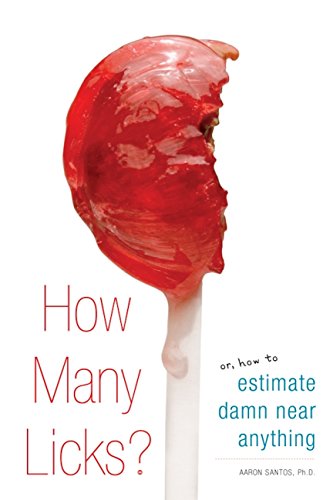
How many licks to the center of a Tootsie Pop? How many people are having sex at this moment? How long would it take a monkey on a typewriter to produce the plays of Shakespeare? For all those questions that keep you up at night, here’s the way to answer them. And the beauty of it is that it’s all approximate! Using Enrico Fermi’s theory of approximation, Santos brings the world of numbers into perspective. For puzzle junkies and trivia fanatics, these 70 word puzzles will show the reader how to take a bit of information, add what they already know, and extrapolate an answer. Santos has done the impossible: make math and the multiple possibilities of numbers fun and informative. Can you really cry a river? Is it possible to dig your way out of jail with just a teaspoon and before your life sentence is up? Taking an academic subject and using it as the prism to view everyday off-the-wall questions as math problems to be solved is a natural step for the lovers of sudoku, cryptograms, word puzzles, and other thought-provoking games.
User’s Reviews
Reviews from Amazon users which were colected at the time this book was published on the website:
⭐Mathematical calculations exist everywhere throughout our daily lives, and experiences from adolescence to adulthood mark subconscious, instinctive techniques to crunch and analyze numbers. The perception of mathematics and numbers in society, however, has skewed our desire and willingness to receive information and analyze it in real terms. As a postdoctoral researcher in Chemical Engineering at Michigan University, Dr. Aaron Santos has produced a novel that removes the tiresome, cumbersome, and negative attitude toward mathematics, throwing the reader a plethora of understandable and thought-provoking statistical problems. The inspiration for his work derives from the famous commercial in the 1980’s where a cartoon boy asks an owl, “How many licks does it take to get the Tootsie Roll center of a Tootsie Pop?” The answer is comical in the commercial, but in reality, truly how many licks would it take for a child to sit down and attempt? Questions like these may seem nonsensical to the statistical purist, but for the average person, Santos’ book shows that you can sit down yourself and enjoy solving application problems – if approached the right way.Approximation is paramount to the critical thinking of developing children (and elders too!), and Dr. Santos clearly shows that reasoning can be tackled as a “fun game” to play with your mind. Totaling 176 pages, the book focuses upon Enrico Fermi’s theoretical approximation through orders of magnitude. This basically means that problems with gigantic scope, such as the number of hair follicles on every citizen of China, can be dwindled down to sensible terms. Santos reminds us that fluid intelligence in a subject is not necessarily required for magnitude problems (although it may help). What is required, however, is the ability to employ simple math, common sense, and back-of-the-envelope guesstimates to find reasonable solutions.The structure and style of Dr. Santos’ novel is straightforward and logical for the 70 mathematical problems. He introduces the question at hand, which are usually entertaining to think about and brings a smile to your face. Next, he references a ballpark estimate that we should anticipate in our final answer, hoping to elicit upper and lower extremes for what a typical reader may generate. Santos challenges readers by his “Ask Yourself This” section of the problem, acting as basic steps to consider and recognize. Some readers will be stumped form the get-go and rely on Santos’ steps heavily, while the more academic individual can skip this section and attempt to delve into the problem on their own. Santos also presents a “Helpful Hints” section that derives useful resources from the Internet as well as everyday texts that individuals can read.After this set-up, the reader is prepared to create a formula, and the author constructs the simplest version of the recipe, outlining variables and defining assumptions to make plugging-in numbers accessible. The author follows this protocol for each and every problem he presents, which is remarkable since the difficulty can progressively fluctuate based on the subject at hand. Nevertheless, every reader can analyze and dissect complicated phenomenon through this book using small steps, assumptions, and ballpark estimates.To offer perspective into the type of problems Santos is tackling, I would like to present some of my favorite head-scratching questions posed by the author. How much food would Spiderman hero Peter Parker have to eat to produce an equivalent amount of web in a day? How sensitive would a shark’s nose have to be in order to detect a drop of blood from one mile away? How many years would it take before the United States finally shares a border with China? How long would it take a monkey on a typewriter to write Hamlet? How many tears would be equivalent to crying in a river? The questions can go on and on if the individual is imaginative enough…Approximations like these seem unreasonable at first and difficult for average readers, but just use common sense! For the Spiderman problem, hypothesize the average length of one web and calculate that for one mile (reasonable distance for Spiderman to travel in one day), and then convert this web length to food through calculating a web’s density, volume, mass and, therefore, pounds. Of course, every estimation problem will force a reader to create his or her list of assumptions, but this is the essence of the book and develops the type of critical thinking that college students, scientists, and other professionals must implement to succeed.While Santos’ book is incredible in scope through its simplicity, I was critical of the fact that he never considered substitute methods for tackling each problem. Each reader views and analyzes their world in different ways, so it would have been entertaining to ponder various solutions based on our approach. The author seemingly presents structure, framework, and assumptions to his problems all on one page, making it appear that this is the “right and only” way to approach the issue. Being a college student, I understand that this is not case, but the everyday reader, especially students who are younger or new to statistics, may be fooled into this mindset. Using approximation is a visceral experience drawn from our experience in everyday life, so it is normal for one student to “underestimate” and the other to “overestimate” a true solution. Santos’ standards for assumptions are, indeed, reasonable and natural, but the statistical guru might find fault in his work for being too narrow-minded in the process.My only other criticism of the book stemmed from the validity of Santos’ conclusions. Some of his calculations make sense in a literal numbers sense but hold weaker credibility in reality. There are tons of variables to consider, and clearly the author “dumbs it down” enough through assumption formation. However, I believe that Santos’ goal in these calculations is not necessarily to present the “realest” means for calculating natural events but rather to show that it is possible.There is a joy and admiration toward solving “geeky” everyday problems, and Dr. Santos permeates this feeling throughout his book. There are limitless possibilities for estimation, which is a testament to Santos for appreciating and relishing the opportunity to practice this discipline through his work. I feel obligated to say that all individuals, no matter their profession, intelligence, or age, should always critically attempt to analyze the world around us. It helps in gaining a personal sense of what we want to achieve and how the natural world aids in this understanding. While these tools are not a direct substitute for true academic knowledge and familiarity, being able to estimate is a skill that can extrapolate meaningful data in a short amount of time.This novel proves that having knowledge and “teaching” knowledge are two entirely distinctive skillsets. Some of the best “experts” in sciences and humanities have extreme difficulty teaching real-world applications toward large lecture classes or one-on-one with students. This does not, in any way, diminish their intellectual capacities or accomplishments… except that they might not be the best professors of their craft. Dr. Santos is a hybrid type of professor, one that incorporates substantial knowledge into a fun approach, translating a student’s understanding of a problem. In a society where education sometimes takes a backseat to other aspects of our culture, I applaud the author for showing mathematics in an intellectual, personal pursuit, one that fulfills our own lives.I give this book a very high recommendation for any reader looking to become more informed in the thrill of crunching everyday numbers to make meaningful conclusions. It encompasses phenomena we constantly wonder about on a daily basis and finds easy solutions in the world around us. Younger students in middle school and high school would definitely benefit more from this book than, say, college graduate students or researchers. Adults and academic professionals should not dismiss this book just because it displays simplicity. This is the type of book every individual wants at their bedside at night before they go to sleep, and buying this book at new price from vendors is an absolute steal. I can only hope that Dr. Santos’ work continues to shine among through his career.
⭐I’m not sure what I was expecting when I ordered this book, but I must admit that the clincher (for me, anyway) was the set of example questions listed on the product description – you have to admit, they were funny and intriguing.Having read the book, I don’t think I’m much better at “estimating damn near anything”. In the first chapter, the book gives you some advice on how to start addressing a question – any question of approximation – and the rest of the book provides many exercises.The gist of advice on approximating anything is: take a guess! How many dirt bike racers are in New York? Well, round up the total population of New York, apply exponential notation, decide on a reasonable maximum and minimum possible number of racers, etc.Of course, there are some questions within the book that require knowledge of specific values, such as the elasticity of rubber, the pull of gravity, and the distance between the Earth and the Moon. For these questions you’ll find the values at the back of the book. For other such values in real life just hope you paid attention in school.There is no secret art in guesstimating anything – either take an educated guess or use some degree of common sense. I was hoping for something new to take away from this book, but found very little.The sample problems presented in the book are great, though, and it has a very good format.
⭐This item has math in it which makes it intrinsically sweet and worth 5 stars by itself, but once I tried it on, that’s when the magic happened. After checking to ensure that the book would properly cover my test, I walked from my trailer to Wal-mart with the book under my arm and was immediately approached by women. The women knew from the math in the book that I, like math, am a mysterious loner who knows how to ‘howl at the moon’ from time to time (if you catch my drift!). The women that approached me wanted to know if I would be their boyfriend and/or give them money for something they called mehth. I told them no, because they didn’t have enough teeth, and frankly a man with a math book shouldn’t settle for the first thing that comes to him.I arrived at Wal-mart, mounted my courtesy-scooter (walking is such a drag!) sitting side saddle so that my math book would show. While I was browsing tube socks, I could hear aroused asthmatic breathing behind me. I turned around to see a slightly sweaty dream in sweatpants and flip-flops standing there. She told me she liked the math in my book, I told her I wanted to howl at her moon. She offered me a swig from her mountain dew, and I drove my scooter, with her shuffling along side out the door and into the rest of our lives. Thank you math book.Pros: Fits my girthy frame, has math in it, attracts womenCons: Only 1 book (could probably use a few more), cannot see math when closed, math would have been better if it glowed in the dark.
⭐Definitely a fun, light read. It is lacking in that I wanted more of the fun math problems, such as, how long would it take 3 grown men to eat the Michelin Tire Man if he were made of marshmallows. I did appreciate the wittiness of the writing, but only gave it 4 stars as it really is an entire book about estimation. It was a little preachy for a book about something with clear, set parameters. I would, however read more if this turned into a series including books about Parabolas (How to keep from approaching an asymptote.) Read it on a plane.
⭐Don’t buy the book for children.
⭐Amazon recommended this book when I selected Doug Hubbard’s ‘How To Measure Anything’. The only common ground is that both books mention Fermi’s famous puzzle about how to calculate the number of piano-tuners in Chicago. Hubbard uses it as an example of his contention that anything can be estimated, and goes on to provide some quite sophisticated methods for doing so. ‘How many Licks’ simply applies the same simple math to a whole string of similar examples. A shallow treatment, perhaps entertaining for young children.
⭐it’s not like your description, after we opened it the front cover is a bit dirty and inside the page turns yellow… We’re quite disappointed.
⭐I have mixed feelings for this book. On the one hand, its cover is self-explaining, i.e. it tells exactly what reader will find inside. And that is good, for it was the reason I bought this book. On the other hand, the book is too short, as is the part which describes the method of approximation (SPOILER ALERT: the major part of the book are text problems which are, in my opinion, too general and too easy).To end on a positive note, this book is quite well written. It is easy and fun to read.
⭐Great guide for FERMI problems. Problems are harder as you reaching end of the book.
⭐This was a very interesting book, incidentally i would have to attribute my recent promotion to some of the techniques i learned inside (if you’re going for an analytical career, you can really impress some people at interviews with these techniques for estimation). I honestly believe that the learning in this book is directly applicable in real life.The book starts off with some quick lessons and gets the ball rolling with some exercises – a very light read in my opinion that’s easy to pick up and let go. (I actually got through most of the book by reading whenever i have to wait for my girlfriend to get ready.)
Keywords
Free Download How Many Licks?: Or, How to Estimate Damn Near Anything in PDF format
How Many Licks?: Or, How to Estimate Damn Near Anything PDF Free Download
Download How Many Licks?: Or, How to Estimate Damn Near Anything 2009 PDF Free
How Many Licks?: Or, How to Estimate Damn Near Anything 2009 PDF Free Download
Download How Many Licks?: Or, How to Estimate Damn Near Anything PDF
Free Download Ebook How Many Licks?: Or, How to Estimate Damn Near Anything