

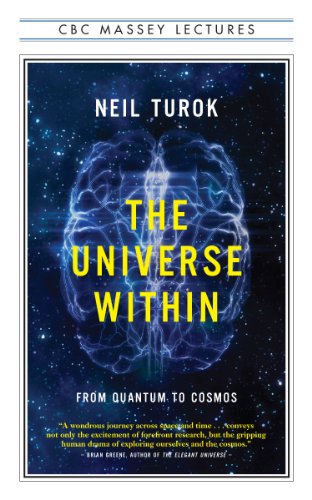
Ebook Info
- Published: 2012
- Number of pages: 306 pages
- Format: PDF
- File Size: 3.93 MB
- Authors: Neil Turok
Description
“With [The Universe Within’s] deeply thoughtful reflections on the place of science in society, on the need to educate the underserved, and on plenty of other topics rarely addressed in this sort of book, Turok takes you where no physicist has gone before. It’s well worth making the journey with him.” — TIME MagazineWinner of the Lane Anderson Award, longlisted for the Charles Taylor Prize, shortlisted for the Libris Award for Non-Fiction and selected as an Amazon.ca Best BookThe most anticipated nonfiction book of the season, this year’s Massey Lectures is a visionary look at the way the human mind can shape the future by world-renowned physicist Neil Turok.Every technology we rely on today was created by the human mind, seeking to understand the universe around us. Scientific knowledge is our most precious possession, and our future will be shaped by the breakthroughs to come.In this personal, visionary, and fascinating work, Neil Turok, Director of the Perimeter Institute for Theoretical Physics, explores the transformative scientific discoveries of the past three centuries — from classical mechanics, to the nature of light, to the bizarre world of the quantum, and the evolution of the cosmos. Each new discovery has, over time, yielded new technologies causing paradigm shifts in the organization of society. Now, he argues, we are on the cusp of another major transformation: the coming quantum revolution that will supplant our current, dissatisfying digital age. Facing this brave new world, Turok calls for creatively re-inventing the way advanced knowledge is developed and shared, and opening access to the vast, untapped pools of intellectual talent in the developing world. Scientific research, training, and outreach are vital to our future economy, as well as powerful forces for peaceful global progress.Elegantly written, deeply provocative, and highly inspirational, The Universe Within is, above all, about the future — of science, of society, of ourselves.
User’s Reviews
Reviews from Amazon users which were colected at the time this book was published on the website:
⭐Turok is a world class theoretical physicist with a great interest in innovative education as well as cosmology. The book is based on a series of lectures, and reflects the wide interests of the author. Many of Turok’s lectures are available on YouTube and I highly recommend listening to them since his lecturing is as good if not better than his writing which is quite good. Turok occasionally goes back in history to give you a more complete understanding of a subject. He gives a brief biography of himself and how it develops his way of thinking and uses this to introduce the Scientific Method. He talks about some of the big experiments being done currently and then develops the history of where some of the ideas started that we are now testing. He goes way back to the Pythagoreans and Egyptians to explain the insights they had. He himself has adopted the philosophy that you don’t have to be responsible for the world that you’re in, that he got from Richard Feynman who in turn picked it up from John Von Neumann.He goes back in history to discuss some of the greats like Newton describing his great creativity in mathematics, his physical intuition and ability to perform critical experiments. Turok then moves to the Age of Enlightenment in Scotland and gives a history of James Clerk Maxwell, and in London the great experimentalist Michael Faraday. Maxwell was a great mathematician with wide ranging interests, while Faraday had superb physical intuition and the ability to design and carry out insightful experiments. The two together did a phenomenal job of explaining electricity and magnetism and laying the groundwork for a major revolutions in industry and improvements in the quality of life for people in industrialized nations.This combination of a great theoretician and one of the best experimenters ever, resulted in the combination of the many laws of electricity and magnetism into a single consistent mechanical framework. Using the best experimental data Maxwell was able to predict the speed of light accurately and determine that it was electromagnetic in nature. This allowed Hendrik Lorentz to see a symmetry between space and time. The resulting Lorentz transformations later helped Einstein develop general relativity. I’ve been immersed in physics and cosmology for decades and find that Turok makes connections among the work of great scientists that are much clearer than most.Action is defined mathematically as the energy multiplied by the time or the momentum times the length. Richard Feynman used the idea of action to propose that the quantum world follows all possible histories (paths) at once with some paths more probable. He uses this idea to explain the ‘double slit’ experiment, that the particle or photon follows both paths to the screen. When you add both paths you get the Schrodinger equation. Turok points out that in solving the Schrodinger equation, that contains imaginary numbers (contain i which is the square root of -1), is an application of the Pythagorean theorem, and squaring expressions that contain imaginary numbers become real numbers and have an application to the world around us.The symmetry concept says if you transform a system by rotating, translating or any other transformation the system should not change. It turns out that a system described in terms of its action that is unchanged by shifts in time, which is true of most physical systems, automatically has its energy conserved. For experiments on the earth both energy and momentum are conserved. The conservation laws are mathematical consequences of the symmetries of space and time and other basic ingredients found in the laws of physics.Despite extraordinary success in predicting the outcomes of experimental measurements produced from the quantum electrodynamics theory, QED, theorists like Paul Dirac felt that the mathematical tricks like normalization, required to keep answers from blowing up to infinity, made the results suspect. He also believed that exploring beautiful mathematics would provide insight into understanding the universe.Cosmologies such as string theory and M theory are discussed and found wanting. Turok also touches on his own theory which sees the start of the universe as just one step in a continuing cycle due possibly to the collision of two M theory membranes. He considers these theories to be powerful tools that can help us understand the universe, but they are incomplete. The number of grand unified theories, GUTS, have proliferated and have become very complex despite not including gravity.Turok notes that a lot of the most innovative work in the 1900’s was done by Jewish scientists like Bohr and Einstein who were newcomers to the field since they had historically been kept out of the field. Turok is doing his part to set up special schools in Africa. Their purpose is to find and train students with great potential, who might otherwise be excluded, to increase the possibility that they will make the next breakthroughs.In the last chapter he switches to quantum computing where he explains that once you get to individual particles like atoms and electrons it is possible to form qubits, quantum bits. They have this property of following all paths at the same time, and can potentially hold a great amount of information. In addition they can be entangled so they communicate essentially instantaneously. Because of the probability factor each cubit has the possibility of storing a very large numbers of bits. Any attempt by an outsider would result in a major change to the data and could be easily detected. Estimates have been made that indicate that present computer encryption systems would be useless against this speed. He sees possible connections in bringing ideas and people closer together world-wide. There are experiments showing that relatively small numbers of electrons can act together as a new type of matter and that there are many new types.In the last chapter he uses the ideas of many people from many different eras to tie together the fantastic breakthroughs science has made with the possible creation of better communication between the scientific world and the world we live in. His hope is that using the many innovations we can create a fairer and even more interesting world in which to live.
⭐This is indeed an excellent book. Neil Turok’s background has been in the areas of mathematical physics and early universe physics, focusing on observational tests of fundamental physics in cosmology. With Stephen Hawking, for example, he developed the so-called “Hawking-Turok Instanton Solutions” which, according to the no-boundary proposal of Hawking and James Hartle, are able to describe the birth of an inflationary universe. And, with Paul Steinhardt at Princeton, he developed a cyclic model for the universe in which the big bang is explained as a collision between two “brane-worlds” in M theory. This model, in turn, was published in 2007 by Steinhardt and Turok as the popular science book, “Endless Universe”. Turok is presently the head of The Perimiter Institue for Advanced Physics in Canada.While not everyone may be able to understand the very depths of Turok’s thinking about physics and the universe, there is little doubt that most will be able to follow his retelling of the history of science as he engages the reader in a cosmological journey that is both clear and fascinating. It is a journey that ultimately focuses on the revolution in physics that resulted from Heisenberg’s “uncertainty principle”, a journey that now involves a host of different theories as to how the universe began and evolved. It is a journey, ultimately, that establishes an inextricable link between the worlds of science and spirituality, a journey, finally, that someone like Richard Dawkins (modernity’s most vocal atheist) could very well learn from.
⭐I really loved this book and am very grateful to Neil Turok for writing it. I have read other books on cosmology and physics meant for the lay person, and they have been great and informative (and mind-blowing!) as well. But, this book does something unique and important that the others don’t — which is to connect the rigor, advancement and passion of science to our human story and our shared future. I thought the book had a poignancy and an insightfulness that one does not often find in a book about physics. I very much appreciated that, and carry away from it a very inspirational and hopeful message, as well as a better understanding of the physics and the history of science that underpins it all. I would highly recommend it to anyone with an interest in theoretical physics and in humanity’s place in nature.Here is a great interview with Neil Turok from 2012, which kicks off the Massey Lectures:https://www.youtube.com/watch?v=IhtkOSBAEyA
⭐This is really compilation of Turok’s lectures. Nonetheless, a worthwhile read even for the mathematically challenged. As an analogue creature, it leaves me with a sense of unease that I am dealing with quantum future which is largely counterintuitive – at least to my limited intuition. I need to live another 50 years to catch up with the digital.The interpreters and communicators of the new physics have a job in front of them – or is it behind them. I am not so sure any more.
⭐Written for the Layman, succeeds extremely well. I learned so much about the sub-particles in Quantum Mechanics that I just couldn’t understand in most of the books for the higher educated. The confirmation of the Higgs Boson was something I’ve been waiting on for many years. A Unified Field theory will not be far off. This will change our lives and our future much as the discovery of the Electron led to entire Industries such as Electric Power and then Electronics.
⭐The sections of this book outlining the turbulent early life of the author and his subsequent efforts to promote Science and Mathematics in the African continent ARE inspiring. I also found the end chapter stimulating and far reaching as befits the thoughts of, arguably, the most eminent Cosmologist of today. I do however have reservations concerning the ‘meat’ of the book as I think very very few people will gain any understanding of the concepts Turok attempts to outline here – in fact, he acknowledges as such on p 210 ” (in the post Planck era)… we had to give up any notion of being able to picture things as they really are….ideas had to be replaced with a more abstract all-encompassing theory which reduced our capacity to know or visualise reality”. This is ably demonstrated in his ‘explanation’ of “The World in an Equation”! I do also feel he sprinkles the text with puzzling terms (e.g. ‘vacuum energy’s gravity’) and over stretches himself at times trying to connect early concrete concepts with today’s modern ideas (Unless you are already familiar with Argand diagrams in mathematics, the connection between Pythagoras and Complex Numbers,(p168), will escape you).I note that the glowing reviews of this book on the dust cover are all courtesy of high flying academics but I just think that the average non-academic but scientifically interested reader will get little out of this work. Sorry
⭐I really enjoyed reading this. It’s not just a “straight” popular book on physics – there are loads of such books. This takes a wider perspective and includes interesting sections on how humans through the ages have tried to address fundamental issues in philosophy and science.There is very little mathematics in the book so you don’t need to be put off if doing sums isn’t your cup of tea. What shines through is the author’s fascination with the universe and how physics can explain so much of what we see and experience. I suspect if you have no background at all in science you will find some of the sections a little tough to understand, but not impossible if you persevere.It’s not often that someone who is brilliant at physics/maths also has the skills to communicate both their enthusiasm and knowledge to the general public in ways that are understandable and entertaining. Neil Turok has managed to do all this.
⭐Another excellent book on the subject of the history of the universe and the amazing ability of mankind to make sense of it all.
⭐Wonderful book…takes you from the beginning of modern science to the latest ideas in cosmology..
⭐Neil has a way of summarizing the science and society. I like it so much I might buy a few more copies to give out
Keywords
Free Download The Universe Within: From Quantum to Cosmos (The CBC Massey Lectures) in PDF format
The Universe Within: From Quantum to Cosmos (The CBC Massey Lectures) PDF Free Download
Download The Universe Within: From Quantum to Cosmos (The CBC Massey Lectures) 2012 PDF Free
The Universe Within: From Quantum to Cosmos (The CBC Massey Lectures) 2012 PDF Free Download
Download The Universe Within: From Quantum to Cosmos (The CBC Massey Lectures) PDF
Free Download Ebook The Universe Within: From Quantum to Cosmos (The CBC Massey Lectures)