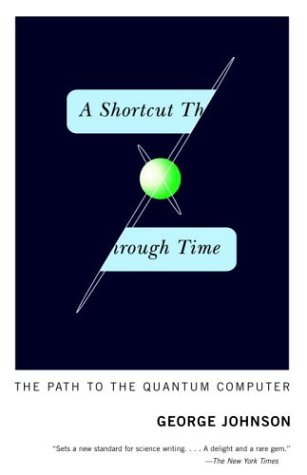
Ebook Info
- Published: 2007
- Number of pages: 226 pages
- Format: PDF
- File Size: 7.19 MB
- Authors: George Johnson
Description
In this remarkably illustrative and thoroughly accessible look at one of the most intriguing frontiers in science and computers, award-winning New York Times writer George Johnson reveals the fascinating world of quantum computing—the holy grail of super computers where the computing power of single atoms is harnassed to create machines capable of almost unimaginable calculations in the blink of an eye.As computer chips continue to shrink in size, scientists anticipate the end of the road: A computer in which each switch is comprised of a single atom. Such a device would operate under a different set of physical laws: The laws of quantum mechanics. Johnson gently leads the curious outsider through the surprisingly simple ideas needed to understand this dream, discussing the current state of the revolution, and ultimately assessing the awesome power these machines could have to change our world.
User’s Reviews
Reviews from Amazon users which were colected at the time this book was published on the website:
⭐Great book, I’m almost done but just thought I would write this review now. The book is great, I wanted to learn a little more about the idea of quantum computing and never had luck in finding a good book to get. Came across the preview for this book and they said it was an excellent book for people with little knowledge of quantum computers. Thats exactly what this book is for, people with little or knowledge before hand of what quantum computer is all about. The writer drills and drills in your head of what it is, he includes several diagrams as well to help you understand. If your looking for something that is super in depth and is really technicle in nature, the book isn’t for you. At least I don’t think it is. But a great book for people who just want to get the fundamentals of understanding quantum computing then you this book is for you!
⭐Even though Richard Feynman once quipped, “…nobody understands quantum mechanics,” I was still hoping to come away with a better understanding of quantum computing than Johnson provides. The author spends too much time covering the general principles of computing and not enough time on quantum computing. Specifically, he beats the reader over the head with the rather clear concept of the Turing machine. He forays into the tinkertoy computer — an interesting historical curiosity, to be sure — but does not make clear how the tinkertoy computer relates to quantum computing, other than that it is an example of a Turing machine, and does not even explain the tinkertoy machine well enough to get a clear idea of its functioning. Much the same is true for the simple Geniac switch, love of his childhood, which occupies an unseemly number of pages. At the same time, quantum computing is not covered precisely enough for the reader to digest and express the gist of it.What is interesting to the computer programmer is a) how the program is loaded, b) how processing is accomplished, and c) how the output is read. We can set an initial state by shining a laser on a bunch of particles (Johnson pretty much leaves it at that). The problem here is that setting the initial state of a program is not the same as loading the program itself, in other words, somewhere there must be a distinction between loading code and loading data, as well as code operating on data. It seemed to me that Johnson skirts the issue by ignoring this distinction and leaving the processing “black-box” to the collapse of probability waves of entangled particles whose initial state was set by a laser. The probability waves’ collapse — by what mechanism we never find out — is somehow controlled by a poorly explained mathematical theory that normally governs the behavior of cellular automata. On the other hand, if code and data are one and the same, then it seems at first blush that the output should deterministically be known at the start, or that the output would be no more helpful than the input.My feeling persists, however unfair, that science writing should be left to the rare scientists in each field who possess the pedagogic and literary skill to explain their work to a lay audience, and not left to science journalists. Throughout the text, I kept waiting for that spark that synthesizes the concepts into some feeling of real comprehension, but never got it. Perhaps, given Feynman’s assessment of quantum mechanics, that elusive spark is impossible — especially for a popular science book. On the other hand, maybe it is and “A Shortcut Through Time” isn’t it.
⭐”A Shortcut Through Time” is a well-written introduction to the complex topic of quantum computing. Quantum computing, in a general sense, is the utilization of various quantum mechanical phenomenon, such as entanglement, for the benefit of a powerful computer, or data processing engine.In a more basic sense, this is a book about the potential for computing devices that operate at the atomic level. This engaging and well-written book is, in various parts, a historical overview of computing, a vivid description of quantum mechanics and an exposition of the potential for quantum computing.While written for a general audience, several advanced topics are covered in a unique manner, such as a good description of “NP-complete” (Nodeterministic Polynomial-time) problems.Highly recommended for those with an interest in learning more about the potential for a new approach to computing.
⭐Quantum computing is one of those things that is almost impossible to explain to someone who doesn’t already have a good understanding of both quantum physics and computational theory- and yet Johnson manages to present a beautiful, elegant explanation without resorting to the typical hand-waving and metaphor that characterizes most popular books on modern physics. He explains, in clear and precise language, (1) why it is that quantum uncertainty makes powerful computing possible; (2) the nature of computationally difficult problems (i.e., those solvable in exponential time and those that are not NP-complete) (3) the physics involved in the physical realization of quantum computing, and (4) Shor’s algorithm and other algorithms used in quantum computing. A beautiful, precise, and fascinating book.
⭐Though it isn’t up to date technologically, this relatively short book contains crystal clear explanations of subjects like entanglement, wave functions, quantum cryptography and the like, all carefully spelled out in a way that a focused reader can grasp without math formulas. An excellent example of relatively complex science for the non-scientist.
⭐A truly remarkable book! Reading this, I finally understand WHY quantum computation would be so different!(Problems that scale exponentially in the classical domain can scale linearly in the quantum world.)Even more amazing, all this is accessible for a non-technical audience, with analogies, examples and illustrations.If you’ve ever wondered what all the hoopla is about, read this and find out.
⭐fascinating read
⭐A deep subject for my shallow mind. I don’t have thirteen more words to say here. Let me oyt of thisbox.
⭐I brought this book after a series of events led to a PhD quantum physicist moving into my student flat. It gives a good overview into the theory and relevance of quantum computers. Well written for a beginner, but it focuses on molecular based computers, rather than the optical systems my PhD to be works on. Nevertheless, it’s helped break the language barrier, and make a whole subsection of Wikipedia semi understandable to me.
⭐I bought this book to get some understanding of quantum computing. It explains things in a very simple way. It is geared to a lay person interested in what all the fuss is about in quantum computing. Very helpful.
⭐~量子計算も話題になって、10年近くたった。ようやく、ここ数年、学部向けの教科書や、雑誌などで一般向けの解説がチラホラ出てきている。本書は、ニューヨークタイムズの科学欄などを書いているJohnsonによるもので、手頃なページ数で、うまく説明していると思えた。チューリングマシンと量子状態という二つの難しい原理を説明しなければならないので、日本人~~の専門家が一般向けに解説しているものは、誇張されていたり、話題が散漫になっているものがあるなど、取り付きにくい。また、日本人の科学解説者で、きちんと理解して解説されてる本が見当たらないので、本書の訳が出るといいと思う。~
⭐
Keywords
Free Download A Shortcut Through Time: The Path to the Quantum Computer in PDF format
A Shortcut Through Time: The Path to the Quantum Computer PDF Free Download
Download A Shortcut Through Time: The Path to the Quantum Computer 2007 PDF Free
A Shortcut Through Time: The Path to the Quantum Computer 2007 PDF Free Download
Download A Shortcut Through Time: The Path to the Quantum Computer PDF
Free Download Ebook A Shortcut Through Time: The Path to the Quantum Computer