Ebook Info
- Published: 2001
- Number of pages: 224 pages
- Format: PDF
- File Size: 3.50 MB
- Authors: Craig F. Bohren
Description
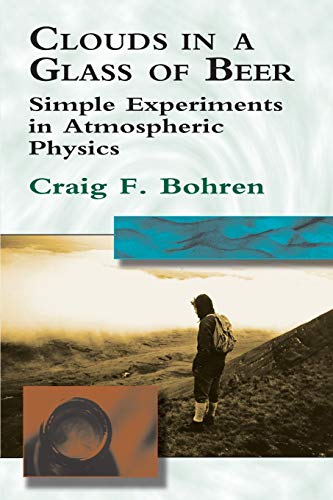
Ever wonder why steam rises from a bowl of hot soup or why a greenhouse retains heat? And have you ever puzzled over the real meaning of “once in a blue moon” or why sand is darker when it’s wet than when it’s dry? And just why, exactly, do bubbles appear in a glass of beer when you add salt to it?These and many other baffling questions are answered in this engaging book by a physics professor at Pennsylvania State University. Ranging from playful to serious, Professor Bohren’s lively and entertaining discussions employ a liberal mixture of humor and anecdote to debunk a host of scientific myths and render science lessons thoroughly understandable. Chapters include “On a Clear Day You Can’t See Forever,” “A Murder in Ceylon.” “The Green Flash,” “Physics on a Manure Heap,” ” Indoor Rainbows,” and “Multiple Scattering at the Breakfast Table.””The book rings with a unifying tone: the science of the everyday physical world is fun. And so is the book,” writes Jearl Walker, a member of the Physics Department at Cleveland State University. Beginning physics and general readers will be fascinated by the scientific knowledge gained from this work; and science teachers will find it a treasure trove of ideas for simple, vivid classroom demonstrations.
User’s Reviews
Reviews from Amazon users which were colected at the time this book was published on the website:
⭐This is not a chummy kitchen science experiment book. The science is serious and some principles obtuse. I studied this sort of thing in college and found some of it tough going, though I do think I came away with a lucid understanding for the effort.The author rambles a bit, mixing exposition and reminisces. This is not a terrible thing, but may not be what you expect. Some of the experiments are elegant and clever, and impressed my 6 year-old considerably. The author’s bent is towards optical phenomena, such as why the sky is blue, more than the meteorological, though there’s plenty in there.A fun and interesting book in a conversational and sometimes amusing format. And yes, I finally can explain why the sky is blue.
⭐Clouds in a bottle of beer was an eye-opening exposure to the physics, and some say chemistry, that creates so many exquisite natural phenomenon in the atmosphere. You will learn what creates sun-dogs, moon circles and even about specters. These specters are not exactly ghosts but they’re as close as the average person will get to seeing them. This book is more complex than a simple question and answer work on “why does [blank] happen?”If you have a passion outdoor photography, this is a must-read. After reading this book, you will be able to guess, predict and explain many more of your photographs than you had before. Even as an engineer, there was much I gleaned from Bohren’s work. It’s a quick and entertaining read and well worth the time. This book was originally suggested by Galen Rowell and I heartily second his recommendation.
⭐I’m pretty disappointed to be buying a “new” book and receive it with a hole in the back of it.
⭐My husband is a student meteorologist and interested in atmospheric physics; this book is written simply enough that it is enjoyable to read and understandable even to a layman like myself, while sharing enough scientific detail that my husband enjoyed it. While you could conduct your own experiments with this book, the experiments are explained as if the author is telling an interesting story and always followed by a scientific explanation about how the prior example relates to atmospheric physics. It’s really not necessary to recreate the experiments yourself, unless you want to.I thought it was an enjoyable book that sought to make the reader more curious and interested in atmospheric physics through examples and topics we could relate to. Nice gift for a scientifically inclined person, at a reasonable price.
⭐This is a terrible book with an attractive title. It i a collection of inexpensive experiments to teach atmospheric physics 1.01. The author was happy to publish his lectures notes: that can certainly be useful to another teacher, but it does not make a book. For instance, the book is made of a series of experiments: it is not organized by concepts and the concepts are not explained. It is not a book. You can find hundreds of such experiments for free on the internet, many of them on Youtube.
⭐Craig Bohren’s explainations are not only accurate but clear and easy to read. His writing is entertaining and inspires one to perform the experiments themselves. Great reading for those with no science background at all to PhD’s in physics.
⭐Clouds in a Glass of Beer is not a book for everyone. If you do not have a vast understanding of atmospheric science and physics, you will not enjoy reading this book. In essence, this book is 22 different experiments with an explanation on how each experiment works. If you do find enjoyment in reading about the atmosphere, however, you will enjoy this book. The first experiment is, as you probably guessed, why clouds form in a glass of beer when salt is added. The passage goes on to explain why and how the clouds form, why a cloud comes out of a freshly opened bottle of beer, and the behavior of the bubbles. It is interesting to see all of the scientific forces behind this action, even though it may become hard to understand at times. The next experiment is how to make a cloud form in a bottle. This is done by filling the bottom with water and a tube, sucking a little bit of the air out through the tube, letting some smoke in, blowing air into the jar, putting your finger on the end and releasing it quickly. If the bottle is painted black, the cloud should be easier to see. One experiment I found very entertaining was how to keep fog from forming on a mirror. It consisted of smearing an extremely small amount of dish washing detergent on the glass and trying to fog the mirror to proved that it worked. The soap forces all the fog droplets to create a thin layer of water. Many of the experiments in this book are quite interesting. This book answers why a rainbow could form in the winter, the requirements for a blue moon, and why you can’t see forever on a clear day. If you have a great understanding of science, this book will, without a doubt, amuse you.
⭐This book was recommended for my atmospheric physics course, as it often provides an alternative,simple view on what can be tricky topics. It is easy to pick up and put down, and can be read in sections. It also appeals to an audience ranging from teenagers to graduates, though teenagers may find it slightly hard going as some of the topics can get complicated, and often provides a more hands-on approach to what can be abstract ideas.Excellent book for it’s price, even if you only dip into it once.
⭐Bought as a gift for a future meteorologist. Taken off to university.
⭐I love physics experiments that can be done int he kitchen, the home, or the out of doors. I was hoping this book might be a useful addition to that genre. Sorry, it didn’t make the cut. It’s full of experiments the author conducted, but unfortunately they’re not amenable to kitchen table demonstration. I quit reading it before I had competed it.
⭐Penso che sia uno dei libri divulgativi che preferisco, non è troppo facile, ma è scritto molto bene. Ti riesce a trasmettere una nuova visione dei fenomeni di tutti i giorni. E’ incredibile quante domande non ci facciamo: perché molte volte esce una piccola “nube” dalle bottiglie di birra appena stappate? Perchè la sabbia bagnata è più scura rispetto a quella asciutta… Un calssico libro di divulgazione avrebbe evitato i dati e i grafici invece questo li fornisce e gli spiega esaustivamente. Assolutamente da leggere!
⭐
⭐Des expériences simples pour répondre à des questions simples, c’est précieux parce que la physique ce n’est pas forcément simple. L’expérience qui fait le titre du livre est particulièrement intéressante parce qu’il y a beaucoup d’idées préconçues sur la vapeur d’eau dans l’air et sur la formation des nuages. Le livre me semble utile pour enseigner parce qu’on passe par-dessus les équations pour s’intéresser à “ce qui se passe”.
⭐
Keywords
Free Download Clouds in a Glass of Beer: Simple Experiments in Atmospheric Physics in PDF format
Clouds in a Glass of Beer: Simple Experiments in Atmospheric Physics PDF Free Download
Download Clouds in a Glass of Beer: Simple Experiments in Atmospheric Physics 2001 PDF Free
Clouds in a Glass of Beer: Simple Experiments in Atmospheric Physics 2001 PDF Free Download
Download Clouds in a Glass of Beer: Simple Experiments in Atmospheric Physics PDF
Free Download Ebook Clouds in a Glass of Beer: Simple Experiments in Atmospheric Physics