Ebook Info
- Published: 2010
- Number of pages: 352 pages
- Format: PDF
- File Size: 2.78 MB
- Authors: Ian Stewart
Description
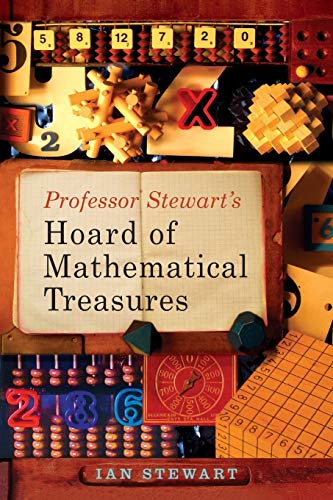
Opening another drawer in his Cabinet of Curiosities, renowned mathematics professor Ian Stewart presents a new medley of games, paradoxes, and riddles in Professor Stewart’s Hoard of Mathematical Treasures. With wit and aplomb, Stewart mingles casual puzzles with grander forays into ancient and modern mathematical thought. Amongst a host of arcane and astonishing facts about every kind of number from irrational and imaginary to complex and cuneiform, we learn: How to organize chaosHow matter balances anti-matterHow to turn a sphere inside out (without creasing it) How to calculate pi by observing the stars . . . and why you can’t comb a hairy ball. Along the way Stewart offers the reader tantalizing glimpses of the mathematics underlying life and the universe. Mind-stretching, enlightening, and endlessly amusing, Professor Stewart’s Hoard of Mathematical Treasures will stimulate, delight, and enthrall.
User’s Reviews
Editorial Reviews: From Booklist Stuffed with puzzles, jokes, word problems, puns, and history and lore about math, this sequel to Professor Stewart’s Cabinet of Mathematical Curiosities (2009) reads like a numbers guy performing stand-up comedy (“A piece of a string walked into a bar . . .”). An old hand at the routine, Stewart’s contention that his compendium can entertain anyone with math-class memories is amply borne out, and his ability to surprise is one reason. One never knows what’s next: a proof that two plus two indeed equals four jostles with a spoof of proof itself. To keep readers on their toes, or at least flipping back to his “superlative storehouse of sneaky solutions,” Stewart flummoxes them with bizarre propositions, such as two plus two actually equals zero—when you’re doing modular arithmetic. Speaking of equality, the equal sign makes for a go-to topic for amusing vignettes, while stories about math underlying modern technology underscore the serious side of a subject with which Stewart makes such good sport. A great distraction for math mavens at any knowledge level. –Gilbert Taylor About the Author Ian Stewart is emeritus professor of mathematics at the University of Warwick. His recent books include Calculating the Cosmos, Significant Figures, In Pursuit of the Unknown, and Professor Stewart’s Hoard of Mathematical Treasures. He is a fellow of the Royal Society. He lives in Coventry, UK.
Reviews from Amazon users which were colected at the time this book was published on the website:
⭐A few months ago I saw the book “Prof Stewart’s cabinet…” in a book store. Only the price kept me from buying it then (thinking I would get it cheaper through Amazon). A few days later, at Amazon’s, I found this 2nd book (which was even cheaper ‘used’), so I decided to buy this 2nd book of “Prof Stewart” first. And indeed it was first class, money worth! Ian Stewart writes in a clear and attractive way, you would not expect from a professional mathematician. Fun with all kinds of different math problems and games, not just the ‘useless’ (but mind-triggering) stuff, but with many problems a link to ‘real math’ is given as well. Hyperlinks to sites with more information make it really complete.I am still reading the book (as many topics tease me to do further ‘research’ myself, I proceed only slowly), but it is really great fun for all who like math puzzles and the like. My kids now do find me a real math geek even more – though I am not (I think…) – but the book surely will get a prominent place on my bookshelves. If I will finish the book, I might buy some other books of Ian Stewart as well.
⭐The book was just what I wanted and expected. Good solid puzzles and articles that have certainly challenged by 70-year-old brain. No I did not “get” them all, some are a bit beyond me, so far, and I shall go through the book again, I hope. This is not just arithmetic, not just numerological curiosities; it has taken me into some mathy areas I didn’t get in high school. Yeay.
⭐I am a Jr. High math teacher and this book has come in handy NUMEROUS times. I’m sure like every other classroom, I have some students that are very low when it comes to math and I have some students that challenge me everyday with questions! This book is full of obscure math problems and “tid-bits” that appeal and will catch the interest of any math student (and teacher). Well worth the purchase!
⭐I thought this was for the every day reader, but everything is a tricky math problem. He presents how someone did something, then challenges you to figure it out. I thought it was a fact-filled reader, not a problem book.
⭐I like Stewart’s work. Nice short, easy to digest pieces of interesting mathematics.
⭐interesting to read, and full of ideas
⭐…though if you enjoy math, and math puzzles, you’ll have a lot of fun.Really excellent book–a nice blend of puzzles, mathematical trivia and interesting stories, as well as current research. Highly recommended.
⭐As expected.
⭐Ian Stewart is a professor of mathematics and over the years he has kept bits of notes on mathematical curiosities, puzzles, facts, stories he has come across. This book is a publication of some of those little treasures. This book carries on from his earlier Cabinet of Mathematical Curiosities which had a different collection of curiosities.There are about 150 topics in all, some run to many pages such as the development of the abacus, others are short and to the point. Some puzzles I could solve fairly quickly others remained baffling. I guess it is just down to whether you see a method to solve it straight away or you just flail around. But that is the enjoyment of puzzle solving.You will find a story about Newton’s cats (not that interesting) alongside a logic puzzle about swallowing elephants (quite interesting). And that is the nature of this book, each reader will find a different mix of things to enjoy.The stories and puzzles cover a huge range of topics including number theory, topology, mathematical tricks, cryptography, cosmology.It is a fine book to just dip into, as each item has nothing to do with the others.Professor Stewart does provide outline answers to most of the puzzles although even understanding some of the methods used at times is a challenge in itself!I enjoyed this book and came away from the book with a few extra party tricks to try out with friends and family along with a collection of ‘did you know’ stories (did you know that the = sign was developed by a Welshman in 1557!)Highly recommended for anyone who likes intellectual puzzles or learning interesting snippets of information.
⭐Having bought this after Ian Stewart’s companion book “Cabinet of Mathematical Curiosities” this one was, for me, aslightly less gripping. Nevertheless I’m glad to have got it as there’s plenty in it to my taste.
⭐A must read for anyone interested in mathematics, from young enthusiast to seasoned professional. Professor Stewart, these are treasures indeed. It should be noted that there are many references to the Cabinet of Methematical Curiosities (another brilliant book), so it might be worth buying them as a pair.
⭐Ian Stewart is terrific. As a maths teacher I have used this book to develop some interesting angles from which to extend or introduce a new topic. I’m not sure if everybody could access the book as it does include explanations needing A level maths undstanding.A great book.
⭐Just reading this makes me smarter. It contained knowledge that I didn’t know! 5 stars
Keywords
Free Download Professor Stewart’s Hoard of Mathematical Treasures in PDF format
Professor Stewart’s Hoard of Mathematical Treasures PDF Free Download
Download Professor Stewart’s Hoard of Mathematical Treasures 2010 PDF Free
Professor Stewart’s Hoard of Mathematical Treasures 2010 PDF Free Download
Download Professor Stewart’s Hoard of Mathematical Treasures PDF
Free Download Ebook Professor Stewart’s Hoard of Mathematical Treasures