

Ebook Info
- Published: 2017
- Number of pages: 480 pages
- Format: PDF
- File Size: 15.47 MB
- Authors: David N. Schwartz
Description
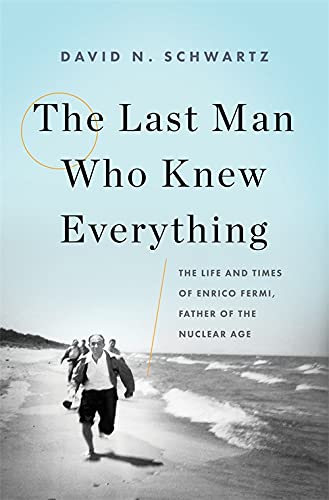
The definitive biography of the brilliant, charismatic, and very human physicist and innovator Enrico Fermi In 1942, a team at the University of Chicago achieved what no one had before: a nuclear chain reaction. At the forefront of this breakthrough stood Enrico Fermi. Straddling the ages of classical physics and quantum mechanics, equally at ease with theory and experiment, Fermi truly was the last man who knew everything — at least about physics. But he was also a complex figure who was a part of both the Italian Fascist Party and the Manhattan Project, and a less-than-ideal father and husband who nevertheless remained one of history’s greatest mentors. Based on new archival material and exclusive interviews, The Last Man Who Knew Everything lays bare the enigmatic life of a colossus of twentieth century physics.
User’s Reviews
Editorial Reviews: Review “Mr. Schwartz deftly conveys the aesthetic beauty of Fermi’s insights without getting mired in their minutiae.”―Economist “There have been other accounts of his life, yet David N. Schwartz’s new portrait, The Last Man Who Knew Everything, is the first thorough biography to be published since Fermi’s death 64 years ago in 1954. Schwartz, working with limited sources, tells the story well…[His] biography adds importantly to the literature of the utterly remarkable men and women who opened up nuclear physics to the world.”―New York Times Book Review “[Schwartz] does an admirable job of explaining the science and provides careful assessments of Fermi’s influence… [and illuminates] the human effects of a project that was so urgent yet so terrible in its long-term implications.”―Foreign Affairs “Schwartz’s The Last Man Who Knew Everything offers the most comprehensive description of Fermi’s work so far, as well as fresh insights into his personality.”―Nature”The Last Man Who Knew Everything manages the neat double trick of making both Fermi and his abstruse work accessible to readers living in the world he did so much to create, for good and ill.”―Christian Science Monitor”An informative and fun read, rich in those anecdotes and tales that…help to elucidate what was driving the work of the giant that Fermi was…. The more mundane aspects of Fermi’s life–his fears, vanities and human errors, emerge…from these pages.”―Physics World”David Schwartz’s elegant narrative is a formidable achievement, shining a bright light on Enrico Fermi, the most enigmatic physicist of the early atomic era. Schwartz has exhausted the archives and crafted what will certainly stand as the most deeply biographical account of this brilliant scientist’s tragically short life.” ―Kai Bird, Pulitzer Prize-winning biographer and co-author with Martin J. Sherwin of American Prometheus: The Triumph and Tragedy of J. Robert Oppenheimer”It is testimony to David N. Schwartz’s excellence as a biographer that he can reveal the workaholic Fermi to have been such a fascinatingly complex figure… [Schwartz] excels in a portrayal that is balanced and nuanced, sympathetic but unflinching.”―The Spectator (UK)”A lucid writer who has done his homework, Schwartz…delivers a thoroughly enjoyable, impressively researched account…Never a media darling like Einstein or Oppenheimer, Enrico Fermi (1901-1954) is now barely known to the public, but few scientists would deny that he was among the most brilliant physicists of his century…A rewarding, expert biography of a giant of the golden age of physics.”―Kirkus”Told in a sure, steady voice, Schwartz’s book delivers a scrupulously researched and lovingly crafted portrait of the ‘greatest Italian scientist since Galileo.'”―Publishers Weekly”In this compelling new biography, Schwartz makes clear how little lay beyond the reach of this scientific polymath…. A sophisticated portrayal of a complex man.”―Booklist”No physicist has more concepts and places named after him than Enrico Fermi, and for good reason. A central figure in so much of twentieth-century physics, Fermi was renowned for his imagination, his brilliance, and his style. This comprehensive biography is a treasure trove of detail and revealing insight into a unique scientific figure.” ―Sean Carroll, author of The Big Picture: On the Origins of Life, Meaning, and the Universe Itself”A tremendous book, fascinating and clear. I now know Enrico Fermi as well as anyone could today. Schwartz writes with a joy and passion for the subject and genuine interest in the man that shines through. There are great scientists working today on AI and gene-editing, exploring ‘multi-verse’ theories, searching for ‘Goldilocks’ planets, and developing new means of powering space travel. I hope they will someday have a biographer and chronicler as talented as Schwartz to tell their story.”―Richard A. Clarke, author of Against All Enemies, Cyber War, and Warnings”One of the finest biographies of the year, The Last Man Who Knew Everything combines the historic, the scientific and the personal in a deft and effortless way. Enrico Fermi was easily one of the most fascinating human beings of the 20th century, a man whose intellectual brilliance was trapped inside an all-too-human shell. The result, in David Schwartz’s able interpretation, is nothing short of spellbinding.”―Gary Shteyngart, author of Little Failure and Super Sad True Love Story”In this compelling and well-researched biography, David Schwartz reveals both triumph and tragedy in the life and work of Enrico Fermi, one of the greatest and hitherto most enigmatic scientists of the 20th century.”―Frank Close, professor of physics at Oxford and author of Neutrino and Half-Life”David Schwartz has written a highly-readable account of an undervalued figure in the making of the atomic age—one that puts Enrico Fermi in the proper historical context.”―Gregg Herken, author of Brotherhood of the Bomb”Enrico Fermi was part of a great brain drain pre-WWII from Axis nations, when ideology overwhelmed the search for truth and even self-interest. We don’t want to happen in America. Despite what you might think from the title, The Last Man Who Knew Everything, this amazing book by David Schwartz is brimming with anecdotes in which Enrico Fermi is not the smartest guy in the room. He is focused on family, colleagues and meaning. David really puts us intimately at the table for the historic atomic revolution. This humanization of geniuses and forging public engagement in complex science is crucial today as we become ever more dependent on technological leadership. As fresh and riveting a biography as any you will find.” ―George Church, author of Regenesis”Enrico Fermi was a singular figure of modern science, and David Schwartz has written a singular biography. His book is unusually adept and nuanced in its appreciation and explanation of both the scientific and humanistic aspects of its subject. It is also a joy to read, as Schwartz has a beautiful authorial voice that is perfectly appropriate for his subject matter: appreciative and sympathetic, without falling into the hyperbolic or uncritical. It is a rare book that will please both the experts and the novices, but I think this is such a rare book.” ―Alex Wellerstein, assistant professor at the Stevens Institute of Technology and author of Restricted Data: The Nuclear Secrecy Blog About the Author David N. Schwartz holds a PhD in political science from MIT and is the author of two previous books. He has worked at the State Department Bureau of Politico-Military Affairs, and at Goldman Sachs in a variety of roles in both London and New York. He lives in New York with his wife, Susan. His father, Melvin Schwartz, shared the Nobel Prize for Physics in 1988.
Reviews from Amazon users which were colected at the time this book was published on the website:
⭐Review of Schwartz’ “The last man who knew everything” by Paul F. Ross Enrico Fermi is presented by biographer David N. Schwartz as the last man who knew all there was to know about physics. It is a fascinating account full of the admiration that biographers often have for their subjects. The story has some extraordinary turns … Fermi traveling with his wife from Fascist Italy to Norway in December 1938 to receive the Nobel prize in physics, traveling to New York via London in the next two weeks to escape the__________________________________________________________________________________________Schwartz, David N. “The last man who knew everything: The life and times of Enrico Fermi, father of the nuclear age” 2017, Basic Books, New York NY, xxiii + 453 pages__________________________________________________________________________________________Italian government he disrespected, and learning from his physics colleagues – on arrival in New York – that the findings for which he had just received the Nobel prize were wrong! Fermi’s findings had just been surpassed. This reader was held in continuing attention from the time of Fermi’s earliest work in radioactive decay in Rome through the time of the delivery of the US atomic weapons in Hiroshima and Nagasaki. All the rest of Fermi’s life was important, of course, but this part of the story is gripping. Jeremy Bernstein’s review of the biography (WSJ, 16-17 December 2017, p C15) prompted me to buy the book. A later review in The Economist was equally praise-filled. Before reading this account, I knew of Einstein’s letter to President Roosevelt in August 1939 that urged that nuclear research in development of a nuclear bomb be undertaken immediately by the US, with energy, since the Germans might already be doing similar research. Roosevelt’s actions created the Manhattan Project. I had learned that Fermi had conducted a crucial experiment in a squash court under Stagg (football) Stadium at the University of Chicago in 1942 that had been a key contribution in advancing knowledge in this nuclear age. But I knew none of the details. Schwartz’ account fills in the details with a level of explanation accessible to the general reader. One need not be a physics major, a mathematician, or even a science buff to understand Schwartz’ story. I was always ready and willing to return to the reading! While the title, The last man who knew everything, suggests that physicists are the brightest and most knowledgeable of the human species, a predilection among those admiring the “hard” sciences that this reader resents, Schwartz is clear enough in his summary that he holds Fermi to be an outstanding contributor among physicists to date, and extraordinarily bright, but understands that there is much important knowledge that Fermi did not have. This reader was enrolled at the University of Chicago for the academic year 1950-1951. That was the year this reader discovered the science to which he then gave his career. Seeking to supplement his private finances, he continued his well-learned habits of having part time work during the academic year … and for January through May, 1951, work was operating a mass spectrometer in the laboratory of Nobel chemist Harold Urey … colleague to Fermi at Los Alamos and at the University of Chicago. This student did a night shift and never met Dr. Urey. Someone had pinned a clipping on the laboratory door which read “Some people think the atom bomb will not destroy the world. There is a pessimist in every crowd.” This student, matriculated in a professional school at that time and doing some catch up studies in statistics as well as other course work as he realized his career direction had changed, was not a science student at that time. But there was a cyclotron on campus, and I often walked to that building and stood in the balcony for thirty minutes watching those preparing experiments scurry around at the lower levels. Reading The last man who knew everything, I learn that the cyclotron I was visiting was brand new, had just been put into operation, that Fermi was on campus while I was there, that he was waiting for the completion of the then-world’s-most-powerful-cyclotron so that he could undertake some new experiments. These discoveries, enabled by this reading, were surprises. I learned that my path had come close to crossing Fermi’s path … if only in the sense that we lunched now and then in the same commons dining room for students. If you’re interested in knowing how science progresses, if you’re interested in knowing the events that led to the US development and first use of the atom bomb and the deeply felt and widely shared debate then and now about the moral choices, and safety risks, associated with nuclear power, you’ll enjoy this read. Copyright © 2018 by Paul F. Ross All rights reserved.ReferencesSchwartz, David N. The last man who knew everything: The life and times of Enrico Fermi, father of the nuclear age 2017, Basic Books, New York NY
⭐This biography of one of the greatest physicists of the first half of the 20 Century suffers greatly because the author is not a physicist, and really doesn’t understand the significant details of Fermi’s achievements in physics. What’s perhaps worse, the telling of Enrico Fermi’s story is in plodding and sometimes defective prose, with muddled timelines and connections. Let me give a simple example: much is made of the close relationship between Enrico and his older brother Giulio… they supposedly had a mutual enthusiasm for physics. Yet when Enrico meets a friend of Enrico’s father, an engineer, who immediately realizes Enrico is something of a prodigy, and begins to lend him well-selected math and physics books— the mastering of which eventually turned Enrico into a genius who seemingly had all of physics at his fingertips at all times— we hear nothing about Giulio. As far as I can tell from the muddled timeline, he was still alive at this time (he died tragically in a mishap involving routine surgical general anesthesia). Again, the author makes much of the failure of Fermi’s group, and two other European groups, all studying nuclear reactions induced by neutrons, to realize that they were fissioning uranium instead of “creating transuranic elements.” He even gives this as an example of “cognitive dissonance.” If the author had spoken to some nuclear physicists about this question, he would have learned that various detectors used in the field detect various specific particles. Nobody was using detectors that would have revealed the fission itself, or the byproducts of fission, at that time. Later he blames Fermi for not immediately realizing that a short-lived isotope of xenon, one of the fission fragments produced in reactors, could temporarily “poison” a reactor because of its huge neutron absorption cross section. And so on.The author in fact seems mainly interested in Fermi’s attitudes toward what became a nuclear arms race, and toward nuclear secrecy. But Fermi had little or no interest in political and strategical questions… he was a physicist, and solely focused on physics… and when he did express an opinion on such matters, it often changed completely later as circumstances changed, the mark of a man with intelligence.Fermi’s inner life will always remain mysterious because he kept no diaries and wrote no revealing letters. From childhood, his time and effort were poured into his famous “notebooks,” in which he expertly summarized EVERYTHING he was learning about physics at the time. His entire life was devoted to physics, to doing physics, and to learning more physics. When you have the intellectual talents that Fermi had, that is a life well spent.My general reaction to this book was one of disappointment. It could have been greatly improved if the author had worked with a co-author who understood the physics that was involved in any given one of Fermi’s many tremendous achievements.
⭐This is an extensive and detailed biography tracing Fermi’s life, his associations with other scientists and why Fermi was considered one of the giants of 20th century physics. For this I’m thankful and the book deserves 4 stars. However, I always cringe when biographies start off with “there won’t be any equations or math or complex scientific concepts in this book”. Ugh. Why not? Who would be reading about Enrico Fermi other than people who want to know why his science was so groundbreaking? Yes, it’s fun to learn about his likes and dislikes, his relationship with his wife, his ski trips in New Mexico – I’d never have know any of this had I not read the book. But I do know something about the weak force and about beta decay and it’s fascinating stuff (if told well). What I’d hope to learn was how Fermi came to the amazing insights that he did. To do that might require diving into the science and reviewing the papers and notes that he and his colleagues left behind – including the dreaded M word! (math) But I doubt anyone can truly understand Fermi until they understand Beta decay (and why it’s so amazing! Hint: in beta decay, a neutron almost magically turns into a proton and even more magically, an electron pops out of nowhere for the sole reason of conserving charge).
⭐The book is written by Fermi’s son and portrays a warm insiders account of his father. Although Fermi was one of the worlds leading scientists and an extremely intelligent man in a very complicated field – the account of his like and work is gripping and not over technical.The book is packed with information and quite long so a slow but sure read is the best way to go.
⭐This was a fascinating account of Fermi’s life ! It revealed aspects of his life which I knew nothing about: his early work whilst in Italy, the fact that he and his group had, without realising it, induced artificial fission of Uranium, for which he was later awarded the Nobel prize. His enormous number of students, colleagues and friends whom he taught, mentored and helped during his extraordinary life. This he was able to do because he was very talented both as a theoretical and an experimental physicist. As the Americans would say ” the go to guy* if you had a problem in Physics.
⭐A really close look at Mr. Fermi one of the genii of the 20th century. It was wonderful to accompany him and feel his brilliance. The father of the atom bomb as well as Nobel prize winnner. Only difficulty, he did not spend as much time with his family as he could have.
⭐Fabulous book. Well written with humour and full of information about Enrico Fermi’s life and work. You don’t have to be interested in science or engineering to enjoy this!
⭐An interesting biography of an amazing man working during difficult times.
Keywords
Free Download The Last Man Who Knew Everything: The Life and Times of Enrico Fermi, Father of the Nuclear Age in PDF format
The Last Man Who Knew Everything: The Life and Times of Enrico Fermi, Father of the Nuclear Age PDF Free Download
Download The Last Man Who Knew Everything: The Life and Times of Enrico Fermi, Father of the Nuclear Age 2017 PDF Free
The Last Man Who Knew Everything: The Life and Times of Enrico Fermi, Father of the Nuclear Age 2017 PDF Free Download
Download The Last Man Who Knew Everything: The Life and Times of Enrico Fermi, Father of the Nuclear Age PDF
Free Download Ebook The Last Man Who Knew Everything: The Life and Times of Enrico Fermi, Father of the Nuclear Age