

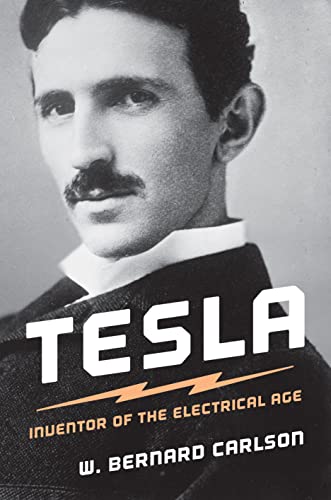
Ebook Info
- Published: 2015
- Number of pages: 520 pages
- Format: PDF
- File Size: 5.60 MB
- Authors: W. Bernard Carlson
Description
The definitive account of Tesla’s life and workNikola Tesla was a major contributor to the electrical revolution that transformed daily life at the turn of the twentieth century. His inventions, patents, and theoretical work formed the basis of modern AC electricity, and contributed to the development of radio and television. Like his competitor Thomas Edison, Tesla was one of America’s first celebrity scientists, enjoying the company of New York high society and dazzling the likes of Mark Twain with his electrical demonstrations. An astute self-promoter and gifted showman, he cultivated a public image of the eccentric genius. Even at the end of his life when he was living in poverty, Tesla still attracted reporters to his annual birthday interview, regaling them with claims that he had invented a particle-beam weapon capable of bringing down enemy aircraft.Plenty of biographies glamorize Tesla and his eccentricities, but until now none has carefully examined what, how, and why he invented. In this groundbreaking book, W. Bernard Carlson demystifies the legendary inventor, placing him within the cultural and technological context of his time, and focusing on his inventions themselves as well as the creation and maintenance of his celebrity. Drawing on original documents from Tesla’s private and public life, Carlson shows how he was an “idealist” inventor who sought the perfect experimental realization of a great idea or principle, and who skillfully sold his inventions to the public through mythmaking and illusion.This major biography sheds new light on Tesla’s visionary approach to invention and the business strategies behind his most important technological breakthroughs.
User’s Reviews
Editorial Reviews: Review “Winner of the 2015 Sally Hacker Prize, Society for the History of Technology””Winner of the 2015 IEEE William and Joyce Middleton Electrical Engineering History Award, History Committee of the Institute of Electrical and Electronic Engineers””One of Amazon.com’s 2013 Best Science Books””One of Booklist Online’s Top 10 Science & Health Books for 2013″”One of Choice’s Outstanding Academic Titles for 2013″”One of The Guardian’s Best Popular Physical Science Books of 2014, chosen by GrrlScientist””Honorable Mention for the 2013 PROSE Award in Biography & Autobiography, Association of American Publishers””Longlisted for the 2014 Royal Society Winton Prize for Science Books””[An] assiduous, endlessly patient biography. . . . In Carlson’s eyes, Tesla’s relationship with modernity in all its forms–its fixation with progress and explanation, capital and connection, but also its fragmentation of narrative and self–is more complex and revealing than even the conspiracy nuts have imagined.”—Richard Barnett, London Review of Books”Carlson sheds light on the man and plenty of his inventions. . . . [An] electric portrait.” ― Publishers Weekly”Superb. . . . Carlson brings to life Tesla’s extravagant self-promotion, as well as his eccentricity and innate talents, revealing him as a celebrity-inventor of the ‘second industrial revolution’ to rival Thomas Alva Edison.”—W. Patrick McCray, Nature”Soundly footnoted, yet eminently readable, it provides a balanced examination of the man and his work, focusing particularly on Tesla’s distinctive style of invention.” ― Natural History”Carefully researched and thoughtfully written. . . . Clearly surpassing earlier accounts, [this] will be the gold standard for Tesla biography.”—Thomas J. Misa, Science”A scholarly, critical, mostly illuminating study of the life and work of the great Serbian inventor.” ― Kirkus Reviews”Carlson even has something to teach readers familiar with Seifer’s dissection of Tesla’s tortured psyche in Wizard (2001) and O’Neill’s much earlier chronicle of Tesla’s childhood and early career in Prodigal Genius (1944). Carlson provides not only a more detailed explanation of Tesla’s science but also a more focused psychological account of Tesla’s inventive process than do his predecessors. Carlson also surpasses his predecessors in showing how Tesla promoted his inventions by creating luminous illusions of progress, prosperity, and peace, illusions so strong that they finally unhinge their creator. An exceptional fusion of technical analysis of revolutionary devices and imaginative sympathy for a lacerated ego.”—Bryce Christensen, Booklist”This is a fascinating glimpse into the life of a monumental inventor whose impact on our contemporary world is all too unfamiliar to the general public. Carlson relates the science behind Tesla’s inventions with a judicial balance that will engage both the novice and the academic alike. Highly recommended to serious biography buffs and to readers of scientific subjects.”—Brian Odom, Library Journal”Carlson deftly weaves the many threads of Tesla’s story.”—Nicola Davis, Times”Splendid.”—Jon Turney, Times Higher Education”Run, don’t walk, to buy this book for the Nikola Tesla cultist in your life. . . . [Carlson] is the first trained academic historian of technology to approach this topic, and he snaps the intense, romantic Serb back into his proper context.”—Colby Cosh, Maclean’s Magazine”Carlson takes a historian’s approach to piecing together Tesla’s life. He resists the temptation to focus only on Tesla’s persona as an eccentric genius with a flair for drama. . . . Instead, Carlson sets out to answer three questions: ‘How did Tesla invent? How did his inventions work? And what happened as he introduced his inventions?'”—Maggie Fazeli Fard, Washington Post”Required reading for any would-be innovator.”—Christine Evans-Pughe, Engineering and Technology”An impressive piece of scholarship.”—Graham Farmelo, Daily Telegraph”Carlson has written an exhaustive biography of Tesla, remarkable for its breadth and thoroughness. He explores and details all his major inventions, providing illustrations and in some cases even reproductions of the patent applications. This is as fair and balanced a biography of Tesla as one could hope for, no mean feat for a man so full of contradictions.”—Gino Segre, Physics in Perspective”Historian Carlson . . . has at last written a balanced and nuanced scholarly treatment of Tesla in the technical and social contexts of his time. . . . Carlson’s easy-to-read style and almost flawless exposition of technical matters will make this book attractive for everyone from general readers to engineers and historians. It is well illustrated and indexed with extensive footnotes. This book is likely to become the standard scholarly biography of Tesla for decades to come.” ― Choice”Since the death of Nikola Tesla in 1943, his life has deserved a worthy biography. Bernard Carlson has delivered that in Tesla: Inventor of the Electrical Age, which portrays Tesla as intensely human. . . . Anyone, whether simply an interested reader or a professional historian, engineer, or physicist, will finish Tesla with a deepened understanding of his world, character, and accomplishments.”—Robert Rosenberg, Physics Today”This major biography sheds new light on Tesla’s visionary approach to invention and the business strategies behind his most important technological breakthroughs.” ― World Book Industry”The author Bernard Carlson has put a herculean effort in presenting a detailed biographical study of one of the greatest engineer-scientists of human history, Nikola Tesla. . . . The book may be treated as a benchmark by future biographers of inventors and scientists.”—Mainak Sengupta, Current Science”It is a very readable work and presents the whole picture of Tesla both as an electrical wizard and as a human being with all the associated foibles. I particularly liked the way Carlson interspersed the narrative with commentary on the inventive process, the role of illusion, and the social implications of his technologies on bringing about positive changes in society as a whole. If you wish to read a factual book about Tesla, this is the one.”—Eric P. Wenaas, IEEE Technology and Society Magazine”[Readers] will certainly see this volume as an indispensable guide to one of the most fascinating yet controversial and misunderstood innovators of the modern era.”—Graeme Gooday, Metascience”[A] masterly study of the man and his work, explaining how business interests as well as scientific curiosity drove Tesla. Carlson shows how engineers, just as much as artists, benefit from creativity, imagination and idealism.”—Roger Backhouse, Journal of the Society of Model & Experimental Engineers”[T]his is an enjoyable biography of Tesla, concentrating in detail on his engineering achievements and business arrangements, even though it could have been firmer on the unscientific nature of some of Tesla’s ideas.”—Brian Clegg, Popular Science”The most objective and balanced Tesla biography to date.”—Tibi Puiu, ZME Science”Tesla is a tour de force of sound scholarship and cogent analysis that brings to life one of the most eccentric and enigmatic characters in the history of technology.”—Michael Brian Schiffer, Register of The Kentucky Historical Society”An eminently readable history that, while avoiding hagiography, reconstructs the intellectual development of one of history’s great electrical inventors and the social contexts in which he worked.”—Benjamin Gross, Chemical Heritage”Carlson’s book is likely the definitive biography of Tesla. It is a challenging read, but a rewarding one. It also contributes in the wider context to the reinvention of scientific biography as a prism of cultural history.”—Guillaume de Syon, Canadian Journal of History”Carlson’s book stands out compared with previous Tesla biographies. . . . The result is an eminently readable history that, while avoiding hagiography, reconstructs the intellectual development of one of history’s great electrical inventors and the social contexts in which he worked.”—Benjamin Gross, Chemical Heritage”Dr. Carlson has written an outstanding work, exhibiting a true understanding of the complex person who was Nikola Tesla. The book is alternatively uplifting–as it reveals how Tesla’s mind worked, creating prototypes of inventions which have changed the world–and heartbreaking. . . . The book is much more than a biography, as Carlson examines the art of invention as it applied to Tesla. He skillfully weaves into the narrative insights as to why Tesla approached his work in the way he did.”—John Bowditch, Technology and Culture”Only the bravest of historians elects to take on the challenge of writing a scholarly biography of Tesla that examines and critiques such fondly cherished myths. And Bernie Carlson is certainly up to this challenge. . . . [A]n indispensable guide to one of the most fascinating yet controversial and misunderstood innovators of the modern era.”—Graeme Gooday, Metascience”[Carlson’s] extensive notes on his sources are invaluable for Tesla researchers, and his book sheds light on many misconceptions perpetuated in some popular Tesla biographies.” ― Nexus Magazine”The problem for any biographer is that there are really two distinctly different Nikola Teslas. One is the towering genius shunned by the ignorant establishment, whose greatest works are still suppressed; this is the Tesla adored by the alternative science community and the popular media. . . . The other Tesla is the miserable failed inventor whose great plans and endless boasts came to nothing. . . . Carlson manages the impressive feat of steering a middle course between these two.”—David Hambling, Fortean Times”The great strength of Carlson’s biography is that, throughout his account of these complex developments, he tries to evaluate Tesla’s work and behaviour without falling into the twin perils of hero-worship or skepticism. . . . Carlson’s biography not only provides us with an account of a man whose achievements amazed the world and contributed significantly to the emergence of the electrical age. It is also provides valuable insights into the way in which innovation can be projected into the popular media and arouse the interest of financiers.”—Peter J. Bowler, European Legacy Review “Carlson has written a serious, rigorous book grounded in the academic history of technology, but also a page-turner that any fan of Tesla will enjoy.”―Robert MacDougall, Western University”Nikola Tesla, like one of his oscillators, flickered between different states so quickly that they can easily blur. Carlson captures this extraordinary, contradictory life―inventor, futurist visionary, showman, and, at times, ranting narcissist. We get to see how Tesla scrambled like mad, built with ambition, and in his later efforts failed monumentally. Here is a book that guides us through this wild ride with empathy and without hagiography.”―Peter Galison, Harvard University”Combining archival research with the latest scholarship from the history of technology, Carlson has written the balanced, scholarly biography that Nikola Tesla has long deserved. This is the definitive study of his life and work.”―David E. Nye, University of Southern Denmark”Most biographies of Tesla lack technical background and are uncritical and adulatory in their approach. Carlson’s perspective as a historian―particularly a historian of technology―is indispensable for understanding Tesla’s place in the rapidly changing American society of the late nineteenth and early twentieth centuries. His style is engaging and accessible, and the book will clearly be of value to the historical community.”―Bernard S. Finn, curator emeritus, Smithsonian Institution”Tesla is a tour de force of scholarship and analysis. This is the definitive work on Tesla that brings to light much new information about his life, his inventions, and the changing socioeconomic context in which he worked. Carlson has mined the primary sources to an unprecedented depth and breadth. The book is nothing less than extraordinary.”―Michael Brian Schiffer, author of Power Struggles: Scientific Authority and the Creation of Practical Electricity before Edison From the Back Cover “Carlson has written a serious, rigorous book grounded in the academic history of technology, but also a page-turner that any fan of Tesla will enjoy.”–Robert MacDougall, Western University”Nikola Tesla, like one of his oscillators, flickered between different states so quickly that they can easily blur. Carlson captures this extraordinary, contradictory life–inventor, futurist visionary, showman, and, at times, ranting narcissist. We get to see how Tesla scrambled like mad, built with ambition, and in his later efforts failed monumentally. Here is a book that guides us through this wild ride with empathy and without hagiography.”–Peter Galison, Harvard University”Combining archival research with the latest scholarship from the history of technology, Carlson has written the balanced, scholarly biography that Nikola Tesla has long deserved. This is the definitive study of his life and work.”–David E. Nye, University of Southern Denmark”Most biographies of Tesla lack technical background and are uncritical and adulatory in their approach. Carlson’s perspective as a historian–particularly a historian of technology–is indispensable for understanding Tesla’s place in the rapidly changing American society of the late nineteenth and early twentieth centuries. His style is engaging and accessible, and the book will clearly be of value to the historical community.”–Bernard S. Finn, curator emeritus, Smithsonian Institution”Tesla is a tour de force of scholarship and analysis. This is the definitive work on Tesla that brings to light much new information about his life, his inventions, and the changing socioeconomic context in which he worked. Carlson has mined the primary sources to an unprecedented depth and breadth. The book is nothing less than extraordinary.”–Michael Brian Schiffer, author of Power Struggles: Scientific Authority and the Creation of Practical Electricity before Edison About the Author W. Bernard Carlson is professor of science, technology, and society in the School of Engineering and Applied Science and professor of history at the University of Virginia. His books include Technology in World History and Innovation as a Social Process: Elihu Thomson and the Rise of General Electric, 1870-1900. Read more
Reviews from Amazon users which were colected at the time this book was published on the website:
⭐Nicola Tesla was born in 1858 in a village in what is now Croatia, then part of the Austro-Hungarian Empire. His father and grandfather were both priests in the Orthodox church. The family was of Serbian descent, but had lived in Croatia since the 1690s among a community of other Serbs. His parents wanted him to enter the priesthood and enrolled him in school to that end. He excelled in mathematics and, building on a boyhood fascination with machines and tinkering, wanted to pursue a career in engineering. After completing high school, Tesla returned to his village where he contracted cholera and was near death. His father promised him that if he survived, he would “go to the best technical institution in the world.” After nine months of illness, Tesla recovered and, in 1875 entered the Joanneum Polytechnic School in Graz, Austria.Tesla’s university career started out brilliantly, but he came into conflict with one of his physics professors over the feasibility of designing a motor which would operate without the troublesome and unreliable commutator and brushes of existing motors. He became addicted to gambling, lost his scholarship, and dropped out in his third year. He worked as a draftsman, taught in his old high school, and eventually ended up in Prague, intending to continue his study of engineering at the Karl-Ferdinand University. He took a variety of courses, but eventually his uncles withdrew their financial support.Tesla then moved to Budapest, where he found employment as chief electrician at the Budapest Telephone Exchange. He quickly distinguished himself as a problem solver and innovator and, before long, came to the attention of the Continental Edison Company of France, which had designed the equipment used in Budapest. He was offered and accepted a job at their headquarters in Ivry, France. Most of Edison’s employees had practical, hands-on experience with electrical equipment, but lacked Tesla’s formal education in mathematics and physics. Before long, Tesla was designing dynamos for lighting plants and earning a handsome salary. With his language skills (by that time, Tesla was fluent in Serbian, German, and French, and was improving his English), the Edison company sent him into the field as a trouble-shooter. This further increased his reputation and, in 1884 he was offered a job at Edison headquarters in New York. He arrived and, years later, described the formalities of entering the U.S. as an immigrant: a clerk saying “Kiss the Bible. Twenty cents!”.Tesla had never abandoned the idea of a brushless motor. Almost all electric lighting systems in the 1880s used direct current (DC): electrons flowed in only one direction through the distribution wires. This is the kind of current produced by batteries, and the first electrical generators (dynamos) produced direct current by means of a device called a commutator. As the generator is turned by its power source (for example, a steam engine or water wheel), power is extracted from the rotating commutator by fixed brushes which press against it. The contacts on the commutator are wired to the coils in the generator in such a way that a constant direct current is maintained. When direct current is used to drive a motor, the motor must also contain a commutator which converts the direct current into a reversing flow to maintain the motor in rotary motion.Commutators, with brushes rubbing against them, are inefficient and unreliable. Brushes wear and must eventually be replaced, and as the commutator rotates and the brushes make and break contact, sparks may be produced which waste energy and degrade the contacts. Further, direct current has a major disadvantage for long-distance power transmission. There was, at the time, no way to efficiently change the voltage of direct current. This meant that the circuit from the generator to the user of the power had to run at the same voltage the user received, say 120 volts. But at such a voltage, resistance losses in copper wires are such that over long runs most of the energy would be lost in the wires, not delivered to customers. You can increase the size of the distribution wires to reduce losses, but before long this becomes impractical due to the cost of copper it would require. As a consequence, Edison electric lighting systems installed in the 19th century had many small powerhouses, each supplying a local set of customers.Alternating current (AC) solves the problem of power distribution. In 1881 the electrical transformer had been invented, and by 1884 high-efficiency transformers were being manufactured in Europe. Powered by alternating current (they don’t work with DC), a transformer efficiently converts current from one voltage and current to another. For example, power might be transmitted from the generating station to the customer at 12000 volts and 1 ampere, then stepped down to 120 volts and 100 amperes by a transformer at the customer location. Losses in a wire are purely a function of current, not voltage, so for a given level of transmission loss, the cables to distribute power at 12000 volts will cost a hundredth as much as if 120 volts were used. For electric lighting, alternating current works just as well as direct current (as long as the frequency of the alternating current is sufficiently high that lamps do not flicker). But electricity was increasingly used to power motors, replacing steam power in factories. All existing practical motors ran on DC, so this was seen as an advantage to Edison’s system.Tesla worked only six months for Edison. After developing an arc lighting system only to have Edison put it on the shelf after acquiring the rights to a system developed by another company, he quit in disgust. He then continued to work on an arc light system in New Jersey, but the company to which he had licensed his patents failed, leaving him only with a worthless stock certificate. To support himself, Tesla worked repairing electrical equipment and even digging ditches, where one of his foremen introduced him to Alfred S. Brown, who had made his career in telegraphy. Tesla showed Brown one of his patents, for a “thermomagnetic motor”, and Brown contacted Charles F. Peck, a lawyer who had made his fortune in telegraphy. Together, Peck and Brown saw the potential for the motor and other Tesla inventions and in April 1887 founded the Tesla Electric Company, with its laboratory in Manhattan’s financial district.Tesla immediately set to make his dream of a brushless AC motor a practical reality and, by using multiple AC currents, out of phase with one another (the polyphase system), he was able to create a magnetic field which itself rotated. The rotating magnetic field induced a current in the rotating part of the motor, which would start and turn without any need for a commutator or brushes. Tesla had invented what we now call the induction motor. He began to file patent applications for the motor and the polyphase AC transmission system in the fall of 1887, and by May of the following year had been granted a total of seven patents on various aspects of the motor and polyphase current.One disadvantage of the polyphase system and motor was that it required multiple pairs of wires to transmit power from the generator to the motor, which increased cost and complexity. Also, existing AC lighting systems, which were beginning to come into use, primarily in Europe, used a single phase and two wires. Tesla invented the split-phase motor, which would run on a two wire, single phase circuit, and this was quickly patented.Unlike Edison, who had built an industrial empire based upon his inventions, Tesla, Peck, and Brown had no interest in founding a company to manufacture Tesla’s motors. Instead, they intended to shop around and license the patents to an existing enterprise with the resources required to exploit them. George Westinghouse had developed his inventions of air brakes and signalling systems for railways into a successful and growing company, and was beginning to compete with Edison in the electric light industry, installing AC systems. Westinghouse was a prime prospect to license the patents, and in July 1888 a deal was concluded for cash, notes, and a royalty for each horsepower of motors sold. Tesla moved to Pittsburgh, where he spent a year working in the Westinghouse research lab improving the motor designs. While there, he filed an additional fifteen patent applications.After leaving Westinghouse, Tesla took a trip to Europe where he became fascinated with Heinrich Hertz’s discovery of electromagnetic waves. Produced by alternating current at frequencies much higher than those used in electrical power systems (Hertz used a spark gap to produce them), here was a demonstration of transmission of electricity through thin air—with no wires at all. This idea was to inspire much of Tesla’s work for the rest of his life. By 1891, he had invented a resonant high frequency transformer which we now call a Tesla coil, and before long was performing spectacular demonstrations of artificial lightning, illuminating lamps at a distance without wires, and demonstrating new kinds of electric lights far more efficient than Edison’s incandescent bulbs. Tesla’s reputation as an inventor was equalled by his talent as a showman in presentations before scientific societies and the public in both the U.S. and Europe.Oddly, for someone with Tesla’s academic and practical background, there is no evidence that he mastered Maxwell’s theory of electromagnetism. He believed that the phenomena he observed with the Tesla coil and other apparatus were not due to the Hertzian waves predicted by Maxwell’s equations, but rather something he called “electrostatic thrusts”. He was later to build a great edifice of mistaken theory on this crackpot idea.By 1892, plans were progressing to harness the hydroelectric power of Niagara Falls. Transmission of this power to customers was central to the project: around one fifth of the American population lived within 400 miles of the falls. Westinghouse bid Tesla’s polyphase system and with Tesla’s help in persuading the committee charged with evaluating proposals, was awarded the contract in 1893. By November of 1896, power from Niagara reached Buffalo, twenty miles away, and over the next decade extended throughout New York. The success of the project made polyphase power transmission the technology of choice for most electrical distribution systems, and it remains so to this day. In 1895, the New York Times wrote:“Even now, the world is more apt to think of him as a producer of weird experimental effects than as a practical and useful inventor. Not so the scientific public or the business men. By the latter classes Tesla is properly appreciated, honored, perhaps even envied. For he has given to the world a complete solution of the problem which has taxed the brains and occupied the time of the greatest electro-scientists for the last two decades—namely, the successful adaptation of electrical power transmitted over long distances.”After the Niagara project, Tesla continued to invent, demonstrate his work, and obtain patents. With the support of patrons such as John Jacob Astor and J. P. Morgan he pursued his work on wireless transmission of power at laboratories in Colorado Springs and Wardenclyffe on Long Island. He continued to be featured in the popular press, amplifying his public image as an eccentric genius and mad scientist. Tesla lived until 1943, dying at the age of 86 of a heart attack. Over his life, he obtained around 300 patents for devices as varied as a new form of turbine, a radio controlled boat, and a vertical takeoff and landing airplane. He speculated about wireless worldwide distribution of news to personal mobile devices and directed energy weapons to defeat the threat of bombers. While in Colorado, he believed he had detected signals from extraterrestrial beings. In his experiments with high voltage, he accidentally detected X-rays before Röntgen announced their discovery, but he didn’t understand what he had observed.None of these inventions had any practical consequences. The centrepiece of Tesla’s post-Niagara work, the wireless transmission of power, was based upon a flawed theory of how electricity interacts with the Earth. Tesla believed that the Earth was filled with electricity and that if he pumped electricity into it at one point, a resonant receiver anywhere else on the Earth could extract it, just as if you pump air into a soccer ball, it can be drained out by a tap elsewhere on the ball. This is, of course, complete nonsense, as his contemporaries working in the field knew, and said, at the time. While Tesla continued to garner popular press coverage for his increasingly bizarre theories, he was ignored by those who understood they could never work. Undeterred, Tesla proceeded to build an enormous prototype of his transmitter at Wardenclyffe, intended to span the Atlantic, without ever, for example, constructing a smaller-scale facility to verify his theories over a distance of, say, ten miles.Tesla’s invention of polyphase current distribution and the induction motor were central to the electrification of nations and continue to be used today. His subsequent work was increasingly unmoored from the growing theoretical understanding of electromagnetism and many of his ideas could not have worked. The turbine worked, but was uncompetitive with the fabrication and materials of the time. The radio controlled boat was clever, but was far from the magic bullet to defeat the threat of the battleship he claimed it to be. The particle beam weapon (death ray) was a fantasy.In recent decades, Tesla has become a magnet for Internet-connected crackpots, who have woven elaborate fantasies around his work. Finally, in this book, written by a historian of engineering and based upon original sources, we have an authoritative and unbiased look at Tesla’s life, his inventions, and their impact upon society. You will understand not only what Tesla invented, but why, and how the inventions worked. The flaky aspects of his life are here as well, but never mocked; inventors have to think ahead of accepted knowledge, and sometimes they will inevitably get things wrong.
⭐Before I read Tesla: Inventor of Our Modern Electric Age by Bernard Carlson I had an image of Nikola Tesla’s contribution to the field of electrical engineering that I picked up from the culture. As stated in the title of the book, Tesla is credited as the inventor of the electric age, pioneering our modern day AC power systems. He is remembered as a humble inventor didn’t care about money, making him the prey of greedy businessmen like Thomas Edison. Tesla is celebrated as a genius ahead of his time who, because of circumstances outside of his control, was not able to produce the technology he set out to. As it turns out, many of the commonly held beliefs about Tesla turned out not to be true.Nikola Tesla is often credited as the person who is responsible for the success of AC power transmission, but this is not true. Tesla did not pioneer AC distribution systems, invent the transformer, or discover that AC was better than DC current for transferring power over long distances. Tesla’s contribution to the field of electrical engineering is limited to his invention of the AC motor. He cannot be credited with the development of the AC power distribution systems that were adopted during his time or that we use today. Tesla was an engineering student in Graz, Austria in1882 when came up with the concept for the AC motor. At this time there were already AC power systems for arc lighting in Paris. When Tesla, a recent college graduate, joined Graz & Co in Budapest the engineers had already developed one of the first systems to use a transformer and to transmit AC over long distances. The transformer, a crucial component to AC power distribution, is often mistakenly credited as an invention of Tesla’s but he only made further improvements to it. Michael Faraday invented the first version of a transformer which went on to be further developed by other inventors such as the engineers at the Ganz factory, the Westinghouse company and Tesla.Another popular myth is that there was a professional and personal rivalry between Edison and Tesla, and that Edison somehow screwed Tesla over. Tesla moved to New York in 1884 and went to work for Edison two days after landing because had a good reputation with the company from doing work on dynamos at Edison Electric in Europe. At this point in time Edison had already invented the incandescent bulb, but there was still a demand for AC powered arc lighting for outdoor applications. Edison had patented a design for an arc lighting system and he tasked Tesla with working out the details. Tesla labored intensely and came up with good results, but Edison ended up deciding to not use the system because of business reasons. Tesla took it personally that his hard work was shelved and angrily quit in disgust. He had only worked for Edison for 6 months. There is also a story that, while Tesla was working for Edison, Edison joked in passing that if Tesla achieved a certain efficiency with a DC system he was working on Edison would give Tesla $50k, an outrageous sum of money at the time. When Tesla achieved the desired efficiency, he asked Edison for the money who laughed it off saying that Tesla didn’t understand his sense of humor, and the story goes that Tesla felt exploited.There was a period of time between 1880 and the early 1890’s that is famously known as the “war of the currents” which is mistakenly retold as a battle between Edison and Tesla. It was a period of commercial rivalry between businesses providing AC and DC power transmission systems, which turned into a marketing and propaganda smear campaign between opposing camps. During this period of time Edison was heavily invested in and marketing DC systems. Edison was wrong about which system was more practical, and fear-mongered about the dangers of AC in order to win business. Tesla was invested in AC but there was never a public or private debate directly between him and Edison. The current wars ended in 1893 with the decision to use multi-phase AC power at the first Niagara Falls power station. The Niagara Falls power station was funded by Wall Street banker Edward Dean Adams. Adams consulted many engineers and scientists, including Edison, about the preferred form of power for this station. He went with Tesla’s recommendation of multi-phase AC and awarded the work to the Westinghouse Electric Company. Although Tesla is credited with championing multi-phase AC at Niagara, the person who deserves credit for the decision is Adams.Tesla is viewed as someone who didn’t care about celebrity or money, in contrast to Thomas Edison’s obsession with fame and fortune, but this is also not true. Part of this misunderstanding is because he tore up his contracts he had made with George Westinghouse licensing his motor, sacrificing a tremendous amount of money. After Tesla left Edison to work on his AC motor in 1884 he eventually ended up doing business with Westinghouse, who had founded a company to provide AC power in 1885 . Tesla licensed his patents to Westinghouse in 1888 for a large sum of money but by 1891 Westinghouse was in severe financial distress. He was generating a lot revenue in his electric business but had over-expanded his staff, facilities and had spent a lot of money acquiring smaller competing business. Even though the AC motor was an important piece of technology, the market had not caught onto it and there were few customers who could actually use the technology at the time. There were still technical problems with the motor that had to be resolved. The motor ended up being a commercial success in the late 1890’s but by 1891 it was not clear that this would be true. Westinghouse’s investors did not see Tesla’s motors as having any potential in 1891 and they requested that Westinghouse terminate his contract with Tesla. Although Tesla had an intense dedication to his love of invention and experimentation, it is incorrect to say that he did not care about money. Tesla lived in the fanciest hotel in NY, dined in the most exclusive restaurant, and befriended the richest and most famous people he could. Tesla was a total fame-hound and put a lot of effort into getting as much publicity as he could. Tesla was a devoted inventor and part of his motivation for acquiring fame and fortune was to help fund his projects, but he was hardly the humble stoic figure that many imagine. Unfortunately, over the years Tesla made too many bold claims about his inventions that he did not live up to and lost all credibility.The chapters of the book that detail Tesla’s other inventions were depressing because he had so many failures and missed opportunities. Tesla spent decades working on wireless lighting technology but never produced any marketable technology. He experimented with x-rays as the technology was beginning to develop, and narrowly missed the opportunity to come up with a useful invention. He strongly believed, for some bizarre reason, that it was possible to transmit power through the earth’s crust- even though the ground is used to dissipate electric energy in every form of electric technology that I’ve ever heard of. He made many bold claims about the technology he would invent to transmit wireless communication, and was deeply hurt when he was beat by Marconi in the invention of the radio. Tesla spent months in Colorado Springs experimenting with wireless power and believed his results proved he could build a functional station to transmit wireless power, but the Wardenclyff Station that he built was a complete failure. For the last decades of his life Tesla worked on a particle-beam accelerator that was never proved to function as he claimed.Tesla is mythologized as a genius inventor because of his claims about his ability to visualize an invention, test it in his mind, and then build a perfectly functional prototype in real life. However, this seems to be untrue. His only significant invention, the AC motor, required many different iterations before he created a working prototype and it still had kinks to work out after he licensed the patents. In popular culture he is often used as an example of the power of visualization, but almost all of his inventions were complete failures.I have to admit that I was a little bit disappointed to discover that Tesla was not the man I thought he was, and confused about his popularity in today’s culture. I admire his dedication to invention and the enormous amount of energy and creativity he channeled into it, but I don’t think he was a good role model. One of his greatest shortcomings was his lack of connection to reality- he believed that if he could visualize something in his head it would therefore work in real life, but he often ignored evidence that might prove him wrong. This lack of respect for reality, in my opinion, led to his long string of failures and devastating mental breakdown. There have been many different scientists and inventors that have contributed to the field of electrical engineering, Tesla made an important contribution but should not be considered the “inventor of the electric age” as the title of this book suggests.
⭐Written by an engineer for engineers, with little about Tesla’s character, personality and what made him tick. I was quite disappointed. Not only was it written in an impersonal colourless style but it contained quite a few easy-to-check errors. This was disconcerting because it made me then wonder what other hard-to-check errors might be in there as well. I am a magazine journalist who bought this, and other books by and about Tesla has background research for a feature on Tesla, ahead of a visit to the Tesla Museum in Belgrade. A disappointment, especially given the colourful intro (which I expect must have been written by the book’s editor). I bought on the strength of that, from the Look Inside snippet. But the colour soon faded and we were into a dry discourse on electronics and long extraneous (and dry) passages on the works of others or abstracted takes on Tesla’s ancestors in Serbian history. Just plain dull.
⭐Absolute genius ..one if not the most important men in the world
⭐Informative book, thank you. I must agree with one of reviewers though; it is rather technical and that is a comment from someone who studied engineering, who I gave the book to after.
⭐A great book done by a historian who took the time tor research it. Moreover, he understand the importance of the different aspect of the work being done by Tesla on motors. Both scientifically and in link with the evolution of concepts in physics at that time. The struggle of AC versus DC at that time.
⭐I was interested in the man and looking for a biography. This book is well written and gives a lot of technical details about the inventions of Tesla. It might require some study for people who don’t know much about electricity and magnetism. There’s also very good pictures and schemes to illustrate the inventions of the electrical age.
Keywords
Free Download Tesla: Inventor of the Electrical Age in PDF format
Tesla: Inventor of the Electrical Age PDF Free Download
Download Tesla: Inventor of the Electrical Age 2015 PDF Free
Tesla: Inventor of the Electrical Age 2015 PDF Free Download
Download Tesla: Inventor of the Electrical Age PDF
Free Download Ebook Tesla: Inventor of the Electrical Age