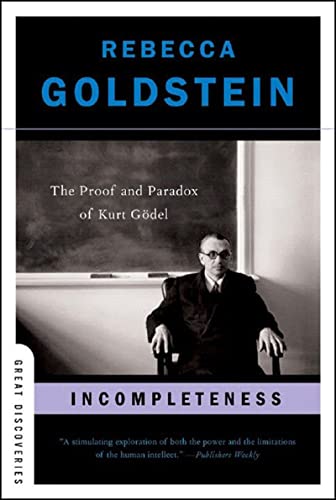
Ebook Info
- Published: 2006
- Number of pages: 224 pages
- Format: PDF
- File Size: 1.12 MB
- Authors: Rebecca Goldstein
Description
A gem…An unforgettable account of one of the great moments in the history of human thought. ―Steven PinkerProbing the life and work of Kurt Gödel, Incompleteness indelibly portrays the tortured genius whose vision rocked the stability of mathematical reasoning―and brought him to the edge of madness. 4 illustrations
User’s Reviews
Editorial Reviews: Review “Gödel’s torment and his genius. By the book’s end, we understand well why Einstein would look forward to ‘the privilege of walking home with Gödel,’ and we can’t help but wish that we’d been able to join them.” ― Brian Greene, author of The Elegant Universe and The Fabric of the Cosmos”In this penetrating, accessible, and beautifully written book, Rebecca Goldstein explores not only the work of one of the greatest mathematicians but also the relation of the human mind to the world around it.” ― Alan Lightman, author of Einstein’s Dreams About the Author Rebecca Goldstein is a MacArthur Fellow, a professor of philosophy, and the author of five novels and a collection of short stories. She lives in Cambridge, Massachusetts.
Reviews from Amazon users which were colected at the time this book was published on the website:
⭐I’ve always liked Rebecca Goldstein’s novels, which deal with the problems of finding romantic love for people working in the hard sciences — math, physics, and philosophy. The truth is that it’s really hard for people to find romantic love in these fields, but Goldstein is at least a cheerleader for it. So, when I heard that Goldstein had written a non-fiction book about Godel, a historic thinker whose contributions I’ve long thought about, well, the book piqued my interest. Generally, I think that if a book of this nature gets you thinking about things, then it’s mainly successful. And mainly this book is. Goldstein’s descriptions of the Vienna Circle are pretty fascinating, and her recollections and the recollections of her colleagues at Princeton and the Institute for Advanced Study about Godel are illuminating, too. Godel in all of this still comes out as pretty much a cipher, being overshadowed by the stronger personalities of Einstein, Wittgenstein, Russell, even Oppenheimer. Apparently, that’s just the way he was, and maybe there isn’t all that much to say about him personally, but the author does do some digging. The author is very good, too, at using her philosophical training at putting everyone in philosophical boxes — platonists, positivists, empiricists — if you’re into that sort of thing, but where the book falls down is on the explanation of the proof itself. Granted, the author admits that her mathematical skills maybe were somewhat better when she was still in graduate school. Still, the easy stuff of the proof is the encoding of mathematical statements by prime number factorization and the general idea that the proof is premised on the liar’s paradox. However, she glosses over the more difficult and central elements of the proof as to how there is necessarily a propositional function that can decide whether a godel number of a statement has a property that makes the statement provable, and then the diagonalization lemma — well, let’s just say she punts on that. This appears to me to be fairly problematic. If someone is continually gushing about how brilliant the proofs are, and what a major contribution the incompleteness proofs are to the history of human and mathematical thought, and yet really can’t explain precisely how the proof works, then it appears that maybe someone is just sucking up to the authorities that be. If the author doesn’t really understand it, then how many experts in the world really do, and how sure can we be that there isn’t some problem in it somewhere.One has to wonder how important the incompleteness proofs will still be a hundred or two hundred years from now. Goldstein appears to recount how both Russell and Hilbert resisted the conclusions of incompleteness, but Russell was overwhelmed by the force of personality of Wittgenstein, and Hilbert couldn’t always get his own program back on track by herding in the cats. If the heart of a logical proof is itself a paradox of logic, as the liar’s paradox is, then one has to wonder about its conclusions. This is a little like premising a proof of arithmetic on ‘zero divided by zero’, where you then might be able to prove almost anything. Russell sounds in the book that he wanted to limit this sort of problem by the theory of types, but perhaps there should just be some more general prohibition against introducing paradoxes into mathematical proofs, and then to see where you can go from there. Godel is commonly compared to Escher, who built logically impossible buildings, which may be interesting, but perhaps it is more important to understand ways to build actual buildings — or build proofs — that architecturally won’t fall down in the real world. When I was growing up, all of the proofs in geometry class appeared to be pretty straightforward — you could generally follow the logic and understand why they had to be true. Perhaps there was always some over-preaching about ‘finding a neighborhood around a point’ or ‘taking the limit as a value goes to zero’, but you could usually understand what they were getting at. Yet these days everything is more complicated and less immediately verifiable: take the four color map theorem, which was evidently only ‘proved’ by a computer enumerating a vast number of special configurations (even though earlier proofs from the nineteenth century looked pretty good), and then Wiles’ proof of Fermat’s Last Theorem that is premised on the Taniyama-Shimura Conjecture relating elliptical curves and modular forms. Maybe someday seventh graders will understand how elliptical curves relate to modular forms, but if everything is so complicated, then how do we really know what is true.Then there’s the question of what it all means. Even if there is no proof, the idea it embodies still resonates. Goldstein appears to want to limit the impact of Godel’s incompleteness theorems to just what it says about the theory of the arithmetic of natural numbers, and wants to reject the implications used by modernism, existentialism, and anti-intellectualism that makes everything relative to man and downplays the power of the rational. But she still wants to draw on her own philosophical training to bring in its relevance to the old academic debates on the theory of mind, and whether a computer can ever think the way a person does. Undoubtedly, Godel’s work has had implications, or at least established some benchmarks, that are relevant today to the fields of computer science, coding theory, and algorithmic complexity. But it appears to me to be fairly pointless to argue about whether computers will ever think like people, particularly as new varieties of neural networks continue to develop; these philosophical problems may help point the way, but they don’t really contribute to the technical solutions, where only time will tell, and machines may never be able to do everything exactly the way a human can, even if they are able eventually to pass a Turing Test. And I guess the author would disagree with me if I tried to draw implications from the incompleteness theorems to the more rigorous theories of physics, which she doesn’t consider, where incompleteness might be read to say that the entire movement to unify the laws of physics is pointless because each theory — gravity, quantum mechanics, electromagnetism — simply stands independently on its own, is incomplete, not necessarily consistent with the other theories, but simply co-existent. This problem may have originated with Einstein, pondering in his old age at what the author implies is the turkey farm of the Institute of Advanced Study, and how his unified field theory — continued by others with theories of everything and spontaneous symmetry breaking — is all leading us astray. Suppose we just draw the implication that the theories of physics don’t unify, that the universe just continues to diversify with more and more unrelated phenomena, that ‘all laws are local’, which is really all that is implied by incompleteness.
⭐’For example, Roger Penrose made the incompleteness theorems central to his argument that our minds, whatever they are, cannot be digital computers.”This is a current, widespread dispute.”What Gödel’s theorems prove, he argues, is that even in our most technical, rule-bound thinking—that is, mathematics—we are engaging in truth-discovering processes that can’t be reduced to the mechanical procedures programmed into computers.”If mathematics is trusted (everyone does), Gödel’s proof confirms human reason is more powerful than any possible computer! Wow!”Notice that Penrose’s argument, in direct opposition to the postmodern interpretation of the previous paragraph, understands Gödel’s results to have left our mathematical knowledge largely intact. Gödel’s theorems don’t demonstrate the limits of the human mind, but rather the limits of computational models of the human mind (basically, models that reduce all thinking to rule-following).” (25)IntroductionI A Platonist among the PositivistsII Hilbert and the FormalistsIII The Proof of IncompletenessIV Gödel’s IncompletenessNotesSuggested ReadingGoldstein covers Godel’s incompleteness theorem and it’s effect on mathematics. She highlights the philosophical issues. Shows the metamathematical implications are more profound than the mathematical ones. She includes some biography of Godel’s life, but she seems focused on explaining Godel’s motives and goals more than events.Excellent description of Schlick and his Vienna circle, of which Godel was a member. The developments of the logical positivists and why they became so influential is explained. The milieu of post war Vienna is described as ‘the research laboratory for world destruction’. (Page 69)”The overall topic was the moral and intellectual death and decay of all that had come before, and the need to construct entirely new methodologies, forms and foundations.” The old world died in 1914. They knew that and wanted to create a new one. They did and we are living with the result.The fascinating thing was although the Vienna circle converted much of the intellectual world to logical positivism (reality is only what can be positively shown) Godel, even though a member, created a proof that they were wrong! Goldstein believes Godel’s desire to disprove positivism led him to prove the ‘incompleteness’ of mathematics.Clearly explains that the usual meaning of Godel’s work is to justify relativism, which is not how Godel understood his work. Godel deeply believed his work demonstrated that the human mind can discern deeper mathematical truth than any formal system of mathematics can find. In other words, he proved -mathematically- that it is not possible for any computer program to find all the mathematical truths that are available to the human mind!Where does that capacity come from? How can the human mind connect to the hidden, difficult, profound and amazing mathematical concepts that continue to match the physical world? How does the insight or ‘intuition’ of mathematical concepts enter the mind of the mathematician?This is the theme of the book as Goldstein presents the isolation of Godel because of his rejection of positivism. She also connects his friendship with Einstein due to Einstein’s same intellectual battle. His work is called the ‘Theory of Relativity’ and is used to justify a subjective world. Einstein disagreed. He believed the accurate name would be ‘Theory of Invariance’, totally the opposite! Two world class thinkers, whose ideas were twisted to mean the contrary to what they believed. How sad. Both were isolated and world famous.Also shows how Godel’s devotion to logic gave him an uncommon courage to believe what his research found. For example, (page 60) she relates “I found those little Bible studies published by the Jehovah’s witnesses. . .These contained careful underlinings and marginalia in the logicians hand.” Another author mentions that Godel believed in the resurrection. He also was devoted to the writings of Leibniz.Chapter eleven starts with an excellent description of thee problem of certainty. What is “proof”? Reminds us of the well known point that all deductive reasoning (such as mathematics) must start with unproven beliefs. We hope to use beliefs that are clear, simple and agreed by everyone (therefore do not need proof).(Page 123) “The resulting beliefs can feel intuitively obvious precisely because we are not prepared to face their real and suspect source in our own personal situations and egos.” Euclid used only five. These five were trusted for thousands of years and yielded fantastic results. We now believe one of them (parallel postulate) is wrong!Godel’s work shows that mathematics requires various direct beliefs, “intuitions”, that cannot be “proved” by mathematics. This was and is a shocking, deeply disturbing conclusion to those who understand the significance. David Hilbert, the leader of mathematics at the time, was angry when he saw Godel’s work. It destroyed his life’s work.This book is an excellent introduction to Godel’s work. I find it fascinating due to its effect on the intellectual world. If, as with other world changing ideas, (Copernicus, Newton, Einstein) it takes a century for them to be assimilated into the culture, we should be seeing an increased effect soon. What the effect will be is unknown. As Godel showed, deductive reason cannot learn all that the human mind can discern.
⭐Roughly speaking, Godel’s theorem tells us that there are true statements in. mathematics that cannot be proved. This put an end to Hilbert’s dream of finding some axiomatic system for the whole of Maths, where every true statement could be proved. In this book Godel’s life is described from his days in Vienna to his time at Princeton. Particularly interesting is his interaction with Einstein. They used two walk together to work at the institute in Princeton This part is easy to read and well-written but the author then makes a valiant effort to explain the ideas that Godel used to prove his results. Of course, not easy reading but very worthwhile.
⭐The book is essentially in three parts1. The Vienna Circle and Godels place within it. There are a references to differing philosophical schools without explaining what they are and their relevance. This part is overlong.2. The Theory itself – an attempt to explain in lay terms isnt entirely successful. Its not surprising as its a complex theory but part 1 could have been reduced and this worked on more3. Godels adult life. An anecdotal skim through Godels social interactions. Could have been omitted to be honest,
⭐The flow was good, the subject was interesting and well explained. I’d even describe it as a “page turner”.(I skipped the 10 or so pages which are supposed to explain the proof, I find that either you are an expert in a given field or the simplified explanation is pointless.)
⭐I was familiar with Godel but knew little about Wittgenstein before reading this short but enchanting book about their mid-20th century clash of ideas. Two very interesting characters– so different but each brilliant in his own way. This book also provides clear insights into Godel’s key contributions to mathematical logic, for the layman like myself.
⭐Well written and informed story of an eccentric brain
Keywords
Free Download Incompleteness: The Proof and Paradox of Kurt Gödel (Great Discoveries) in PDF format
Incompleteness: The Proof and Paradox of Kurt Gödel (Great Discoveries) PDF Free Download
Download Incompleteness: The Proof and Paradox of Kurt Gödel (Great Discoveries) 2006 PDF Free
Incompleteness: The Proof and Paradox of Kurt Gödel (Great Discoveries) 2006 PDF Free Download
Download Incompleteness: The Proof and Paradox of Kurt Gödel (Great Discoveries) PDF
Free Download Ebook Incompleteness: The Proof and Paradox of Kurt Gödel (Great Discoveries)