

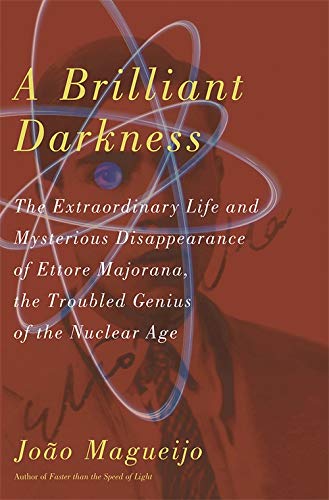
Ebook Info
- Published: 2009
- Number of pages: 304 pages
- Format: PDF
- File Size: 4.64 MB
- Authors: Joao Magueijo
Description
On the night of March 26, 1938, nuclear physicist Ettore Majorana boarded a ship, cash and passport in hand. He was never seen again. In A Brilliant Darkness, theoretical physicist Joao Magueijo tells the story of Majorana and his research group, “the Via Panisperna Boys,” who discovered atomic fission in 1934. As Majorana, the most brilliant of the group, began to realize the implications of what they had found, he became increasingly unstable. Did he commit suicide that night in Palermo? Was he kidnapped? Did he stage his own death?A Brilliant Darkness chronicles Majorana’s invaluable contributions to science — including his major discovery, the Majorana neutrino — while revealing the truth behind his fascinating and tragic life.
User’s Reviews
Editorial Reviews: From Publishers Weekly Part mystery, part biography and part nuclear physics primer, Magueijo’s book takes readers through an investigation into the melodramatic life, work and bizarre disappearance of a troubled young physicist after he boarded a ship in Palermo on the cusp of WWII. A twisted prodigy raised by domineering parents, Majorana (born 1906) became one of the Via Panisperna boys, a group of raucous young physicists nurtured by fission pioneer Enrico Fermi. Majorana discovered a subatomic particle called the Majorana neutrino, but refused to publish any papers and so never got credit for his discovery. Magueijo’s examination of Majorana, aided by interviews with his living relatives, reveals a troubled, confounding man whose disappearance has inspired as many conspiracy theories as the Roswell incident. Whether Majorana committed suicide, joined a monastery, or ran off to Argentina, whether he deserves a Nobel Prize (if he’s still alive somewhere) as Magueijo, a theoretical physicist at Imperial College, London (Faster than the Speed of Light), insists, it’s clear his life and approach to his work were both singular and outrageously strange. Photos, illus. (Dec.) Copyright © Reed Business Information, a division of Reed Elsevier Inc. All rights reserved. From Booklist *Starred Review* No twentieth-century scientist deserved the Nobel Prize more than the Italian physicist Ettore Majorana. So argues Magueijo, who nonetheless admits that the Nobel selection committee faced an insuperable obstacle in considering Majorana: only the living are eligible for the prize, and after March 26, 1938, no one knew whether Majorana was alive or dead. For on that date, one day after he had inexplicably handed a cache of his papers to a baffled student, the gifted theorist boarded a ship in Palermo—and vanished! Unraveling the mysteries left in the wake of that departing ship, Magueijo delves deep into the subatomic theories developed by the enigmatic genius, theories so advanced that they dazzled Majorana’s mentor, Enrico Fermi, and have continued to mesmerize scientists ever since. For the benefit of nonspecialists, Magueijo explains these scientific theories in mercifully simple terms. But what simple terms can illuminate a tortured and unstable personality, vulnerable to bouts of depression and prone to antisocial reclusiveness? The complexities of that personality resist assimilation into any of the standard explanations—suicide, kidnapping, flight, monastic retreat—for Majorana’s disappearance. But astounded readers will thank Magueijo for his daring venture into the science and the psyche of a perplexing figure. –Bryce Christensen Review Publishers Weekly “Part mystery, part biography and part nuclear physics primer…. Magueijo’s examination of Majorana…reveals a troubled, confounding man whose disappearance has inspired as many conspiracy theories as the Roswell incident.”Library Journal “[Magueijo] could have easily fallen into the jargon of his profession to describe the work of a fellow scientist, but he does not. His clear explanation of Majorana’s insight into nuclear physics, often accompanied with drawings and illustrations, will appeal to a wide audience.”SEEDMagazine.com “A Brilliant Darkness excavates Majorana’s troubled life, explaining his contributions to physics and uncovering new clues about his peculiar disappearance more than 70 years ago.”Booklist (starred review) “Magueijo explains [Majorana’s] scientific theories in mercifully simple terms. But what simple terms can illuminate a tortured and unstable personality, vulnerable to bouts of depression and prone to antisocial reclusiveness? The complexities of that personality resist assimilation into any of the standard explanations – suicide, kidnapping, flight, monastic retreat – for Majorana’s disappearance. But astounded readers will thank Magueijo for his daring venture into the science and the psyche of a perplexing figure.” About the Author Joao Magueijo has taught at Cambridge University, Princeton University, and the University of California, Berkeley. He currently holds a Chair in Theoretical Physics at Imperial College, London. Author of Faster Than the Speed of Light, he lives in London. Read more
Reviews from Amazon users which were colected at the time this book was published on the website:
⭐The lives of nuclear physicists aren’t the stuff of casual entertainment to most readers. All the more credit to Joao Magueijo for having written a highly entertaining biography that reads more like a novel thanks to his engaging wit. Left wanting more, I sought out The Strangest Man which by contrast is the sort of sober, exhaustive biography one might expect regarding a figure like Paul Dirac about whom so much more is documented than Ettore Majorana whose youthful disappearance left far less to go on and by turn far more to Magueijo’s imagination. That the authors of both are themselves nuclear physicists with a talent for demystifying their subjects’ technicality lends an air of authority to their attempts to explain what most of us can barely begin to grasp. Nevertheless, I would be challenged to relate much more than the nothing I knew about nuclear physics before I picked up these two books and maybe that’s just as well as it maintains my fascination about these two barely fathomable characters and the genius they had in common. Had I read The Strangest Man first I’m not convinced that I would have gravitated to A Brilliant Darkness so my recommendation would be to begin with the latter. Regardless your interest in the subject I think you’ll enjoy the author’s sense of humor and editorial skill in keeping his narrative fresh and fast paced.
⭐A good read; however, most of the information about Ettore Majorana was gossip and conjecture. Throwing out hypothesis about what happened to Ettore in 1938 is conjecture and moot. He disappeared and we’ll never know why. And is it important anyway? Character sketches about his comtempory scientists were interesting. The book also had a lot of science which was reasonable written for a layman like me.
⭐Joao ruined my plans for the day because I couldn’t put it down. There was a lot of history that I found new to me. Worth the read.
⭐This book is a must read for anyone interested in physics
⭐Magueijo is not a good writer and needs far more editing than he got. His first book was OK because the polemic was in his own field and therefore deeply felt. This book would have been much better if someone had explained to the author that it is better not to sound unhinged too often if one wants people to keep reading.
⭐The main focus of this fascinating book is the life of brilliant Italian theoretical physicist Ettore Majorana who mysteriously disappeared in 1938 at the young age of 31. Since his body has never been found, many theories abound as to what could have happened to him, e.g., suicide, joining a monastery, moving incognito to another country/continent, being abducted by a foreign power, etc. Majorana’s life and disappearance have also been the subjects of various films and books. The author, a theoretical physicist, has done an excellent job of bringing everything together in a widely accessible way. He has travelled abroad to meet key people and see important places to gain as much insight as possible into the life and legend of his brilliant subject, thus making this book part memoir. Intermixed with the biographical/historical information are absorbing chapters focussing on Majorana’s science: atomic and nuclear physics, quantum mechanics and particle physics. Although these chapters are a bit technical, they have been written in such a clear and friendly prose that any interested general reader can easily understand them. The many diagrams that these chapters contain are very effective in illustrating the ideas presented in the text. The writing style is friendly, chatty, very articulate, authoritative, often tongue-in-cheek, and quite engaging; it can also be somewhat irreverent at times and, very occasionally, even a bit crude by science/biography book standards – thus, on the whole, making this a very original and entertaining book. Although anyone could enjoy and learn a great deal from this captivating book, it is most likely the avid science buffs who will appreciate it the most.
⭐A Brilliant Darkness by Joao Magueijo is an exceptional biography in both its writing and pace. Those who are somewhat versed in the history of science will find this a fascinating read as it exposes a number of interesting facets of the birth of the nuclear age, especially as it pertains to Italian physics and the rise of the Axis powers. Further, the writer does well to intersperse large nuggets of scientific discussion throughout the many chapters that make the life of Ettore Majorana relevant to the reader. Why should we care about a physicist who suddenly vanished? Magueijo does a masterful job of making you care – both for the historical perspective and the ethical questions he raises. For the hardcore science buff, the battle to discover the true nature of the neutrino is covered in depth, and pairs well with other books that cover the subject such as “Neutrino” by Frank Close.I would suggest that this be read by a mature audience simply because Magueijo covers adult themes in the book while discussing the life of Ettore Majorana, along with some colorful language.
⭐Written by a physicist it describes the little known life story of a great original thinker Ettore Majorana whose ideas may even now take atomic physics out of the crisis in which it finds itself today. Steve Weinberg in article published in the December1999 issue of Scientific American wrote that it would be a disaster if the LHC would discover just one Higgs particle . Unfortunately just one Higgs particle has been discovered till now. Perhaps (as the author mentions in passing) Majorana may provide us with an alternative view. In passing the author also mentions some little known facts about the history of physics like how Fermi and Salam may have won the Nobel Prize twice if they had been more daring and and how both regretted it all their life. Incidentally Majorana never regretted his not winning a Nobel because he did not care to publish his paper before some one else independently worked out and published the same thing and was rewarded with a Nobel.
⭐The main focus of this fascinating book is the life of brilliant Italian theoretical physicist Ettore Majorana who mysteriously disappeared in 1938 at the young age of 31. Since his body has never been found, many theories abound as to what could have happened to him, e.g., suicide, joining a monastery, moving incognito to another country/continent, being abducted by a foreign power, etc. Majorana’s life and disappearance have also been the subjects of various films and books. The author, a theoretical physicist, has done an excellent job of bringing everything together in a widely accessible way. He has travelled abroad to meet key people and see important places to gain as much insight as possible into the life and legend of his brilliant subject, thus making this book part memoir. Intermixed with the biographical/historical information are absorbing chapters focussing on Majorana’s science: atomic and nuclear physics, quantum mechanics and particle physics. Although these chapters are a bit technical, they have been written in such a clear and friendly prose that any interested general reader can easily understand them. The many diagrams that these chapters contain are very effective in illustrating the ideas presented in the text. The writing style is friendly, chatty, very articulate, authoritative, often tongue-in-cheek, and quite engaging; it can also be somewhat irreverent at times and, very occasionally, even a bit crude by science/biography book standards – thus, on the whole, making this a very original and entertaining book. Although anyone could enjoy and learn a great deal from this captivating book, it is most likely the avid science buffs who will appreciate it the most.
Keywords
Free Download A Brilliant Darkness: The Extraordinary Life and Mysterious Disappearance of Ettore Majorana, the Troubled Genius of the Nuclear Age in PDF format
A Brilliant Darkness: The Extraordinary Life and Mysterious Disappearance of Ettore Majorana, the Troubled Genius of the Nuclear Age PDF Free Download
Download A Brilliant Darkness: The Extraordinary Life and Mysterious Disappearance of Ettore Majorana, the Troubled Genius of the Nuclear Age 2009 PDF Free
A Brilliant Darkness: The Extraordinary Life and Mysterious Disappearance of Ettore Majorana, the Troubled Genius of the Nuclear Age 2009 PDF Free Download
Download A Brilliant Darkness: The Extraordinary Life and Mysterious Disappearance of Ettore Majorana, the Troubled Genius of the Nuclear Age PDF
Free Download Ebook A Brilliant Darkness: The Extraordinary Life and Mysterious Disappearance of Ettore Majorana, the Troubled Genius of the Nuclear Age