

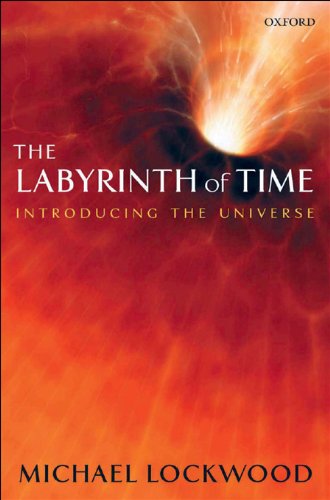
Ebook Info
- Published: 2007
- Number of pages: 416 pages
- Format: PDF
- File Size: 4.06 MB
- Authors: Michael Lockwood
Description
Modern physics has revealed the universe as a much stranger place than we could have imagined. The puzzle at the centre of our knowledge of the universe is time. Michael Lockwood takes the reader on a fascinating journey into the nature of things. He investigates philosophical questions about past, present, and future, our experience of time, and the possibility of time travel. And he provides the most careful, lively, and up-to-date introduction to the physics oftime and the structure of the universe.He guides us step by step through relativity theory and quantum physics, introducing and explaining the ground-breaking ideas of Newton and Boltzmann, Einstein and Schroedinger, Penrose and Hawking. We zoom in on the behaviour of molecules and atoms, and pullback to survey the expansion of the universe. We learn about entropy and gravity, black holes and wormholes, about how it all began and where we are all headed. Lockwood’s aim is not just to boggle the mind but to lead us towards an understanding of the science and philosophy. Things will never seem the same again after a voyage through The Labyrinth of Time.
User’s Reviews
Reviews from Amazon users which were colected at the time this book was published on the website:
⭐Another book on “time” that goes astray. Like the person who was listening to Einstein explain relativity to him- he said I was convinced that Einstein understood it.Anyway, Lockwood does not make this book easy to understand- he constantly jumps around in his writing making it more difficult, on a difficult subject to begin with.If you want read some books on “time,” here are a few that actually are about “time” and are IMO readable:G.J. Whitrow’s “The Natural Philosophy of Time,” second edition, 1980, does great job of discussing and elucidating these tricky issues of “time.” Whitrow’s book also presents a wonderful historical perspective of the human concept of “time” throughout the ages.Also interesting is “chronos,” by Etienne Klein, originally published in French in 2003, English translation 2005. This book is a diamond in the ruff which contains some interesting ideas, e.g. footnote 3 (located on p. 168) to Chapter 7, where Klein discusses Albert Le Grand (1200-1280), and Le Grand’s statement:”What depends on the soul is not the existence of time, but the perception of time.”And this to me this what so many people who write and discuss “time” seem to miss. The existence of “time” does not need humans or human “consciousness,” “time” existed before humans and will exist after humans are gone. What we struggle with is the perception of “time.”Other good books are “About Time- Einstein’s Unfinished Revolution,” 1995, by Paul Davies; “The Arrow of Time” by Peter Coveney and Roger Highfield; “The River of Time” by Igor D. Novikov.If you want to learn about the “Universe,” “From Eternity to Here” by Sean Carroll is much more readable than Lockwood’s (although IMO a little to long.)
⭐Interesting approximation with relative comprehensive language ( because sometimes are used technical language, not common for all people), to one of the more exciting philosophical enigmas of life
⭐Michael Lockwood’s book is both exhilarating and irritating.Chapter 1 introduces the ideas of tensed and tenseless time: this distinction contrasts the common sense view that time flows from an under-defined future through the instantaneous present to a fixed past, vs. the classical physics view that `now’ is simply an index into a pre-existing space-time block universe, where there is no flow of time as such. This chapter may put off the casual reader, as it includes much conceptual hand-wringing on the meaning of words. It is a reminder of why science uses precise models expressed in mathematical language, with its clear semantics and rules of inference, rather than ordinary language discussion.Chapters 2-7 are far better. A conceptually clear explanation of special and general relativity, with a discussion of time travel (closed timelike curves) and mechanisms such as wormholes for accomplishing it.Chapter 8 changes gear as Lockwood introduces the Hamiltonian approach to classical mechanics, and phase spaces. Chapters 9 and 10 form an extended discussion about the role of entropy in time asymmetry, placed in a historical context. Again interesting and clear.Things get murky again in chapters 11-13. These purport to be a discussion about why we remember the past, but not the future, but the discussion is shapeless, visiting a number of topics in a meandering fashion.Chapter 14 brings us to Quantum Mechanics. As is the fashion these days, we are taken briskly through the `old quantum mechanics’ to Hilbert spaces and energy eigenstate superposition as the driver of time-varying quantum probabilities. We are then brought to the Measurement Problem, the EPR paper and the various interpretations of QM. This is all pretty brisk, and the reader really needs to have had prior exposure to the Hilbert space formulation of QM to follow what is going on here. Lockwood, like David Deutsche, is a supporter of the `many worlds’ interpretation of QM – he prefers a variant model comprising an `actuality’ dimension. In chapter 15 he explains why this model (space-time-actuality) can resolve time travel paradoxes. Chapter 16 is a clear conceptual discussion of string/M-theory and loop quantum gravity – the two main unification thrusts in current physics.Chapter 17 suddenly goes off in an new direction, focusing on the neurological and philosophical basis of our psychological construct of the present moment. This is an extended period – Lockwood thinks about a second – called `the specious present’. The chapter ends in an obscure philosophical debate on `the temporal mode of presentation’. And that’s it, the book ends.Read this book for the explanations of relativity, quantum mechanics and current frontier thinking in fundamental physics, where it is first-rate. The chapters which deal specifically with philosophical issues probably appeal to a different audience: they seem irritating and nit-picking to this reviewer – why not translate the discussions into formal models where they can be analysed properly?Finally, a number of issues are not well analysed or resolved, such as the nature of causality, the subjective view of time flowing and the reasons why we don’t remember the future. Surely these are not purely philosophical issues, disconnected from our best physical theories? The lack of a concluding chapter is also a serious omission. Finally, you would need a degree in maths or a science subject to really engage with this book.
⭐Michael Lockwood’s book is both exhilarating and irritating.Chapter 1 introduces the ideas of tensed and tenseless time: this distinction contrasts the common sense view that time flows from an under-defined future through the instantaneous present to a fixed past, vs. the classical physics view that ‘now’ is simply an index into a pre-existing space-time block universe, where there is no flow of time as such. This chapter may put off the casual reader, as it includes much conceptual hand-wringing on the meaning of words. It is a reminder of why science uses precise models expressed in mathematical language, with its clear semantics and rules of inference, rather than ordinary language discussion.Chapters 2-7 are far better. A conceptually clear explanation of special and general relativity, with a discussion of time travel (closed timelike curves) and mechanisms such as wormholes for accomplishing it.Chapter 8 changes gear as Lockwood introduces the Hamiltonian approach to classical mechanics, and phase spaces. Chapters 9 and 10 form an extended discussion about the role of entropy in time asymmetry, placed in a historical context. Again interesting and clear.Things get murky again in chapters 11-13. These purport to be a discussion about why we remember the past, but not the future, but the discussion is shapeless, visiting a number of topics in a meandering fashion.Chapter 14 brings us to Quantum Mechanics. As is the fashion these days, we are taken briskly through the ‘old quantum mechanics’ to Hilbert spaces and energy eigenstate superposition as the driver of time-varying quantum probabilities. We are then brought to the Measurement Problem, the EPR paper and the various interpretations of QM. This is all pretty brisk, and the reader really needs to have had prior exposure to the Hilbert space formulation of QM to follow what is going on here. Lockwood, like David Deutsche, is a supporter of the ‘many worlds’ interpretation of QM – he prefers a variant model comprising an ‘actuality’ dimension. In chapter 15 he explains why this model (space-time-actuality) can resolve time travel paradoxes. Chapter 16 is a clear conceptual discussion of string/M-theory and loop quantum gravity – the two main unification thrusts in current physics.Chapter 17 suddenly goes off in an new direction, focusing on the neurological and philosophical basis of our psychological construct of the present moment. This is an extended period – Lockwood thinks about a second – called ‘the specious present’. The chapter ends in an obscure philosophical debate on ‘the temporal mode of presentation’. And that’s it, the book ends.Read this book for the explanations of relativity, quantum mechanics and current frontier thinking in fundamental physics, where it is first-rate. The chapters which deal specifically with philosophical issues probably appeal to a different audience: they seem irritating and nit-picking to this reviewer – why not translate the discussions into formal models where they can be analysed properly?Finally, a number of issues are not well analysed or resolved, such as the nature of causality, the subjective view of time flowing and the reasons why we don’t remember the future. Surely these are not purely philosophical issues, disconnected from our best physical theories? The lack of a concluding chapter is also a serious omission. Finally, you would need a degree in maths or a science subject to really engage with this book.
⭐Très bonne référence pour qui s’intéresse aux questions du temps, évidemment ce serait plus facile à lire en français, mais on ne peut pas tout avoir
⭐
Keywords
Free Download The Labyrinth of Time: Introducing the Universe in PDF format
The Labyrinth of Time: Introducing the Universe PDF Free Download
Download The Labyrinth of Time: Introducing the Universe 2007 PDF Free
The Labyrinth of Time: Introducing the Universe 2007 PDF Free Download
Download The Labyrinth of Time: Introducing the Universe PDF
Free Download Ebook The Labyrinth of Time: Introducing the Universe