

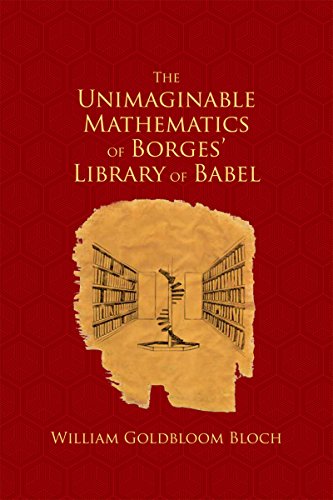
Ebook Info
- Published: 2008
- Number of pages: 212 pages
- Format: PDF
- File Size: 2.43 MB
- Authors: William Goldbloom Bloch
Description
The Library of Babel is arguably Jorge Luis Borges’ best known story–memorialized along with Borges on an Argentine postage stamp. Now, in The Unimaginable Mathematics of Borges’ Library of Babel, William Goldbloom Bloch takes readers on a fascinating tour of the mathematical ideas hidden within one of the classic works of modern literature.Written in the vein of Douglas R. Hofstadter’s Pulitzer Prize-winning Gödel, Escher, Bach, this original and imaginative book sheds light on one of Borges’ most complex, richly layered works. Bloch begins each chapter with a mathematical idea–combinatorics, topology, geometry, information theory–followed by examples and illustrations that put flesh on the theoretical bones. In this way, he provides many fascinating insights into Borges’ Library. He explains, for instance, a straightforward way to calculate how many books are in the Library–an easily notated but literally unimaginable number–and also shows that, if each book were the size of a grain of sand, the entire universe could only hold a fraction of the books in the Library. Indeed, if each book were the size of a proton, our universe would still not be big enough to hold anywhere near all the books.Given Borges’ well-known affection for mathematics, this exploration of the story through the eyes of a humanistic mathematician makes a unique and important contribution to the body of Borgesian criticism. Bloch not only illuminates one of the great short stories of modern literature but also exposes the reader–including those more inclined to the literary world–to many intriguing and entrancing mathematical ideas.
User’s Reviews
Reviews from Amazon users which were colected at the time this book was published on the website:
⭐The author does a very good job of explaining some of the mathematics that are implied from Borges’ short story, and thus uses this as a generative point. The section on the manifold may be a bit confusing for many (although the author does give his frequent “advisories”). Perhaps a little too much time is spent in the beginning making qualifying comments / apologies when they may not be necessary. In my view, there were a few other avenues the author could have explored, but that is hardly considered a failing.There are some moments where I felt as though Bloch was trying to shield Borges. Granted, Borges was not a mathematician, so it would be unfair to scrutinize his short stories according to the conceptual rigour of mathematical theory. I would be very interested if Bloch could follow up with a sustained reading of the Library of Babel with respect to set theory and the axiom of choice (what, if any, is the choice function in the Library?). This is unlike, say, The Garden of the Forking Paths which can be easily explained (so says a math colleague of mine) by the simple procedure of a Gentzen tree.I see this book as a very meaningful contribution to Borges scholarship, but also as a kind of bridge text that attempts to bring together math and literary studies. Bloch is very careful to steer away from producing the kind of “popular math” style book that is short on accuracy and substance.
⭐Good book
⭐If you are a math enthusiast and a Borges fan, you will appreciate this book. It exposes you to the math concepts that Borges might or might not have thought about while constructing his Library of Babel. The problems discussed range from those that will seem trivial to anyone who is reasonably well-versed in mathematics (what is the number of books in the library?) to less obvious ones. The fields that the author ventures in include combinatorics, topology, real analysis, information theory, and graph theory. There is also a chapter that discusses mathematical inaccuracies in the interpretations of the story by literary critics. The level of discussion in the book varies, so those who know mathematics well might find themselves skimming some chapters, whereas those who have little familiarity with the subject might find it hard to understand the more advanced ideas. Overall, this is an enjoyable book for the inquisitive mind.
⭐Bloch is not only a mathematician, he’s also a critic who has reviewed a lot of the literature on the Library of Babel and the life of Borges. So there is a lot in the book besides working out some of the mathematical implications of Borges’ inspirations.If you got as far as calculus in your math studies then you can probably follow most of the math without too much trouble. If you are a fan of Borges, there is a lot here about his math background and interests that you probably didn’t know and which affected other works of his too.If you are neither, pass this by. Go read some Borges and if you like him, then come back and read this.
⭐I read the book .
⭐It was a wonderful idea to use the Borges story to motivate the study of different areas of mathematics. Each chapter provides an introduction to different areas of mathematics related to the story. The execution, though, could have been a bit better. The section on combinatorics is way too long.Anyone familiar with the concept of combinatoric exposion, a term Bloch does not use, will catch on to the main idea rather quickly. Bloch mentions at one point that 10^100 is an unimaginably large number. In light of this, it is not surprising that numbers with exponents in the millions should be beyond our conceptual ability.The brief treatment of logarithms is a lost learning opportunity. Having done a good explanation on how exponents work, it should have been stated that logarithms are simply exponents. Finding the log is the inverse operation of taking an exponent. In a later chapter, Bloch talks about homomorphisms. Wouldn’t it have been wonderful to explain exponents and logs in terms of isomorphisms? exp(x+y) = exp(x)exp(y). Traversing the equation from right to left gives log(xy) = log x + log y. It is the same relationship. logs take the multiplicative identity, 1, and sends it to the additive identity, 0. The multiplcative inverse of x, 1/x, is sent to the additive inverse of x, -x. Bloch later talks about using Stirling’s approximation to get an expression for the factorial of the number of books in the library. Why not show the equation for Stirling’s appoximation and derive the factorial expression? It is a good exercise in the use of logarithms.The section on topology is really done well. I found it took a bit of concentration to follow it, but it was well worth the effort.I got lost on the explanation of how there could be only one Grand Plan for the arrangement of an infinite library. I really had no idea of what was being said. I was very disappointed that no explanation or even a hint of an explanation was given for why the paths to adjacent rooms can get very large.Overall I recommend the book. It could be used to enliven a mathematics class. The chapters on the various areas of mathematics are largely independent of each other, so they can be introduced as needed. Just be warned that some of the chapters are much better than others.
⭐This book is well-researched, comprehensive and, for the most part, clearly written. I’d recommend it for anyone who has an interest in diving deeper into The Library of Babel, and for those who would like to dip their toe into complex mathematical ideas.However there are sections of the book where the writing becomes less clear. Sentences and paragraphs that meander and go in circles. Occasional sections verge on incomprehensible. Sadly this is a pretty major problem. Many of the the mathematical concepts in this book are challenging, and when the writing becomes unclear it is hard to tell whether my difficulties with the concepts come down to my own failure to grasp them, or down the unclear writing. It could absolutely be the former, I don’t think I’m particularly smart and maybe I was just hopelessly smashing my head against certain ideas that I had no real hope of understanding, but which a reader sharper than me wouldn’t have much problem with.
⭐Love Borges? Love the Library of Babel? Love maths?By this book. It’s fabulous.Explores the symbolism and mystery behind this most brilliant thought experiment.
⭐There is something so magical and utterly transcendent in the writings of Borges. His closely and carefully studied pieces are marvels of contemporary literature.This book draws out the mathematical details in the library of Babel in such a way that, like the marvellous
⭐The Mystery to a Solution: Poe, Borges, and the Analytic Detective Story
⭐and the threads that run through Borges.Here the writer tackles combinatorics and permutation.Thoroughly recommended.
Keywords
Free Download The Unimaginable Mathematics of Borges’ Library of Babel in PDF format
The Unimaginable Mathematics of Borges’ Library of Babel PDF Free Download
Download The Unimaginable Mathematics of Borges’ Library of Babel 2008 PDF Free
The Unimaginable Mathematics of Borges’ Library of Babel 2008 PDF Free Download
Download The Unimaginable Mathematics of Borges’ Library of Babel PDF
Free Download Ebook The Unimaginable Mathematics of Borges’ Library of Babel