Ebook Info
- Published: 2003
- Number of pages: 158 pages
- Format: PDF
- File Size: 0.80 MB
- Authors: Fulvio Melia
Description
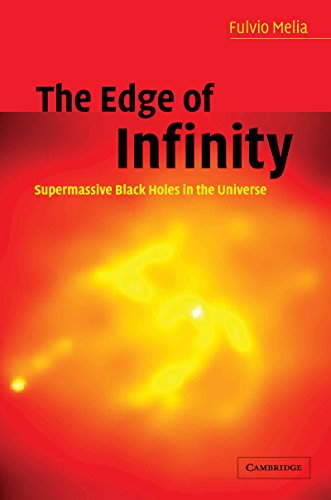
In the past, they were recognized as the most destructive force in nature. Now, following a cascade of astonishing discoveries, supermassive black holes have undergone a dramatic shift in paradigm. Astronomers are finding out that these objects may have been critical to the formation of structure in the early universe, spawning bursts of star formation, planets, and even life itself. They may have contributed as much as half of all the radiation produced after the Big Bang, and as many as 200 million of them may now be lurking through the vast expanses of the observable cosmos. In this elegant, non-technical account, Melia conveys for the general reader the excitement generated by the quest to expose what these giant distortions in the fabric of space and time have to say about our origin and ultimate destiny.
User’s Reviews
Reviews from Amazon users which were colected at the time this book was published on the website:
⭐I am a devoted student for the last 2 years to Einstein’s General Field Theory ofRelativity. Within the ten equations that Einstein’s colleague-mathematicians designedfor him, Einstein inserted the Cosmological Constant..or “CosK” as I call it. CosK wasmeant to balance the metrics and tensors describing gravitational forces within a finitestatic universe. Gravity are the influences of a spacetime curvature. However, Hubblediscovered galaxes moving away from us in “redshift” velocities, perhaps, faster thanCeleritas^2! Einstein alledgedly recanted the finiteness and a static universe with auniverse itself accelerating..in other words, galaxies and its planets will not collapseinto its centres (our sun) vis his Cosk (lambda gee mu nu), rather the Cosk becomes positiveto unknown attraction-energy in deep space. The Edge of Infinity describes black holestrillions of them, perhaps, that counteract gravity (anti-gravity)of stars, galaxies andplanets, sucking them into dense black holes..I’m still in research mode, but I believethe universe is INFINITE. it never began nor will it end. BIG BANG? NO! There may betens of trillion big bangs. Scientist seem to refuse the incomprehensible-INFINITY. Tomy pee brain, this is the home of GOD.Infinity = 0….Geo. McCullough 02/10/2012
⭐Try another book that goes even deeper in only 30 pages.It’s called “Everything About Black Holes” and it explains everything with science. It’s on Amazon.
⭐This is a very concise, well-written review of the research that has been done on supermassive black holes over the past few decades. The book is deliberately targeted at non-specialists; it didn’t contain a single equation, as far as I can recall, and is written in a highly accessible style. I have absolutely NO scientific background, I never even took physics, but I found the book pretty easy to follow. Those with significant background in physics might be disappointed with the lack of mathematical exposition, but this book is a great place for novices to begin.Melia focuses on a number of topics: the nature of supermassive black holes, how they were discovered and how they are detected, theories of how they are formed, their role in galaxy formation, their release of plasma jets, and their ultimate fate. The last chapter also contains a fascinating digression on whether our universe itself is a black hole; I found this to be the most technically challenging part of the book, but it was thought-provoking. I finished the book feeling very excited about the technological advances that are allowing cosmologists to peer deeper and deeper into the cosmos with increasing accuracy. Melia does a great job of explaining the instruments scientists use to detect black holes, and he discusses a number of projects that are likely to be completed in the next few years. Finally, the book contained a number of terrific images that really helped me to follow the narrative. In conclusion, this book is a great place to start for those who want to learn more about these fascinating celestial objects, and at 130+ pages, it is a fairly quick read.
⭐O.k., so I didn’t know what to expect, but I bought the book because I had heard that the 2005 Annual Issue of Astronomy magazine had chosen it as one of the best astronomy books of the year. I would have to agree with their choice. Melia introduces supermassive black holes in a novel fashion. Sure, we first came to know of their existence because of the weird behavior of some galaxies. But he shows how in the past few decades, they’ve come to represent a totally new and dominant category of objects throughout the universe. It now seems that many of them were here long before galaxies formed, and it looks like they were responsible for the formation of galaxies and structure in the universe. But the most amazing thing of all is what observational cosmology is now telling us. Is it true that the universe itself may be a giant black hole? Melia’s book has the best discussion of this that I have yet seen. After reading this, I feel like I’m right on the edge of what astrophysicists know.
Keywords
Free Download The Edge of Infinity: Supermassive Black Holes in the Universe in PDF format
The Edge of Infinity: Supermassive Black Holes in the Universe PDF Free Download
Download The Edge of Infinity: Supermassive Black Holes in the Universe 2003 PDF Free
The Edge of Infinity: Supermassive Black Holes in the Universe 2003 PDF Free Download
Download The Edge of Infinity: Supermassive Black Holes in the Universe PDF
Free Download Ebook The Edge of Infinity: Supermassive Black Holes in the Universe