

Ebook Info
- Published: 1999
- Number of pages: 208 pages
- Format: PDF
- File Size: 1.15 MB
- Authors: Richard Morris
Description
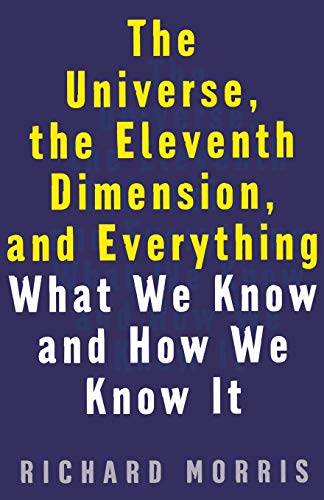
From the formation of the universe to the theory of matter to life on earth, Richard Morris delivers a clear and concise picture of what we know, how we know it, and what the limits to future knowledge might be. Morris begins by discussing various ideas about the ultimate destiny of the universe: whether it will continue expanding or eventually collapse. Next he addresses the search for a unified theory of matter that will encompass the four known forces in nature: gravity, electromagnetism, and the strong and weak nuclear forces. Finally, Morris looks at the origin of life. Once conditions were hospitable, life evolved on Earth almost immediately. But how? With wit and insight Morris takes the reader on a tour through some of the more profound aspects of contemporary science.
User’s Reviews
Editorial Reviews: Amazon.com Review Some books have a hard time living up to their titles, but The Universe, the Eleventh Dimension, and Everything does just fine. Physicist and writer Richard Morris seeks to explain the current state of knowledge in cosmology and subatomic physics; as if that weren’t enough, he goes on to give us his take on how scientists do their work. What would have been three short works in the hands of a lesser writer becomes a challenging, enlightening book that pushes readers forward from the first page. Morris’s gift for explanation is a wonder–few can get across the intricate ephemera of superstring theory without losing the audience at some point, but before we know it, we’ve already covered the scary stuff and are on to something new. Perhaps the most important section of the book is its last, “The Scientific Imagination.” Here the author lays out his thoughts on scientific work–saying, for example, “there is no scientific method”–and shows us that research and theorizing are just as creative and playful as painting and singing. Examples from such greats as Einstein and Galileo cement his arguments and inspire the reader to see the white-coated lab technician as just another stereotypical fantasy. It may not answer the Great Questions (we’re not close yet), but The Universe, the Eleventh Dimension, and Everything is a satisfying survey of what we know and how we learned it. –Rob Lightner From Publishers Weekly Prolific science writer Morris (Achilles in the Quantum Universe) explains current cosmological theories, offers a history of modern physics and summarizes some questions that vex philosophers of science in this accessible, almost garrulous, three-part work. Part one describes “what we know and how we know it” about the Big Bang, from the first few seconds of our cosmos to its probable ultimate fate. Part two, the most substantial, zips through 20th-century discoveries about the nature of matter, from Planck and Einstein to quantum chromodynamics and then to GUTs (Grand Unified Theories) and their wacky but promising successors, the superstring theories. Part three backtracks to Einstein and Newton to consider the role of imagination in scientific discovery, describing others’ ideas about scientific and artistic creativity. (Are laws of physics created, or discovered? And how do scientists know when their theories are true?) Lay readers are sure to pick up intriguing ideas from all three sections, but the book coheres only tenuously (in that all three parts have to do with what’s “real” and what we can observe). It is most enjoyable as a set of three essays rather than as a continuous argument. Copyright 1999 Reed Business Information, Inc. From Kirkus Reviews Here’s a look at the essentials of three major areas of scientific knowledge, from a popular science writer. Morris (Achilles in the Quantum Universe, 1997, etc.) points out that certain areas of physics are presently in a state of rapid flux. In the wake of the flood of new discoveries, and the flood of speculation they have encouraged, he proposes to give lay readers a clear overview of what is definitively known at present, so they can judge new theories in context. The first two sections here, therefore, look at the fundamental ideas of cosmology and particle physics. The Big Bang, contends Morris, is as firmly established as any fact in science. He outlines the evolution of the cosmos since that defining event, with summaries of the scientific evidence from as early as one second afterward, with a strong historical perspective. (However, he does seem overly taken with the anthropic principle, which proposes that the universe is as it is because otherwise advanced life forms would be impossible.) On the other end of the cosmic scale, the structure of matter has been steadily refined downward in size. Morris shows how Einstein established the reality of atoms, and how the giants of quantum physics refined the picture of the inner structure of the atom, right down to the mysterious quark. Gravity still resists easy unification with the other forces of the universe; at present, the most elegant picture of ultimate microcosmic truth appears to be superstring theory, postulating an 11-dimensional space-time continuum. Morris concludes with an extended examination of the scientific imagination, noting that style and personality play as great a role in scientific discovery as in artistic creation. This is in many ways his most provocative and original section. For the rest, Morris goes over familiar territory clearly and entertainingly, with plenty of interesting detail. Workmanlike coverage of important scientific topics. (Illustrations, not seen) — Copyright ©1999, Kirkus Associates, LP. All rights reserved. About the Author Richard Morris earned a Ph.D. in physics in 1968. He is the author of more than 20 books, 10 of which are about science, including Evolution and Human Nature. He lives in San Francisco. Read more
Keywords
Free Download The Universe, the Eleventh Dimension, and Everything: What We Know and How We Know It in PDF format
The Universe, the Eleventh Dimension, and Everything: What We Know and How We Know It PDF Free Download
Download The Universe, the Eleventh Dimension, and Everything: What We Know and How We Know It 1999 PDF Free
The Universe, the Eleventh Dimension, and Everything: What We Know and How We Know It 1999 PDF Free Download
Download The Universe, the Eleventh Dimension, and Everything: What We Know and How We Know It PDF
Free Download Ebook The Universe, the Eleventh Dimension, and Everything: What We Know and How We Know It