Ebook Info
- Published: 2018
- Number of pages: 176 pages
- Format: PDF
- File Size: 1.31 MB
- Authors: David Ruelle
Description
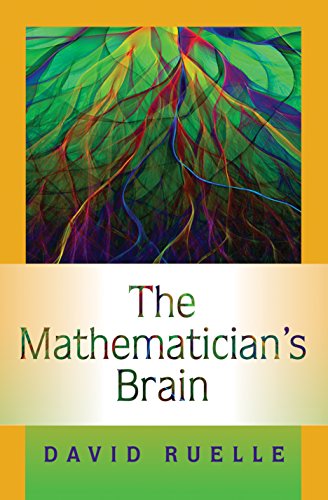
The Mathematician’s Brain poses a provocative question about the world’s most brilliant yet eccentric mathematical minds: were they brilliant because of their eccentricities or in spite of them? In this thought-provoking and entertaining book, David Ruelle, the well-known mathematical physicist who helped create chaos theory, gives us a rare insider’s account of the celebrated mathematicians he has known-their quirks, oddities, personal tragedies, bad behavior, descents into madness, tragic ends, and the sublime, inexpressible beauty of their most breathtaking mathematical discoveries. Consider the case of British mathematician Alan Turing. Credited with cracking the German Enigma code during World War II and conceiving of the modern computer, he was convicted of “gross indecency” for a homosexual affair and died in 1954 after eating a cyanide-laced apple–his death was ruled a suicide, though rumors of assassination still linger. Ruelle holds nothing back in his revealing and deeply personal reflections on Turing and other fellow mathematicians, including Alexander Grothendieck, René Thom, Bernhard Riemann, and Felix Klein. But this book is more than a mathematical tell-all. Each chapter examines an important mathematical idea and the visionary minds behind it. Ruelle meaningfully explores the philosophical issues raised by each, offering insights into the truly unique and creative ways mathematicians think and showing how the mathematical setting is most favorable for asking philosophical questions about meaning, beauty, and the nature of reality. The Mathematician’s Brain takes you inside the world–and heads–of mathematicians. It’s a journey you won’t soon forget.
User’s Reviews
Reviews from Amazon users which were colected at the time this book was published on the website:
⭐I sense that David Ruelle wrote this book as a labor of love, and I feel priveleged to have been able to read it (as with his wonderful book
⭐). He provides a fairly penetrating and sophisticated treatment of the nature of mathematics and what it’s like to be a research mathematician. His writing style is informal and friendly without sacrificing clarity, precision, and elegance. He doesn’t shy away from including some real and nontrivial mathematics (for demonstration purposes), but the book isn’t overly technical and he puts the harder stuff in the endnotes. If you’ve at least dabbled in higher mathematics and have some rudimentary familiarity with set theory, abstract algebra, topology, number theory, Turing machines, etc., you should be able to handle the book (and love it); without that background, it may be tough going.Perhaps the best way to describe the content of the book is to summarize some of the key points:(1) A goal of mathematical deduction is to derive nontrivial and interesting results (particularly mathematical theories), not just any or all results which follow from the axioms. Mathematics makes progress because new theorems are built on prior theorems. As it has developed, mathematics has generally become more difficult, though breakthroughs sometimes allow the solution of many problems to be greatly simplified.(2) Solution of mathematical problems is aided by proper (or clever) classification of problems, imagination, allowing problems to incubate in the unconscious, use of analogy as a heuristic (though not highly reliable), and brute-force use of computers (which is controversial, since such methods have little appeal to our intuition and our desire for insight).(3) Finding proofs can sometimes be very difficult because the process is like “walking in an infinite-dimensional labyrinth,” trying to connect ideas in a sequence which meets the requirements of logic. Even seemingly simple theorems may require very long proofs (eg, Fermat’s last theorem).(4) When errors and gaps in proofs are found, it’s often not overly difficult to correct them, so the resulting theorems tend to be fairly stable. In other words, the same destination can often be reached by many paths.(5) Mathematical papers generally consist of figures, sentences, and formulas. Figures make use of our visual skills, but they’re rarely mandatory. Sentences in natural language are indispensible. Formulas are compact and efficient ways of expressing sentences. Putting all of this together well is an art. Formal language could be used in principle but is unworkable in practice.(6) The conceptual or intuitive aspect of mathematics is related to its natural structures, which are not the same as the formal aspects of mathematics. These structures may reflect human and historically contingent elements, rather than being purely “natural.”(7) The different branches of mathematics are deeply related, sometimes in surprising ways. Set theory (eg, ZFC) is perhaps the most fundamental branch of mathematics. The natural structures of mathematics often guide the development of new branches of mathematics.(8) “Active research in mathematics gives intellectual rewards different from those enjoyed by a spectator.” This research is primarily an individual rather than group activity, but the overall body of mathematics is a collective achievement.(9) Many (but not all) mathematicians are prone to a “somewhat rigid way of thinking and behaving,” mathematicians are twice as likely as physicists to be religious, and, on average, mathematicians don’t possess greater artistic ability than the general population. Their special aesthetic sense is therefore of a different kind from that of artists.(10) Nature is remarkably amenable to mathematical modeling (“unreasonable effectiveness”), especially in physics, and tends to give hints regarding which models to use.(11) There’s a striking contrast between the fallibility of the human mind and the infallibility of mathematical deduction. Unlike science and other intellectual endeavors, mathematics transcends uncertainties and offers a (Platonic) “perfection, purity, and simplicity” which we naturally yearn for, even if we can’t be sure how mathematics ultimately relates to us and physical reality. Moreover, “the beauty of mathematics lies in uncovering the hidden simplicity and complexity that coexist in the rigid logical framework that the subject imposes.”(12) Gödel showed that, for a consistent and nontrivial axiomatic system, the system will contain true statements which can’t be proven from within the system, including its own consistency. This discovery of incompleteness doesn’t overly trouble most mathematicians in their daily work, though I personally find it to be profound and somewhat disturbing, or at least very perplexing …If these key points interest you, I urge you not to miss this book. If you find them obvious, I recommend reading the book anyway, since a list of key points doesn’t do justice to the richness and charm of Ruelle’s discussion. Personally, this book ranks among my favorite mathematics books and I’m a bit saddened to have reached the end of it. Now I just hope that Ruelle will write more books for nonspecialists!
⭐David Ruelle continues the venerable French tradition of great mathematicians andscientists writing for the general educated public about their craft, and aboutthe deeper meanings of it. Especially intriguing are Ruelle’s insights intomathematicians’ minds, and his balanced view of platonism vs. the contingency ofhistory and the human brain. Ruelle mentions that, with very few exceptions, great scientists are not great writers, and he states Henri Poincare as a notable counterexample. I would add thatRuelle himself is even a better specimen of a great mathematician and a great writer.
⭐In this small book the author (a distinguished professor of mathematical physics) touches on what mathematicians do, how they do it, how they think and feel about it, and how they relate to the world at large. On such a quick tour there are bound to be some mysterious turns and bumps on the road. More than necessary occur in this book: advanced topics are frequently introduced with unhelpful advice for the novice such as “Just go through it rapidly.” Nevertheless I enjoyed learning a new bits of math (now I can define algebraic geometry) and stories of mathematicians. What kept me going was the author’s skeptical attitude toward the mathematical establishment of which he is a part, and his genuine compassion for colleagues whose genius can so easily turn to madness.
⭐The author, who is a very distinguished mathematician, gives his personal view on how mathematicians think. It is welcome to have books like this written by real mathematicians, as opposed to philosophers who doesn’t know that much math. While professional mathematicians might not learn much, students of mathematics can get some very nice insights into how mathematics and mathematicians work.Unfortunately, some parts of the book that discuss specific mathematics (as opposed to what mathematics is like in general) are not clearly written and should have been edited better. For example, it shakes the confidence of the reader when early on, the pythagorean theorem is stated incorrectly, and then on the next page a statement is asserted to follow from the pythagorean theorem, when it actually follows from the converse of the pythagorean theorem. Most readers of the book will probably know this anyway so it doesn’t matter, but later, descriptions of more advanced mathematical concepts are sometimes so brief that they would probably be incomprehensible to someone who does not already know them, and puzzling to someone who does.Disclosure: I only skimmed this in the bookstore because I didn’t feel like paying 20 cents per page for it. I hope that an inexpensive paperback edition will appear, with corrections.
⭐Really enjoyed reading this book – I only have an A level education in maths and so there were a few things that I couldn’t understand, but Ruelle makes it clear that these parts aren’t fundamental to the flow of the book, as it focuses much more on the areas surrounding the mathematics – the mathematicians, as a whole or specific individuals, and how they fit (or didn’t fit) within society. At times quite philosophical.
⭐Wonderful book by the learned Prof. Ruelle. I’ll suggest his another masterclass Chance and Chaos and this book a must read, for any serious minded person who wish to pursue a career in Physics.
Keywords
Free Download The Mathematician’s Brain: A Personal Tour Through the Essentials of Mathematics and Some of the Great Minds Behind Them in PDF format
The Mathematician’s Brain: A Personal Tour Through the Essentials of Mathematics and Some of the Great Minds Behind Them PDF Free Download
Download The Mathematician’s Brain: A Personal Tour Through the Essentials of Mathematics and Some of the Great Minds Behind Them 2018 PDF Free
The Mathematician’s Brain: A Personal Tour Through the Essentials of Mathematics and Some of the Great Minds Behind Them 2018 PDF Free Download
Download The Mathematician’s Brain: A Personal Tour Through the Essentials of Mathematics and Some of the Great Minds Behind Them PDF
Free Download Ebook The Mathematician’s Brain: A Personal Tour Through the Essentials of Mathematics and Some of the Great Minds Behind Them