Ebook Info
- Published: 2015
- Number of pages: 256 pages
- Format: PDF
- File Size: 3.68 MB
- Authors: Pankaj S. Joshi
Description
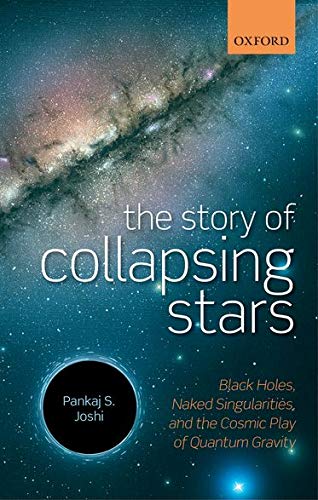
This book journeys into one of the most fascinating intellectual adventures of recent decades – understanding and exploring the final fate of massive collapsing stars in the universe. The issue is of great interest in fundamental physics and cosmology today, from both the perspective of gravitation theory and of modern astrophysical observations. This is a revolution in the making and may be intimately connected to our search for a unified understanding of the basic forces of nature, namely gravity that governs the cosmological universe, and the microscopic forces that include quantum phenomena.According to the general theory of relativity, a massive star that collapses catastrophically under its own gravity when it runs out of its internal nuclear fuel must give rise to a space-time singularity. Such singularities are regions in the universe where all physical quantities take their extreme values and become arbitrarily large. The singularities may be covered within a black hole, or visible to faraway observers in the universe. Thus, the final fate of a collapsing massive star is either a black hole or a visible naked singularity. We discuss here recent results and developments on the gravitational collapse of massive stars and possible observational implications when naked singularities happen in the universe. Large collapsing massive stars and the resulting space-time singularities may even provide a laboratory in the cosmos where one could test the unification possibilities of basic forces of nature.
User’s Reviews
Editorial Reviews: Review “Being written at the level of popular literature on physics and astronomy, this book leads the reader to the current frontier of research in gravitation theory without hiding the yet-unsolved problems and differences of opinion among specialists. In this respect it is unique, and will be extremely valuable reading.” –Andrzej Krasinski, Nicolaus Copernicus Astronomical Center”Pankaj Joshi has written a wonderful book, full of challenges for the reader and also for all physicists! Only in 1998 did dark energy become established, subverting common thought. Joshi takes it all in and he teaches us to ‘listen to nature’ to figure out how to progress and make the leap to quantum gravity, the final unification of the fundamental forces in nature.” –Peter L. Biermann, Max Planck Institute for Radio Astronomy, Germany”In this lucid overview, theoretical astrophysicist Pankaj Joshi corrals the research on collapsing massive stars and space-time singularities, including the idea that the event horizon might be a firewall of fierce radiation. Joshi sees work in these areas as a lab for testing the pressing problems in fundamental physics and beyond.” –Nature”Joshi’s book will inspire graduate students… Recommended.” –Choice”Although meant for a popular audience, The Story of Collapsing Stars presents the open research questions so clearly that it can also serve as a valuable starting point for scientists and students considering research in the area of gravitational collapse.” –Physics Today”Most of what is written in this book is very high level as can be expected from the title. Nevertheless, initiated readers would find it a good and an enjoyable read. … The engaging narrative makes the read more like a story, especially since there are no equations at all other than the very few embedded in the text that the readers should already know or at least be familiar with.” –Contemporary Physics About the Author Pankaj S. Joshi, Senior Professor, Tata Institute of Fundamental Research, MumbaiDr Pankaj S. Joshi works as a Senior Professor with the Tata Institute of Fundamental Research, Mumbai. His research is in the fields of gravitation and cosmology and he has published more than 150 research papers as well as monographs and books on the subject. He has held visiting faculty positions in several countries doing research and lecturing on these topics and has won several awards as well as Fellowships to scientific academies.Professor Joshi has made fundamental contributions in black hole physics and gravitation theory. His extensive analysis of general relativistic gravitational collapse has been widely recognized as providing significant insights into the final fate of massive collapsing stars in the universe, formation of space-time singularities, and cosmic censorship. He has also contributed a large number of books and articles towards science outreach and has given many public lectures.
Reviews from Amazon users which were colected at the time this book was published on the website:
⭐Good for general public
⭐Conventional wisdom in cosmology and theoretical physics suggest that a large star ends its life by collapsing itself into a black hole. But some theoretical studies suggest it could become a spacetime singularity, i.e. a black hole but without an event horizon. In fact, physical processes leading to star collapse suggests formation of naked singularities, but they have not been detected in the cosmos. If they are discovered, it would revolutionize our understanding of spacetime and quantum gravity. They could provide laboratory conditions to study quantum-gravitational effects and help support or contradict string and loop quantum gravity theories.In this book Professor Pankaj Joshi argues that cosmic censorship is not necessarily universal; naked singularities (black holes without event horizon) are formed under certain circumstances and may be observed. The spacetime ripples (gravitational waves) are known to be formed when two black hole or two neutron stars collide, but naked singularities may also generate gravitational waves. Gravitational force dominates at the end of a massive star’s life, and its fate is determined by Einstein’s theory of gravitation, which predicts that the star’s core-collapse results in a singularity. Physicist Roger Penrose conjectured that visible (or “naked”) singularities are forbidden in nature, hence they reside within an event horizon of a black hole.A brief description of this book is as follows:Just before the star’s death, nearly a quarter of the mass of the star is ejected within the final fraction of a microsecond. Just before this, a faraway observer would have seen a sudden dip in the intensity of radiation from the collapsing star, which would be caused by quantum gravity. In the early universe, the conditions were extreme and quantum-gravitational effects dominated; and big bang became a unique event. If singularities are detected, they would allow astronomers to observe the equivalent of a big bang every time a massive star collapse to form a spacetime singularity. This event associated with the emission of high-energy gamma rays, cosmic rays, high energy particles and neutrinos. The energy spectrum and its physical characteristics would provide a basis for evaluating theories of quantum gravity.Stellar life cycle consists of birth from gigantic clouds of dust and galactic material in deep space. They evolve and shine for billions of years, and finally descend into its final phase and eventual death. Stars shine by burning their nuclear fuel; initially hydrogen atoms which fuse it into helium, and later into heavier elements. Each star attains a balance between the force of gravity, which pulls matter toward the center, and the outward pressures generated by fusion. This balance keeps the star active and stable. When all the fuel is converted to iron; nuclear fusion stops. During the final phase of star’s life, the force of gravity dominates and the star contracts and collapse on its core to a size of the earth. At this stage, it will be supported by the force exerted by fast-moving electrons, called electron degeneracy pressure, and the resulting cosmic body is called a white dwarf. Smaller stars lead to red and brown dwarfs. If the star is three to five times the mass of the Sun, it will become a neutron star; here the gravity is so strong that nuclei dissociate into neutrons. The core of this dead star is supported by neutron pressure, and its size may be as little as six miles in dimeter. For more massive stars gravitational force dominate and its final fate is determined by Einstein’s theory of gravitation, which predicts the star’s core-collapse into a singularity.This book describes theoretical arguments for the plausibility of naked singularities, and ways to detect them through experimentally verifiable predictions. The book reads well, but there is not much of “take-home-message” in this book beyond what is already discussed in his 2009 article in “Scientific American.”
⭐About the product:The product description says it’s a hardcover book. But I received paperback. Disappointing. But otherwise the product is in good condition and the paper quality is good. I will never buy from this seller again!About the book:Well, I can suggest you to read it as if it were a textbook. It’s not an easy read as it’s not like a typical book but it’s informative.Therefore it takes a little time to adjust to this style of writing after say, one or two chapters but then you’ll start enjoying the book. Happy with the purchase .
⭐A very poorly written book which could have been 50% shorter and much more interesting. If you are interested in black holes, read the black hole war by Susskind. If you are interested in quantum gravity, read reality is not what it seems by Rovelli. This book simply doesn’t live up to the standard.
⭐Amazing book
Keywords
Free Download The Story of Collapsing Stars: Black Holes, Naked Singularities, and the Cosmic Play of Quantum Gravity in PDF format
The Story of Collapsing Stars: Black Holes, Naked Singularities, and the Cosmic Play of Quantum Gravity PDF Free Download
Download The Story of Collapsing Stars: Black Holes, Naked Singularities, and the Cosmic Play of Quantum Gravity 2015 PDF Free
The Story of Collapsing Stars: Black Holes, Naked Singularities, and the Cosmic Play of Quantum Gravity 2015 PDF Free Download
Download The Story of Collapsing Stars: Black Holes, Naked Singularities, and the Cosmic Play of Quantum Gravity PDF
Free Download Ebook The Story of Collapsing Stars: Black Holes, Naked Singularities, and the Cosmic Play of Quantum Gravity