

Ebook Info
- Published: 2007
- Number of pages: 272 pages
- Format: PDF
- File Size: 2.29 MB
- Authors: Mark Ronan
Description
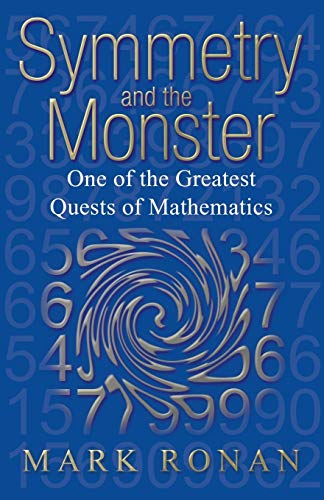
Mathematics is driven forward by the quest to solve a small number of major problems–the four most famous challenges being Fermat’s Last Theorem, the Riemann Hypothesis, Poincaré’s Conjecture, and the quest for the “Monster” of Symmetry. Now, in an exciting, fast-paced historical narrative ranging across two centuries, Mark Ronan takes us on an exhilarating tour of this final mathematical quest. Ronan describes how the quest to understand symmetry really began with the tragic young genius Evariste Galois, who died at the age of 20 in a duel. Galois, who spent the night before he died frantically scribbling his unpublished discoveries, used symmetry to understand algebraic equations, and he discovered that there were building blocks or “atoms of symmetry.” Most of these building blocks fit into a table, rather like the periodic table of elements, but mathematicians have found 26 exceptions. The biggest of these was dubbed “the Monster”–a giant snowflake in 196,884 dimensions. Ronan, who personally knows the individuals now working on this problem, reveals how the Monster was only dimly seen at first. As more and more mathematicians became involved, the Monster became clearer, and it was found to be not monstrous but a beautiful form that pointed out deep connections between symmetry, string theory, and the very fabric and form of the universe. This story of discovery involves extraordinary characters, and Mark Ronan brings these people to life, vividly recreating the growing excitement of what became the biggest joint project ever in the field of mathematics. Vibrantly written, Symmetry and the Monster is a must-read for all fans of popular science–and especially readers of such books as Fermat’s Last Theorem.
User’s Reviews
Editorial Reviews: Review “Succeeds in bringing to the fore an aspect of mathematics that some popularizers miss–that math is not a science of monuments, but a living tradition as vibrant as physics or ethics or law, one in which new monuments pop up weekly and old ones are retrofitted for purposes inconceivable to their creators.”–Seed Magazine About the Author Mark Ronan is a Professor at the University of Illinois at Chicago, and a Visiting Professor of Mathematics at University College London.
Reviews from Amazon users which were colected at the time this book was published on the website:
⭐This book is a ripping yarn – I couldn’t put it down. My wife asked when I came to bed at midnight : “Maths porn again darling? ” Although I have done some group theory, my knowledge was nowhere near enough to make any meaningful attempt to understand the detail of the Monster project and like many others, it remained an intractable beast that others were battling with. Ronan explains in a high level way the history to the Monster starting with Galois and working his way through the historical development. He peppers the account with all manner of interesting observations about the participants which are revealing in ways that one does not often find in maths books. For instance, there is a revealing comment on page 152 about someone of the stature of John H Conway who confessed he “felt like a fraud” in giving talks early on in his work on Monster. It seems a graduate student asked him the obvious question namely ” How do you now that your new group can’t be decomposed into something simpler?” Maths is an unforgiving business.Mark Ronan who has worked with and/or knows most of the heavy hitters in the field has done a wonderful job explaining the history of what is an extraordinary undertaking not only in purely intellectual terms but also in personal terms. The sociological dimensions of this immense task are reflected in all manner of small and large stories. Thus John H Conway bargains with his wife to have blocks of time away from the 4 kids so he can crack some problems and he manages in 12 ½ hours to prove something important about the Leech Lattice. That set him up for life. The proofs in this field can be hundreds of pages long – one by Mason is 800 pages long and has not been published. This itself imposes huge strains on referees. The classification task (which I had read about but had no detailed knowledge of what was involved other than a vague idea it was the equivalent of the 30 Years War) demonstrates what a small group of intensely committed people can do. What they were doing was to provide a set of knowledge that subsequent mathematicians could understand given that the barriers to entry to the detailed knowledge are so high.At a purely personal level one has to marvel at how some of the people concerned threw their lot in with this “monstrous” task. Every budding PhD students knows that problem selection is important and it does not pay to spin one’s wheels forever on some obscure problem.There are some truly astonishing connections revealed in this book. The connection between the number theoretic j function and the character set of the Monster (see pages 192-193) is remarkable but then there is the even more remarkable connection between light rays and the Leech Lattice (see page 224).Mark Ronan has done a great service to all those who have served and still served in the battle with the Monster. Most of the main workers in the field are no longer with us so Ronan’s book provides the general community with some sense of their achievements.For those interested in Lie Theory may I suggest John Stillwell’s accessible book “Naïve Lie Theory” as a starting point. He strips a way a lot of the overheard that makes Lie Theory so daunting.Peter HaggstromBondi BeachSydney, Australia
⭐The author quoted John von Neuman in his introduction: “In mathematics you don’t understand things; you just get used to them”, but this quote serves also as a summary of the whole book. So first, don’t expect to understand things after reading this book and second, don’t expect to get used to them either, unless you are a mathematician. This book is an anecdotal and very light reading that concentrates on the “story” of one of the greatest quests in mathematics. It will give you a better idea of the main mathematicians involved and what they contributed to this almost two century long quest of finding and constructing the “atoms of symmetry” and afterwards of classifying them during the so called “Thirty Years War” (70’s – 2000) in a sort of “periodic table” plus 26 non fitting “exceptional symmetry atoms” or sporadic groups. The “monster” is the biggest of these groups.What this book really shows is that 16-hour days of arduous number-crunching can make you get used to math in a way that the interrelations or patterns between numbers and their basic operations or permutations become “hard-wired” into your brain. Consider following conversation between two “Monsters of Maths” (I summarized the anecdote and changed the wording; T=Thompson, C=Conway). C: “I think there might be some exceptional group in Leech’s Lattice”. T: “I am not sure…give me the size.” 12 1/2 hours later C: “It’s 2^22*3^9*5^4*7^2*11*13*23 or half of it”. 20 minutes later T:”Yes, it’s half of it, I can see it now…It’s…the monster! and… look, it has a baby!…Let’s find out if they really exist…” The figure mentioned by Conway equals 8,315,553,613,086,720,000 and is expressed as factors of prime numbers for simplicity. (yes, simplicity!) How these factors can seem obvious to anybody in the first place is already a mystery for me, but mathematicians seem to send each other postcards with these numbers, and apparently they make sense to them.This book will reveal you the existence of a 196,883 dimensional space, which by the way seems to be the world in which mathematicians live in and, since “the Monster” might be linked to the way the Universe is constructed, we probably also live in it without being aware of it. On the other hand, some anecdotes could have been omitted in order to explain some concepts more deeply, like what makes the exceptions different from the other groups in the “periodic table”, what exactly is a lie algebra, how does a character table work (maybe he could have explained it using a 4 x 4 table), etc. For an understanding of rotations in three dimensional space, read the chapters on lie algebra and group theory in
⭐.
⭐Four stars because as a scientist but non-mathematician I would have liked a little more time spent getting a toe-hold on the basics of this fascinating field. Like: why are five objects different from four? Presumably with pencil and paper I can sit and work this out – but I’d have liked a paragraph to point me in the right direction. And the throwaway comment right in the middle about the sizes of successive atomic orbitals (2, 6, 10, 14…) being determined entirely by their symmetry: I’d love to know where that came from. Held my interest but left me feeling empty.
⭐A very well written book with clear language use and understanding of a fascinating but small part of modern mathematics. A history of mathematicians involved with the evolution of “the monster-group’ is a must for some film producer. Written for novice or otherwise i would suggest anyone serious about math study should have it as part of their library. One minor point some of the analogies used may confuse but that probably tells you more about my reading of it.
⭐This is a history book about the history of research into group theory and the discovery of the “Monster”, not a book about that Monster. The math has been simplified beyond recognition, and even after reading up on the subject in the Wikipedia and with a PhD in computer science, I could not make head or tail of it.The first problem is that the author does not make clear what he means by “a symmetry”.We learn that the “zillions of symmetries” of the Rubik cube are “generated by 90 degree turns”, which in the lines above are compared to “symmetry operators”. This suggests that the 24 turns (4 on each of the 6 sides) are the operators and that the positions that can be achieved are the symmetries. But operators in a (mathematical) group have the property that the combination of two operators is again an operator in that group, so any configuration canbe achieved with a single (compound) operator. So are all these operators “symmetries”? I find it confusing.Symmetries are also explained as permutations, but the relationship remains vague.A second problem is that the level of explanation is very uneven: the root sign is explained, but the j-function is written out without any explanation.We learn a lot about the people around the Monster but next to nothing about the Monster itself, except that it is 196,884-dimensional, but that’s already on the cover of the book. Does it have a geometric representation, like a cube? Or is it just a network of symbols? (Does a network of symbols have symmetries?) If it can be geometric, it must have sides. Are all sides the same length like in a cube or a dodecahedron? How big is it if the length of the shortest side is 1 unit? Answers to such questions would have made the Monster much more accessible.Perhaps the subject is too complicated to allow a popularized treatment, in which case sticking to just the history is OK. But it would have been nice to see an example or two of representatives of the simpler symmetry groups. Some examples are given, but they are not assigned to groups. And it would have been nice to be told to what position in the periodic table of symmetries Rubik’s cube occupies, probably the most complicated symmetric object any of us can relate to.
⭐Mark Ronan ist emeritierter Professor für Mathematik der Universität von Chicago, mit seinem Buch ‘Symmetry and the Monster’ versucht er das überaus spannende, wie auch komplexe Gebiet der endlichen einfachen Gruppen einem breiten Publikum nahe zu bringen.Symmetrien faszinieren Menschen schon seit dem Altertum, das richtige mathematische Mittel zu ihrer Beschreibung ist hingen noch relativ jung: Gruppen, diese Objekte wurden zunächst unter anderem von N. Abel und E. Galois in Zusammenhang mit der Auflösbarkeit algebraischer Gleichungen untersucht. Gruppen erwiesen sich bald als eines der fruchtbarsten mathematischen Konzepte: Felix Klein deckte ihre Beziehungen zur Geometrie auf, und nachdem Sophus Lie speziell stetige Gruppen untersucht hatte, konnte Emmy Noether einen tiefen Zusammenhang zwischen physikalischen Erhaltungsgrößen und Symmetrien beweisen, der heute einen der Grundsteine der quantenmechanischen Elementarteilchen Theorien darstellt.Wenn Mathematiker bedeutende Strukturen entdecken, sind sie sehr daran interessiert, diese vollständig zu verstehen und möglichst zu klassifizieren, das kann oft bedeuten, eine Liste aller möglichen ‘kleinsten Bausteine’ solcher Strukturen zu finden. Für den Fall stetiger Gruppen, sogenannter Lie Gruppen, brachten die Arbeiten von Wilhelm Killing und Elie Cartan recht schnell Erfolg.Es wird vielleicht verwundern, dass sich eine entsprechende Klassifizierung von endlichen Gruppen, als wesentlich komplizierter herausstellen sollte. Einer der Gründe dafür ist, dass die Mittel der Differential Geometrie, die für das Verständnis der Lie Gruppen, so entscheidend waren, auf endliche Gruppen nicht anwendbar sind; die Mathematiker mussten sich also vollkommen neue Werkzeuge schaffen; dazu legten L.E. Dickson und William Burnside wichtige Grundlagen ‘ u.a. mit der Theorie der Gruppen Charaktere.Nach dem Krieg brachten die Beiträge von Claude Chevalley und Jaques Tits einen neuen Aufschwung zur Arbeit an der Klassifikation endlicher Gruppen; das ‘Odd Oder Theorem’ von Walter Feit und John Thompson eröffnete zu dem eine Möglichkeit zu einer Liste der einfachen endlichen Gruppen zu gelangen.Neben den Serien, wie sie schon von den Lie Gruppen bekannt waren, waren um 1900 fünf sogenannte sporadische Gruppen bekannt, die von E.L. Mathieu gefunden worden. Der Autor schildert die Geschichte der Vervollständigung der Liste dieser sporadischen Gruppen, die mit Zvonimir Janko wieder einsetzt. Als einer der wesentlichen Katalysatoren erwies sich ein von John Leech im Zusammenhang mit error correcting codes untersuchtes hoch symmetrisches Gitter in 24 Dimensionen, auf das John Conway von J. McKay gestoßen wurde; mit Unterstützung von Thompson untersuchte Conway die Eigenschaften dieses Gitters und identifizierte Verbindungen zu 12 solchen Gruppen, darunter drei neuen, die später nach Conway benannt wurden. Bernd Fischer kam schließlich das Privileg zu, die größte dieser sporadischen Gruppen zu entdecken ‘ dem Monster (einer von Conways typischen Namenskreationen).Diese gerade neue entdeckten, unvorstellbar großen, Gruppen sollten aber noch weitere Überraschung bereithalten. Bei der Durchsicht einer zahlentheoretischen Arbeit, stieß John McKay auf die Entwicklung einer modularen Funktion, in der als Koeffizient 196884 auftauchte, das ist gerade die Dimension der ersten Darstellung des Monsters + 1; das hätte ein Zufall sein können, gemeinsam mit Conway untersuchten sie die Angelegenheit näher, und fanden noch eine ganze Reihe weiterer solcher ‘numerologischen’ Beziehungen, die sie unter der Bezeichnung ‘monstrous moonshine’ veröffentlichten (einer weiteren von Conways Kreationen als ‘moonshine’ bezeichnet man illegal gebraute Spirituosen).Richard Borcherds, ein Schüler Conways, gelang es schließlich, unter Verwendung von Resultaten von Frenkel, Lepowsky und Meurman, die auch Bezug zur String- Theorie haben, die Moonshine Vermutung zu beweisen; er wurde dafür 1998 mit der Fields Medaille geehrt.Der Autor geht auf all diese faszinierende Entwicklungen ein, versucht beim Leser zumindest eine Vorstellung von den dabei zu bewältigenden Problemen zu schaffen; auf dem Weg dahin streift er das Leben und Schaffen, einer Reihe daran beteiligter Mathematiker. Schlaglichtartig werden gut 200 Jahre Mathematikgeschichte eines der bedeutendsten Probleme der neuen Zeit beleuchtet.Entsprechend dem Anliegen der Allgemeinverständlichkeit, verzichtet der Autor auf dem Gebrauch zu technischer Begriffe, er spricht zum Beispiel lieber von Symmetrie Atomen statt von einfacher Gruppen, das wird durch eine Reihe Anmerkungen zum Text und vier Anhängen mit mathematischen Details, ein wenig ausgeglichen; man wird allerdings eine Bibliographie mit weiterführender Literatur vermissen.
⭐
⭐Die Absicht die mathematische Abhandlung der endlichen Gruppen allgemeinverständlich zu erläutern, eine mathematische Unternehmung die schließlich mehrere Jahrhunderte und Abertausende Zeitschriftenseiten benötigt hat, um zu ihrem Abschluß zu kommen, ist lobenswert. In der Umsetzung mangelt es aber am wichtigsten…der Mathematik! Somit ist vielleicht ein leicht lesbares Werk enstanden, aber leider erfährt man nur sehr wenig, über das eigentliche Untersuchungsobjekt. Alles bleibt qualitativ und bildlich. Wenn man etwas essentielles dazulernen wollte, wird man so enttäuscht. Die eingstreuten mathematischen Anekdoten und Historien sind unterhaltsam, aber auch sie dienen nur selten der Erhellung des mathematischen Kerns, der Anlaß für die genannten Mathematiker war, sich mit dem Thema auseinanderzusetzen. Dem unbedarften Leser muß es am Ende komisch vorkommen, daß die Erforschung eines scheinbar so seichten Forschungsgegenstandes so viel Anstrengung gekostet hat. Alles in allem…Chance vertan…
⭐
Keywords
Free Download Symmetry and the Monster: The Story of One of the Greatest Quests of Mathematics in PDF format
Symmetry and the Monster: The Story of One of the Greatest Quests of Mathematics PDF Free Download
Download Symmetry and the Monster: The Story of One of the Greatest Quests of Mathematics 2007 PDF Free
Symmetry and the Monster: The Story of One of the Greatest Quests of Mathematics 2007 PDF Free Download
Download Symmetry and the Monster: The Story of One of the Greatest Quests of Mathematics PDF
Free Download Ebook Symmetry and the Monster: The Story of One of the Greatest Quests of Mathematics