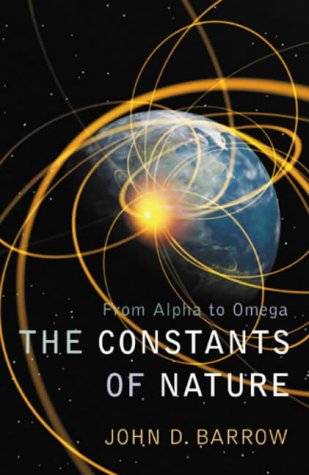
Ebook Info
- Published: 2002
- Number of pages: 352 pages
- Format: PDF
- File Size: 10.37 MB
- Authors: John Barrow
Description
good condition
User’s Reviews
Reviews from Amazon users which were colected at the time this book was published on the website:
⭐In order to explain physical reality, physicists measure and determine physical quantities/parameters/information related to the object/subject in question using well defined laws such as; the laws of classical physics (theory relativity), quantum mechanics, and thermodynamics. Physicists do not know the details of all the laws, and their interpretations/explanations often vary, but the physical laws themselves are the same across the universe. Einstein’s principle of covariance states that laws of nature should appear the same for all observers in the universe no matter where they are located or how they are moving. The equations and the fundamental constants that write these laws are universal, but as physicists try to explain how the universe works, it is increasingly becoming apparent to a few physicists that some fundamental constants such as the speed of light (c), fine-structure constant, proton-electron mass ratio, and gravity (G) have changed over the last 13.7 billion light years.The author chronicles the historical development in the physics research of universal constant and touches upon the most fundamental part of creation. How do these constants that are a part of an equation could have impacted a functional universe that supports life? Mathematician Ramanujan once said that “An equation has no meaning unless it expresses the thought of God.” The dimensionless constant is certainly the thought of God. Time variation of fundamental constants is subjected to theoretical and experimental research by a number of physicists such as; Arthur Eddington, Paul Dirac, George Gamow, Robert Dicke, Brendan Carter and others. The fine-structure constant was originally introduced in 1916 by Arnold Sommerfeld, as a measure of the relativistic deviations in atomic spectral lines of the Bohr’s atomic model. This constsnt is interpreted as a measure of electromagnetic force that holds the atoms together or the strength of the interaction between electrons and photons; the ratio of two energies, the energy needed to bring two electrons from infinity to a distance against their electrostatic repulsion, and the energy of a single photon. It is also defined as the ratio of the strengths of the electromagnetic and gravitational interactions. This constant is a dimensionless quantity (1/137.035999679); hence its numerical value is independent of the system of units used. Many physicists have wondered why God would have created such an odd number for this constant (value of Pi is another example.) One explanation is the cosmological evolution of a quintessence-like scalar field coupled to gauge fields and matter would have effectively modified the coupling constants and particle masses over time. However, the anthropic principle states that the value of the fine-structure is what it is because stable matter could not have existed in the universe if that was any other number. In other words, galaxies, stars, planetary systems and life forms would not have evolved. For instance, if this constsnt was changed by 4%, carbon and oxygen would not have been produced in stars.Since fine-structure constant is present wherever electromagnetism is, it is determined by various methods from atomic spectra. One is by analyzing the atomic spectra of distant galaxies and stars. The second one is the natural reactor of Oklo has been used to check if the atomic fine-structure constant might have changed over the past 2 billion years. That is because it influences the rate of nuclear reactions. For example, Samarium(149) captures a neutron to become Samarium(150), and since the rate of neutron capture depends on the value of this constant, the ratio of the two samarium isotopes in samples from Oklo can be used to calculate the value of this constant that existed 2 billion years ago. The results are conflicting and it is not clear if these constant are changing. Despite the fact that this book has many irrelevant quotations from unorthodox figures such as; Joan Rivers, Woody Allen, Brooke Shields, W.C. Fields, and George Bush, it is highly recommended.1.
⭐2.
⭐3.
⭐4.
⭐5.
⭐”Constants of Nature” is an excellent overview of a fascinating topic–the origins and significance of the constants of the universe. It prompted me to spend a great deal of my free time digging around for more information on many of the topics it addresses, which is always a ringing endorsement for a work of non-fiction.However, it’s not perfect. The book’s subtitle (“From Alpha to Omega”) is somewhat deceptive–the “meat” of the book (after the first few chapters) deals almost entirely with the fine structure constant (alpha). Barrow talks a great deal about constants in general, but never devotes much time to any of the others specifically. Furthermore, at times, Barrow seems to become sidetracked–an inexplicable discussion of the value of contemplating “alternative histories” (i.e., speculating what would have happened if Germany had won World War II, and similar endeavors) awkwardly interrupts the flow of one chapter, for instance. Also, the book has several errors that were immediately obvious to me (for instance, it says light from the Sun takes 3 seconds to reach the Earth; the correct value is more than 8 minutes), which makes me suspect that there are probably many more errors that I missed, but which would be obvious to someone with a marginally greater degree of physics sophistication.However, perhaps the biggest disappointment was in the introduction of the values of the Planck length, Planck time, etc., all of which are central to the book. Barrow justifies the signifiance of these values simply by stating that they are the only values of the appropriate dimensions that can be derived by combining certain other physical constants in straightforward ways. However, from there he makes the logical leap that the Planck distance, for instance, is the “natural” measure of length in the universe. This is certainly a fair statement, but it’s hardly justifiable to make that statement based simply on the fact that it can be derived from a number of other constants–one could have selected another collection of fundamental constants and come up with a completely different “natural” unit of length. In short, the line of reasoning does not justify the conclusion.In all, this is a thought-provoking work, but it’s often short on detail and had a tendency to leave me with more questions than answers. The more technical reader will probably wish for more thorough arguments throughout; however, it’s still an enjoyable read and a fine attempt at popularizing a difficult area of physics.
⭐In his previous book “The Book of Nothing”, John Barrow presents a vacuum and uses it to show us its new meaning. Now he finds another interesting topic – constants of Nature in science (mostly “fine structure” constant but not exclusively), and uses them to teach us about unknown history and measurements in modern cosmology. I find his cube of theories and colorful description of many forms of multiverses (including the one having different times dimension) very educative.Extra flavor is added in chapter 9 (about “virtual history”). It brings some humor and relaxes in the middle of not so easy subjects. Especially chapter 11 requires extra effort and figure 11.6 is missing from the hardcover edition. Generally: book represents another great effort in popularizing sophisticated top end of a science. Hopefully I will remember formula: 2(pi)e^2/hc for a long time to come.
⭐I have read and re-read this book at least 5 times since I bought my first copy in 2003. Each time, a new insight or deeper understanding has emerged. I gave my first copy away and had to replace it because I wanted to re-read it again..Chapters 6, “The Mystery of the Very Large Numbers, ” 7, “Biology and the Stars,” and 8, “The Anthropic Principle” blew me away the first time I read it, and still do. Even though the subject matter is heavy, Barrow writes with a breezy style that makes it read like an historical adventure novel. I highly recommend it to the non-mathematician who wants to understand the true role of The Numbers in the Universe we inhabit and observe.
⭐John Barrow’s latest book has been widely praised for its attempts to illuminate the thinking of some of the world’s greatest scientists on fundamental questions about our universe. He does this by focusing on ‘the constants of nature’ which include constants describing the force of gravity, the speed of light,etc. Despite his laudable attempts to make the subject comprehensible to his audience the book suffers several shortcomings. Firstly it is not clear who the target audience is. An intelligent lay reader (say someone with a degree in a subject outside of the physical sciences) will find a fair proportion of the book beyond his grasp. He will likely comprehend the broad sweep of Barrow’s argument but in later chapters he will surely fail to comprehend fully the detailed descriptions of theoretical physics. An appendixed glossary of scientific terms might have been helpful. On the other hand the book is clearly not written with the scientific community in mind, containing as it does many analogies intended to aid comprehension. To be fair to Barrow it is his subject matter that is the main problem. I have not read many books on physics that get around this problem (biology seems to be easier to explain). Secondly Barrow’s prose is somewhat cumbersome and difficult to follow. Efficient editing would have greatly improved the book. Overall The Constants of Nature remains a good book but a potential purchaser should consider the points made above.
⭐I have been a Barrow reader since being lent The World Within The World by my grandfather. The latter book is a masterpiece that gave me at the age of 16 or 17 a fascination with philosophy and science, and made we want to understand complex pure physics. Also, Impossibility is a brilliant book, and has plenty of open-minded theories, and currently I’m starting to read The Anthropic Cosmological Principal, (nearly in my third year of a maths degree now). When I pre-ordered The Constants of Nature I was anticipating something at least as good as The Book Of Nothing, (another very good book, though less profound than the other three that I mentioned), but I was, in honesty, disappointed. The highlight of the book in my opinion is the section on Eddington. I agree with one of the previous reviewers that it is hard to see who the book is aimed at. It must be aimed at a wider audience than most/all previous books of Barrow’s though, because when I read the book at the time of publishing it didn’t seem as challenging as any of the other books of his that I had read, and there didn’t seem to be any important thesis really; its a bit more like a history book than a novel thesis on looking at physics from a new angle. I would love to see Barrow go back to the level of ‘intelligent laymen/laywomen’ audience such as the level of ‘The World Within The World’, as the engaugingness of the latter is much greater than of this book due to its greater challenge to the reader. I suppose that in the same way as an expert musician that might turn to playing simple stuff because they discover that they are marketable and can appeal to a wide audience, here Barrow is apparently ‘selling out’ in the same way. Also, diagrams from the Book of Nothing are used in this book, and few new diagrams or interesting concepts are touched upon. I recommend any of the other Barrow books that I have read, (those listed above), but just not this one. I’m hoping that Barrow goes back to the higher sophistication of his late 80s/early 90s works.
Keywords
Free Download The Constants of Nature: From Alpha to Omega in PDF format
The Constants of Nature: From Alpha to Omega PDF Free Download
Download The Constants of Nature: From Alpha to Omega 2002 PDF Free
The Constants of Nature: From Alpha to Omega 2002 PDF Free Download
Download The Constants of Nature: From Alpha to Omega PDF
Free Download Ebook The Constants of Nature: From Alpha to Omega