Ebook Info
- Published: 2021
- Number of pages: 516 pages
- Format: PDF
- File Size: 32.99 MB
- Authors: Helge Kragh
Description
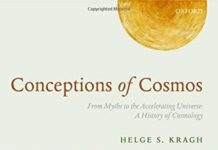
For over three millennia, most people could understand the universe only in terms of myth, religion, and philosophy. Between 1920 and 1970, cosmology transformed into a branch of physics. With this remarkably rapid change came a theory that would finally lend empirical support to many long-held beliefs about the origins and development of the entire universe: the theory of the big bang. In this book, Helge Kragh presents the development of scientific cosmology for the first time as a historical event, one that embroiled many famous scientists in a controversy over the very notion of an evolving universe with a beginning in time. In rich detail he examines how the big-bang theory drew inspiration from and eventually triumphed over rival views, mainly the steady-state theory and its concept of a stationary universe of infinite age. In the 1920s, Alexander Friedmann and Georges Lemaître showed that Einstein’s general relativity equations possessed solutions for a universe expanding in time. Kragh follows the story from here, showing how the big-bang theory evolved, from Edwin Hubble’s observation that most galaxies are receding from us, to the discovery of the cosmic microwave background radiation. Sir Fred Hoyle proposed instead the steady-state theory, a model of dynamic equilibrium involving the continuous creation of matter throughout the universe. Although today it is generally accepted that the universe started some ten billion years ago in a big bang, many readers may not fully realize that this standard view owed much of its formation to the steady-state theory. By exploring the similarities and tensions between the theories, Kragh provides the reader with indispensable background for understanding much of today’s commentary about our universe.
User’s Reviews
Reviews from Amazon users which were colected at the time this book was published on the website:
⭐This book is a detailed and masterful description of the history of big bang cosmology, from its emergence in the 1940s to its observational validation in the 1960s. It is also an inquiry into the nature of the scientific progress — an equally fascinating subject. The book is complete with personal histories of the main participants and gives unique insights into their motivation and the evolution of their views, often obtained through personal correspondence with the author. Being a cosmologist myself, I can add that the book is written with a deep understanding of the subject.
⭐This very good book is a history of scientific cosmology from its initiation with Einstein’s development of General Relativity to the establishment of the Big Bang theory, approximately from about 1920 to 1970. As Kragh demonstrates, cosmology in the modern, scientific sense begins with Einstein’s publication of the Theory of General Relativity which made possible the development of models of the universe. Simple models developed originally by Einstein himself and the Dutch astronomer De Sitter depicted static universes and were based the existing astronomical data suggesting a static universe. The accumulation of astronomical data indicating a larger and expanding universe plus the exploration of models led to alternative models, notably those of the Belgian astrophysicist and priest George Lemaitre, the first systematic development of the Big Bang hypothesis. Kragh discusses very nicely development of these ideas, alternative approaches developed by the small number of other investigators interested in cosmology, and the interaction between theory and observation. He then describes the post-WWII emergence of the major alternative to the Big Bang hypothesis, the Steady State theory developed by the British scientists Hoyle, Gold, Bondi. The development of this theory, the major expansion of the Big Bang theory by American investigators led by George Gamow, the interaction of theory and observational work, and the general nature of the controversy is delineated very well by Kragh in an account that looks both at the primary literature and the general context. Kragh discusses philosophical issues, different national traditions, the impact of new methods in astronomy, and the impact of other developments in physics. For example, in the late 1950s, there was a revival of interest in General Relativity and the emergence of experimental methods to evaluate General Relativity. The success of General Relativity in these experiments gave credance to cosmological models, like the Big Bang, based on General Relativity. Kragh’s discussion of the interaction of theory and experiment in the resolution of the controversy in favor of the Big Bang theory is simply excellent.This book can be seen to some extent as a case study testing Kuhn’s famous model of scientific progression. While Kragh uses Kuhnian terms like paradigm, his overall conclusion is that Kuhn’s model doesn’t really describe the way this major scientific development unfolded. Kragh’s narrative indicates something much more like Kuhn’s “normal science” as the predominant mode of scientific progression.The ideal reader for this book is a cosmologist or physicist with considerable knowledge of cosmology. Kragh presents quite a bit of the narrative by showing the actual equations. Nonetheless, this book is definitely intelligible in a general way to readers with only a vague knowledge of cosmology (like me). Kragh is a very good writer who is careful to provide narrative accessible to general readers. I, for example, don’t have the physics to understand cosmology in depth but I was able to get a good qualitative sense of the important developments and historical process.
⭐Cet ouvrage présente l’histoire de la cosmologie moderne, à partir du début du XXe siècle, en exposant avec minutie l’émergence puis la confrontation de deux théories cosmologiques, le Big Bang et le modèle stationnaire. L’auteur, historien des sciences, manifeste une remarquable compréhension des concepts scientifiques dont il étudie l’évolution, en plus d’un style clair et précis. C’est bien d’histoire des sciences qu’il s’agit ici, et le texte est agrémenté de nombreuses références bibliographiques précises. L’enchaînement des idées est présenté avec beaucoup de précision, tout en restant très agréable à lire. J’ai personnellement pris autant de plaisir à le lire, comme un livre de chevet, que pour Game of Thrones ! :)Il intéressera autant le scientifique du domaine que le lecteur curieux de cosmologie : en tant que professionnel de l’astrophysique, je dois avouer que la plupart des éléments exposés dans cet ouvrage m’étaient totalement inconnus, et que sa lecture m’a ouvert les yeux sur certains aspects historiques, mais aussi épistémologiques, de la cosmologie moderne. Merci M. Kragh pour ce magnifique ouvrage ! Je mets la note maximale sans aucune hésitation !
⭐
Keywords
Free Download Cosmology and Controversy: The Historical Development of Two Theories of the Universe in PDF format
Cosmology and Controversy: The Historical Development of Two Theories of the Universe PDF Free Download
Download Cosmology and Controversy: The Historical Development of Two Theories of the Universe 2021 PDF Free
Cosmology and Controversy: The Historical Development of Two Theories of the Universe 2021 PDF Free Download
Download Cosmology and Controversy: The Historical Development of Two Theories of the Universe PDF
Free Download Ebook Cosmology and Controversy: The Historical Development of Two Theories of the Universe