Ebook Info
- Published: 2009
- Number of pages: 400 pages
- Format: PDF
- File Size: 3.76 MB
- Authors: Heinz R. Pagels
Description
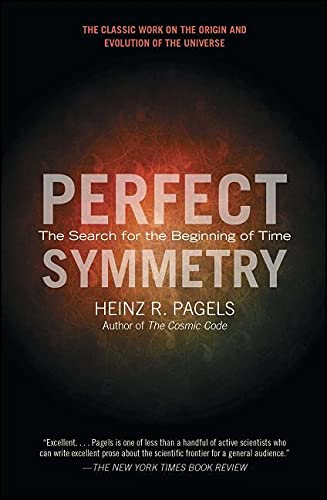
Popular science at its best, this acclaimed classic work describes in stunning detail how cutting-edge discoveries in quantum physics and cosmology are helping to explain the origin and evolution of the universe, of space and time. Perfect Symmetry is an optimistic report about the ongoing synthesis of these two disciplines into a concerted effort to uncover the fundamental laws that not only describe how the stuff that makes up the universe — matter and energy — came into existence but also govern the behavior of the smallest and largest things, from subatomic particles to stars, galaxies, and the universe itself. Written by that rarest of scientists — one who is esteemed by his peers yet capable of making the most complex ideas comprehensible to laymen — Perfect Symmetry is an enthralling intellectual adventure, science that reads like art.
User’s Reviews
Editorial Reviews: Review “Splendid.” — The New York Review of Books”Eloquent…. Pagels has shown a flair for graceful exposition….He is also a wry philosopher.” — Kirkus Reviews About the Author Heinz Pagels was the executive director of the New York Academy of Sciences and adjunct professor at Rockefeller University. The author of several other acclaimed books, including The Cosmic Code: Quantum Physics as the Language of Nature and The Dreams of Reason: The Computer and the Rise of the Sciences of Complexity, he died in 1988.
Reviews from Amazon users which were colected at the time this book was published on the website:
⭐This is an interesting book, but having been written thirty years ago it is somewhat out of date. One easily could overlook the fact that the book was written thirty years ago had this been a history book, but the fields of cosmology and particle physics have advanced so rapidly in 30 years as to make some of the material in this book out of date. For instance, there is no mention of the unexpected acceleration in the rate of expansion of the universe that has been observed in the last thirty years or the concept of dark energy, which has been used to explain it. Also, the pictures in this paperback edition are printed on the same coarse paper as the text and are therefore murky at best. I therefore find it difficult to recommend this book without the caveat that it represents the thinking as of 1985. For those who have not already done so, I would recommend Greene’s ‘The Fabric of the Cosmos” for a more up to date view of cosmology and Oerter’s ‘The Theory of Almost Everything” for a more up to date (and I think more readable) view of the Standard Model of particle physics.I also found that it was more complex than a book like Hawking’s “Brief History of Time”, with a lot more physics. I would only recommend this book for someone with some familiarity with particle physics, the standard model and cosmology. However, I did find a lot to interest me, so I could give the book four-stars, as I have done a lot of reading concerning the standard model and cosmology.What is in the book –The book is divided into three sections as follows:1. Herschel’s Garden, which describes the universe and classical cosmology.2. The Early Universe, which describes fields, quanta, symmetry and the standard model of particle physics and how this related to cosmology.3. While ideas, which describes ideas such as Unified field theories (as of 1985), magnetic monopoles, the idea of the inflationary universe and the ideas concerning the origin of the universe.
⭐The book came in near perfect condition. A super fun and easy read for those into astronomy.
⭐Mr Lovelock presents a theory that must be seriously considered by anyone who has an interest in keeping our planet alive. I would recommend this book highly, and I intend to find the author’s previous books and read them, as well.
⭐Even though it is a bit old, this is a great book. Pagels writes popular science better than anyone I know.
⭐I’ve reread this book several times over the years, and I find it a pleasure each time.I decided to write a review today after starting yet another rereading. An observation that made me want to write a little bit of a review was some of the historical tidbits in the book. He mentions Alvin Clarke discovering a white dwarf star around the star system Serius(sorry if I got the spelling a bit off on the star system serius). Alvin Clark as noted by Heinz Pagels made the optics for the last refracting telescopes before the giant reflectors pretty much put the refractors in their places historically. Because I had read ‘The Glass Giant of Palomar’ I almost knew the name intimatelly. This is why books like the Perfect Symmetry’ and ‘the Glass Giant’ have their place in the intellectual life. It’s like hearing the words of Thales himself or whoever made the number patterns on the those bones tens of thousands of years ago. I then started rereading it and found even more appreciation for our time and place.I of course have read this book before, but after writing about alot of the intellectual historic highpoints of humanity on my blog, I saw the historical viewpoint that Heinz Pagels presents of William Hershel. The fact that Hershel thought of galaxies and lookback time due to the finite speed of light . . . way back in the 1700’s as oppossed to the 1900s makes all of Hershel’s astronomy remarkable indeed. People have to realize that mathematical science at the time needed a certain amount of development before it could go much further than what Newton had done in the 1600’s – the work of Leonard Euler and his associates. There was literally a hundred years of mathematical development before electromagnetism, chemistry, geology, biology, archaeology, and paleontology became intensive areas of study in the 1800s. But, William Herhsel’s astronomy stands out before the 1800s.The book primarilly covers the understanding of astrophysics today; it assumes a knowledge of Galileo, Kepler, and Newtonian physics. and even to a good extent Maxwell’s electromagnetism. This book is a good example of how much knowledge and how many books a given person has to go through to see the extent of human knowledge.I don’t mean to say that this book has a major flaw; i’m just showing that even it isn’t the whole story.The book was a great introductino to the then new inflationary cosmology at the time, and so it makes for a great reference book for 20th century thought.
⭐This book should be in print. This is an excellent primer for understanding cosmology-the birth of the universe. Although pre-string, little quantum theory is left out. But what I liked most was the last twenty pages of his reflections. There he says that scientific truth must be third person, the sharing of collective truth and not a first person ego trip. He quotes Einstein that personal truth is a kind of optical delusion-“a kind of prison for us.” Like many others Pagels found some tranquility in the noosphere of Pierre Teilhard de Chardin who asserted the big bang will eventually culminate in the Omega point, an ocean of consciousness where every drop of water remains conscious of itself. His message is purely scientific- liberate yourself “from the obsession with certainty and hope” since these close you “to new experiences about reality.”Pagels realized that most theoretical physics has become a belief factory and that nothing we hold as truth today will suffice for tomorow’s world. He urges his reader to develop tolerance for complexity and to welcome contradiction in order to escape the fallacies inherent in simplicity and certainty. He urges his reader to live as he died-an explorer of the unknown.
⭐very good service and excellent book
Keywords
Free Download Perfect Symmetry: The Search for the Beginning of Time in PDF format
Perfect Symmetry: The Search for the Beginning of Time PDF Free Download
Download Perfect Symmetry: The Search for the Beginning of Time 2009 PDF Free
Perfect Symmetry: The Search for the Beginning of Time 2009 PDF Free Download
Download Perfect Symmetry: The Search for the Beginning of Time PDF
Free Download Ebook Perfect Symmetry: The Search for the Beginning of Time