

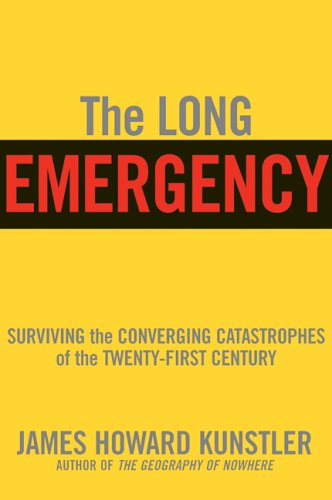
Ebook Info
- Published: 2006
- Number of pages: 336 pages
- Format: PDF
- File Size: 4.65 MB
- Authors: James Howard Kunstler
Description
A controversial hit that sparked debate among businessmen, environmentalists, and bloggers, The Long Emergency by James Howard Kunstler is an eye-opening look at the unprecedented challenges we face in the years ahead, as oil runs out and the global systems built on it are forced to change radically.
User’s Reviews
Editorial Reviews: Review “It used to be that only environmentalists and paranoids warned about the world running out of oil and the future it could bring: crashing economies, resource wars, social breakdown, agony at the pump. Not anymore. . . . America’s dependence on oil is too pervasive to undo quickly, [Kunstler] warns. . . . In the meantime, we’ll have our hands full dealing with . . . the soaring temperatures, rising sea levels and mega-droughts brought by global climate change. Not long ago, a Jeremiah like Kunstler would have been dismissed as a kook. . . . As brilliant as it is baleful . . . and we disregard it at our peril.” —The Washington Post“This is a frightening and important book.” —Time Out Chicago“If you give a damn, you should read this book.” —Colin Tudge, The Independent“What sets The Long Emergency apart…is its comprehensive sweep—its powerful integration of science, technology, economics, finance, international politics and social change, along with a fascinating attempt to peer into a chaotic future. Kunstler is such a compelling and sometimes eloquent writer that the book is hard to put down.” –American Scientist“[A] popular blueprint for surviving the end of oil.” —Paul Greenberg, The New York Times Book Review“Funny, irreverent, and blunt.” –The Globe and Mail“An especial strength of this book is its break with some of the more pernicious strands in the contemporary left, specifically the left’s kneejerk rejection of America acting militarily in its national interest. . . . There are hints of Malthus here, and of Oswald Spangler’s Decline of the West as well. Mr. Kunstler’s book is a jeremiad, driven by authorial presence. Pithy, entertaining descriptions of historical phenomena like the Soviet Union . . . enliven the text, allowing the veteran commentator to expound on themes that might read leaden by a less facile wordsmith. . . . The book succeeds as an accessible primer to a looming crisis that could end the American way of life.” —A.G. Gancarski, Washington Times“Kunstler is an amusing and engaging observer and polemicist, and the terrain he surveys is unforgiving and perilous.” —Robert Birnbaum, The Morning News“Novelist and journalist James Howard Kunstler is the leading popular voice of peak oil, the theory that says we have gone through more than half the world’s supply of this much-needed resource. Kunstler’s regular Monday morning posts foretell a world beset by oil shortages, which he believes will lead to everything from financial shenanigans (sound familiar?) to food riots, not to mention attacks on the wealthy, abandoned suburban housing developments and a forced return to small-town living.” —Helaine Olen, Portfolio“Kunstler displays a kind of macabre wit about the unpleasantness and strife that await us all. . . . His assertions have a neat way of doubling back to anticipate your critiques. If you express doubt about his views, then you may well be among the deluded masses too addicted to your McSUV and McSuburb to accept the reality that lies ahead.”—Katharine Mieszkowski, salon.com“Kunstler is America’s version of an Old Testament prophet, a stinging social critic who warns of dark days ahead if we do not change the way we live.” —Brian Kaller, Pulse“Kunstler’s book was shockingly readable and engaging….He covers a vast array of topics…I felt like I’d taken a crash course on Big Oil, Global Warming, and Geopolitics just to name a few.”—Romi Lassally, Huffington Post“James Howard Kunstler’s The Long Emergency may be destined to become the Dante’s Inferno of the twenty-first century. It graphically depicts the horrific punishments that lie ahead for Americans for more than a century of sinful consumption and sprawling communities, fueled by the profligate use of cheap oil and gas. Its central message—that the country will pay dearly unless it urgently develops new, sustainable community-scale food systems, energy sources, and living patterns—should be read, digested, and acted upon by every conscientious U.S. politician and citizen.” —Michael Shuman, author of Going Local: Creating Self-Reliant Communities in a Global Age“If you give a damn, you should read this book.” —Colin Tudge, The Independent (UK)“Kunstler concentrates on the continuing environmental instability and the political consequences of the fuel cessation in equal bouts and this makes for a well rounded argument.” —Buzz (UK)“In the annals of doomsday literature . . . The Long Emergency is destined to become the new standard. . . . Demands frank consideration of what up to now has been unthinkable: that the ascendancy of the human race might have been a temporary phenomenon. . . . This case has been made before, but here it is made powerfully and articulately, with no apology and no hint of reprieve. . . . The Long Emergency represents a ‘wake-up call’ in the same sense that a hand grenade tossed through your bedroom window might serve as an alarm clock. The book is stark and frightening. Read it soon.” —Jim Charlier, Daily Camera“A shrewd and engaging social commentator.” —Sierra Atlantic“Adds a relentless, scary, and entertaining voice to the rising alarm about life after the cheap oil is gone. . . . The internal logic of the argument is persuasive, and one reads . . . the book with white knuckles.” —Bryant Urstadt, technologyreview.com“Authoritative and eye-opening. His predictions for the future make for a page-turning ‘Brave New World.’” —T-D (London)“James Howard Kunstler has given us, with his usual engaging wit and verve, a new kindof post-apocalypse scenario. Instead of the nuclear or ice-age wasteland of our earlier imaginings, he has depicted with detailed extrapolation the civilization of the United States after the oil runs out and a great economic collapse occurs. It is a strangely arcadian vision, like the agrarian America that Jefferson, Calhoun, and the Southern Agrarians dreamed of. But Kunstler has fleshed it out with delightful quirky insights and provided our science fiction writers with a fresh mise-en-scene.” —Frederick Turner, author of The New World and The Culture of Hope
Reviews from Amazon users which were colected at the time this book was published on the website:
⭐OK, when you read this and meet the Dark Side Of The Force (which really does seem to be us, especially those we elect to *represent* us in government office)… If you’re not scared of the dark side now, you will be. You. Will. Be. It’s very hard to say you like a book that seems to so accurately pinpoint our past failings and even worse the *fixes* we’re making now all in the name of what basically will be the end of the world for humans (our world will adapt and move on, but humans I think already have experienced the pinnacle of the miracles of *modern life* as it pertains to them), but I do like it very much. After picking it up just as a sort of general interest thing (after just finishing a book talking about fracking and all the other ways we are ruining our one and only home’s ability to support us in ANY sort of comfort in the ever-tougher-but-never-ending (although there will BE an ending) search for that sweet crude that is the foundation for all we find comfortable-to-essential for *modern* life). I found the history of the rise and the author’s ideas about the fall of this civilization — all based on the use of fossil fuels that can NOT be renewed — very fascinating reading. When I was a kid in high school, working in a gas station during the first (and worst) of the *oil shortages* and learned the outlines at least of what was happening to us basically for nothing other than greed (my assertion, I don’t know particularly that the author could pick one cause-for-all-that-is-coming to man from his own actions), and never have gotten over the shock of the shortages (especially after the 2nd one!) of something (fossil fuels) that is finite and will end soon. We had the *crises*, then … what, it just ended? The non-renewable resource had been replenished somehow? And then we had the SECOND GAS CRISES! Then — poof! — that, too seemed to somehow disappear by nothing more than the waving of political magic wands. A liter (somewhere between a quart and a gallon) back then started to cost $8.00 per and up, but our prices went right on back to *normal*. We are STILL complaining about the cost of something everyone seems to have hypnotized everyone else into believing will never end at 3 and 4 bucks a gallon! We’re at war all over the globe (but the mid-east seems a particular *hot-spot*). Everything the U.S. did wrong to get to this disposable, wasteful, use-it-and-forget-it lifestyle everyone else now wants to do so they too can have their equivalent of *the American dream*. This book is trying to tell us it isn’t a dream anymore — that WE MAY ALREADY HAVE PASSED THE POSSIBLE PINNACLE OF OUR CIVILIZATION since the oil on which it all was based is going away. Everyone still seems to be doing their best to believe the CATASTROPHE looming on the horizon (where all the boys and girls have nukes now) won’t happen, and still — the oil is running out. Now, we are busily poisoning what’s left of our fresh water (through *fracking*) to make the ever-smaller quantities of oil keep producing at rates they no longer can sustain. It is WAY past time to yell stop, in my opinion. The “Long Emergency” about which the author writes has the serious potential to be the end of mankind on earth (and just by looking around, one can tell THE LONG EMERGENCY already has begun) and still, everything seems to be business as usual. Places all over the United States that used to have large, pure, mostly self-sustaining clean water to drink now can literally turn on the tap, wait a few moments, hold up a source of fire to what should be *tap-water* and instead FIRE comes out. We really need to get going (it’s past too late, but we MUST start!) on this stuff, or THE LONG EMERGENCY may instead become *The End of Man on Planet Earth.” A VERY good read that, without advocating violence or other counter-productive measures, is trying to tell everyone something they desperately need to hear — an excellent and highly recommended read. Be ready for shocks and examples of idiocy almost beyond the ability to comprehend, but please, buy it, read it, and if you can, do SOMETHING, almost ANYTHING to ensure that others also know what is happening and what could happen. This no longer (in my opinion) is something only *our kids* and future generations will have to deal with. It already has started, and we need to start doing something intelligent and productive about it RIGHT NOW!
⭐Kunstler’s portrayal of the coming “Dim Ages” is designed to scare the hell out of you. His provocative language is often valid, but other points are much more speculative or not fully informed. So it’s more like a worst-case scenario for the aftermath of Peak Oil (+ global warming, financial meltdown, etc.). A key contention is that even if we try to switch to renewable energy, we won’t have enough fossil fuels or time to support the conversion process or to maintain the new infrastructure. The result, he predicts, will be a relocalization of the economy around small towns surrounded by farmland. He sees global pandemics as the most likely way nature will rid itself of surplus human population as ecological overshoot intensifies.Kunstler may be right when it comes to the possibility maintaining the suburban US lifestyle, but we all know that there is a huge amount of waste in this lifestyle. Also, just because fossil fuels are used today for something, doesn’t mean that we may not find good, if perhaps somewhat more expensive, substitutes. Transportation is, of course, where the decline of oil will have the biggest impact, with airline consolidation already imminent. But Kunstler dismisses synfuels made from coal, which are politically likely despite global warming. That is, when the going gets tough, coal will be one of the first things politicians will turn toward – we’ll be lucky to make progress on clean coal.Kunstler does recognize that nuclear power is a much better strategy, given the reality of global warming. But he opts for nuclear because he dismisses wind power as unmaintainable – too subject to breakdown, requiring too much fossil fuel support. Here many would disagree, given a many decades supply of coal and nuclear, plus the remaining oil and natural gas, to build the renewables and reduce population impacts.Kunstler is widely read but doesn’t have technical background to fully evaluate what he reads. A prime example of this is his assessment of the “global peak” of oil on p. 24. He defines this as the half way point – the year when half the oil has been used up. Actually the peak is, of course, the peak – the date of maximum oil production. Geologists only forecast that it will approximate the half way point because some version of the law of large numbers should apply to the fact that production profiles of individual wells and of regions are approximately bell-shaped. Production techniques could, and are, changing this to some degree, and we may have already passed the half-way point. Also, this half way point is half way to recoverable oil, not all oil, as Kunstler believes. The USGS includes 50% more oil out there – oil that geologists like Campbell and Deffeyes think will never be recovered at any price.Later Kunstler states that the earth is a closed system (p. 194), and he repeats the death-through-entropy mantra over and over. Of course, life exists on earth precisely because it is not a closed system – it has a continuous supply of solar energy input to overcome the natural tendency toward dissipation and disorder (entropy). Most authors emphasize energy and efficiency, not entropy. Kunstler even declares that “efficiency is the straightest path to hell” (p. 191). He’s right in that efficiency applied to non-renewable resources just uses them up more quickly, a major point of Campbell. But for renewable resources, high efficiency means transforming order without dissipating much of it – the reverse of death-by-entropy.Nevertheless, Kunstler’s wake-up call is much needed. Some of his alarm bells may be false alarms but others certainly signal life-threatening blazes.
⭐I wouldn’t recommend this book for holiday poolside reading, unless you want to have a depressing holiday. However, the message is clear and stark. We are running out of fossil fuels at a rapid rate. Global warming isn’t really the issue we should be worried about, the real problem is oil and natural gas depletion. Once they run out there won’t be any carbon emmisions anyway. The book is well written in a non dramatic style but the message is clear – the greatest challenge of the 21st Century will be upon us sooner than we think and this book makes it very plain that we are nowehere near ready to meet that challenge. The party will soon be over and when it ends, we had better prepare to turn the clock back 200 years in terms of our ability to travel, heat our homes and carry on our businesses.
⭐Breathlessly written by James Howard Kunstler, and with the very long subtitle of Surviving the [End of Oil, Climate Change, and Other] Converging Catastrophes of the 21st Century. My edition had a shorter one by excising the bracketed words but they are key to the book with half of it being about oil (and its curtain-raiser, coal).Both have correlated with our rocketing world population and have defined the carrying capacity of Planet Earth. Before the Industrial Revolution our numbers struggled up to 1 billion and managed to exploit most corners of the world. Now oil allows 7 billion. And when the oil runs out… Will nuclear, hydrogen, solar, wind or hydro cut it? They’re relatively so inefficient and user-unfriendly that it seems not.We believe that technology will deliver. Kunstler doesn’t mention biofuel but that may postdate 2004. It doesn’t change his assertion that oil also fuels technology so it’d better find an alternative before it runs out. Well before; like now, and that doesn’t seem to be happening.Next up is climate change (not global warming!) Here’s a nugget: twice in the last 20,000 years the planet has warmed by double-digit degrees (Fahrenheit, I assume) in about a decade. So you can throw away your smooth temperature projections. It can go crazy!Oh, we’ve had scares about the future before. I grew up with the Cold War and nuclear winter but it was only ever one threat at a time. Now the question seems to be more the order in which the many will come. End of oil; end of gas; rising sea; depleted water; exhausted soil (which in any case requires gas to fertilise it for the yields we expect); disease (exacerbated by rising temperatures). And that’s not all…The Running on Fumes chapter is an economic history and pretty much above my head. But I recognise a few terms, enough to think that Kunstler was somehow predicting the banking and real estate crisis that knocked the bottom out of my shares not long back. If so, I’m impressed and the more ready to believe his other projections.The final chapter is a guess of how, principally, the US may cope post-oil. It sounds rather nice, for the 6 billion who won’t die of course. But they’ll largely be Johnny Foreigners so who cares about them? The other proviso is that society doesn’t degenerate into anarchy or war – rather a big ask given our reputation.An eye-opener for me then and I thought I was au fait with most thinking about the future. This book does continue the sustainable retreat theme, which looks like the only rational, and hopeful, course of action. We won’t like it but we’ll like the alternative worse.
⭐I won’t repeat what the other reviewers have stated, but just read this book and make up your own mind! Personally it ties up for me a lot of loose ends. Yes it’s shocking, but the future may not be that bad. But if the author is right, there may be a few billions less of mankind by the end of this century! It’s a sobering thought! BC
⭐Some VERY useful observations here for anyone wondering about the West’s likely future. It MAY be a bit apocalyptic, but we won’t know until much later, and it’s better by far to be informed. Well worth the money and time to read it.
⭐An account of what the author thinks will happen in the future without oil. Written before the tracking revolution. Analysis of the economy before the 2008 crash is good. The prognostications may be accurate but only time will tell. Downplays role of global warming,
Keywords
Free Download The Long Emergency: Surviving the End of Oil, Climate Change, and Other Converging Catastrophes of the Twenty-First Cent in PDF format
The Long Emergency: Surviving the End of Oil, Climate Change, and Other Converging Catastrophes of the Twenty-First Cent PDF Free Download
Download The Long Emergency: Surviving the End of Oil, Climate Change, and Other Converging Catastrophes of the Twenty-First Cent 2006 PDF Free
The Long Emergency: Surviving the End of Oil, Climate Change, and Other Converging Catastrophes of the Twenty-First Cent 2006 PDF Free Download
Download The Long Emergency: Surviving the End of Oil, Climate Change, and Other Converging Catastrophes of the Twenty-First Cent PDF
Free Download Ebook The Long Emergency: Surviving the End of Oil, Climate Change, and Other Converging Catastrophes of the Twenty-First Cent