

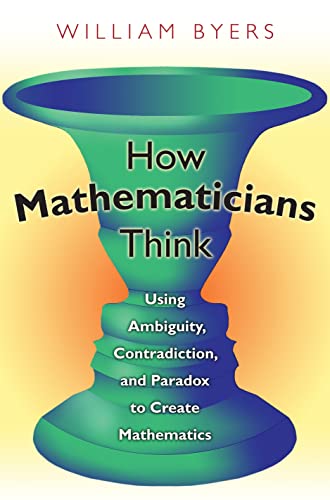
Ebook Info
- Published: 2010
- Number of pages: 424 pages
- Format: PDF
- File Size: 3.51 MB
- Authors: William Byers
Description
To many outsiders, mathematicians appear to think like computers, grimly grinding away with a strict formal logic and moving methodically–even algorithmically–from one black-and-white deduction to another. Yet mathematicians often describe their most important breakthroughs as creative, intuitive responses to ambiguity, contradiction, and paradox. A unique examination of this less-familiar aspect of mathematics, How Mathematicians Think reveals that mathematics is a profoundly creative activity and not just a body of formalized rules and results. Nonlogical qualities, William Byers shows, play an essential role in mathematics. Ambiguities, contradictions, and paradoxes can arise when ideas developed in different contexts come into contact. Uncertainties and conflicts do not impede but rather spur the development of mathematics. Creativity often means bringing apparently incompatible perspectives together as complementary aspects of a new, more subtle theory. The secret of mathematics is not to be found only in its logical structure. The creative dimensions of mathematical work have great implications for our notions of mathematical and scientific truth, and How Mathematicians Think provides a novel approach to many fundamental questions. Is mathematics objectively true? Is it discovered or invented? And is there such a thing as a “final” scientific theory? Ultimately, How Mathematicians Think shows that the nature of mathematical thinking can teach us a great deal about the human condition itself.
User’s Reviews
Editorial Reviews: Review “Winner of the 2007 Best Sci-Tech Books in Mathematics, Library Journal””One of Choice’s Outstanding Academic Titles for 2007″”Ambitious, accessible and provocative…[In] How Mathematicians Think, William Byers argues that the core ingredients of mathematics are not numbers, structure, patterns or proofs, but ideas…Byers’ view springs from the various facets of his career as a researcher and administrator (and, he says, his interest in Zen Buddhism). But it is his experience as a teacher that gives the book some of its extraordinary salience and authority…Good mathematics teaching should not banish ambiguity, but enable students to master it…Everyone should read Byers…His lively and important book establishes a framework and vocabulary to discuss doing, learning, and teaching mathematics, and why it matters.”—Donal O’Shea, Nature”From Byers’s book, if you work at it, you will learn some mathematics and, more important, you may begin to see how mathematicians think.”—Peter Cameron, Times Higher Education Supplement”As William Byers points out in this courageous book, mathematics today is obsessed with rigor, and this actually suppresses creativity…. Perfectly formalized ideas are dead, while ambiguous, paradoxical ideas are pregnant with possibilities and lead us in new directions: they guide us to new viewpoints, new truths…. Bravo, Professor Byers, and my compliments to Princeton University Press for publishing this book.”—Gregory Chaitin, New Scientist”Many people assume that mathematicians’ thinking processes are strictly methodical and algorithmic. Integrating his experience as a mathematician and as a Buddhist, Byers examines the validity of this assumption. Much of mathematical thought is based on intuition and is in fact outside the realm of black-and-white logic, he asserts. Byers introduces and defines terms such as mathematical ambiguity, contradiction, and paradox and demonstrates how creative ideas emerge out of them. He gives as examples some of the seminal ideas that arose in this manner, such as the resolution of the most famous mathematical problem of all time, the Fermat conjecture. Next, he takes a philosophical look at mathematics, pondering the ambiguity that he believes lies at its heart. Finally, he asks whether the computer accurately models how math is performed. The author provides a concept-laden look at the human face of mathematics.” ― Science News”This book is a radically new account of mathematical discourse and mathematical thinking…What Byers’s book reveals is that ambiguity is always present…You can’t quite say that nobody has said this before. But nobody has said it before in this all-encompassing, coherent way, and in this readable, crystal clear style…This book strikes me as profound, unpretentious, and courageous.”—Reuben Hersh, Notices of the AMS”This is a truly exceptional work. In an almost gripping tour de force, Byers examines the creative impulse of mathematics, which to him is the notion of ambiguity, understood to ‘involve a single idea that is perceived in two self-consistent but mutually incompatible frames of reference’…[I]t is a sorely needed complement to often-formulaic textbooks…. An incredible book.”—J. Mayer, Choice”William Byers…has written a passionate defense of the uniquely human aspect of mathematics…Byers [demonstrates] that the insights of mathematicians come about through a discipline that…has something in common with Zen practice. First, there is a positive use of difficulty: ‘the paradox has the enormous value of highlighting a fertile area of thought.’ Then the breakthrough: ‘An idea emerges in response to the tension that results from the conflict inherent in ambiguity.’ These sentences from Byers’s book apply equally to scientific and spiritual work.”—Eliot Fintushel, Tricycle”After a lifetime of research and teaching, [Byers argues] that mathematical breakthroughs do not come from simply manipulating symbols according to strict rules. Byers writes with verve and clarity about deep and difficult mathematical and philosophical issues such as the relationship between great mathematical ideas and cultural crises. Byers discusses in depth some examples of great ideas and crises…and explains why he is dead against seeing the mind as a computer.”—Andrew Robinson, Physics World”It is a pleasure to read [Byers’] well written, carefully referenced, and clearly illustrated arguments. Byers describes what ‘doing math is: a process characterized by the complementary poles of proof and idea, of ambiguity and logic.’ Byers’ book has given me a greater appreciation for mathematics. I recommend it to anyone interested in, and open-minded about, the attempt to define mathematics.”—Lee Kennard, Math Horizons”Byers subverts the widely held notion that mathematicians are a form of computer, or robotic followers of unbending rules. In his view, thinking about math requires creativity and the use of non-logical forms of thought. Thus the ambiguity, paradox and contradiction of the subtitle.” ― The Globe and Mail”Well-organized and carefully written the present book is very useful to all who are interested in How Mathematicians Think!”—Ioan A. Rus, Mathematica”[A] brilliant and easily accessible book on the creative foundations of math and psychology.”—Ernest Rossi, Psychological Perspectives”What does one like to learn when one reads a book? Because the reading of a book is a union between its text and the reader’s consciousness, one answer is the wedding custom of ‘something old, something new, something borrowed, something blue’. All are there in this book. . . . It is a useful book for the apprentice mathematician by clarifying the importance of boldness in making mistakes and declaring that one does not fully understand some technical details which at first sight appear to be more complex than they really are.”—Bob Anderssen, Australian Mathematical Society Gazette”Excellent discussions are presented.” ― EMS Newsletter”[Byers’] book helps us not to eliminate the myths surrounding mathematics and mathematicians, but to master them.”—David Cohen, European Legacy”The author is a mathematician, and he plainly knows what he is talking about. In my opinion he has done a good job of getting it across. . . . The book has a lot of worthwhile material to recommend.”—Robert Thomas, Philosophia Mathematica”Ultimately, How Mathematicians Think shows that the nature of mathematical thinking can teach us a great deal about the human condition itself.” ― World Book Industry Review “An amazing tour de force. Utterly new, utterly truthful.”―Reuben Hersh, author of What Is Mathematics, Really?”Byers gives a compelling presentation of mathematical thinking where ambiguity, contradiction, and paradox, rather than being eliminated, play a central creative role.”―David Ruelle, author of Chance and Chaos”This is an important book, one that should cause an epoch-making change in the way we think about mathematics. While mathematics is often presented as an immutable, absolute science in which theorems can be proved for all time in a platonic sense, here we see the creative, human aspect of mathematics and its paradoxes and conflicts. This has all the hallmarks of a must-read book.”―David Tall, coauthor of Algebraic Number Theory and Fermat’s Last Theorem”I strongly recommend this book. The discussions of mathematical ambiguity, contradiction, and paradox are excellent. In addition to mathematics, the book draws on other sciences, as well as philosophy, literature, and history. The historical discussions are particularly interesting and are woven into the mathematics.”―Joseph Auslander, Professor Emeritus, University of Maryland From the Back Cover “An amazing tour de force. Utterly new, utterly truthful.”–Reuben Hersh, author of What Is Mathematics, Really?”Byers gives a compelling presentation of mathematical thinking where ambiguity, contradiction, and paradox, rather than being eliminated, play a central creative role.”–David Ruelle, author of Chance and Chaos”This is an important book, one that should cause an epoch-making change in the way we think about mathematics. While mathematics is often presented as an immutable, absolute science in which theorems can be proved for all time in a platonic sense, here we see the creative, human aspect of mathematics and its paradoxes and conflicts. This has all the hallmarks of a must-read book.”–David Tall, coauthor of Algebraic Number Theory and Fermat’s Last Theorem”I strongly recommend this book. The discussions of mathematical ambiguity, contradiction, and paradox are excellent. In addition to mathematics, the book draws on other sciences, as well as philosophy, literature, and history. The historical discussions are particularly interesting and are woven into the mathematics.”–Joseph Auslander, Professor Emeritus, University of Maryland About the Author William Byers is professor of mathematics at Concordia University in Montreal. He has published widely in mathematics journals. Read more
Reviews from Amazon users which were colected at the time this book was published on the website:
⭐There is a vastness about mathematics that is daunting: Many works are identified as mathematical; mathematics has a long and colorful history, extending back to the dawn of civilization (and with “primitive” concepts that extend even into primate behavior and the behavior of other animals); and there are many people today, all over the world, who identify themselves as mathematicians, including teachers and university professors who dedicate their lives to mathematics. Thus, the task of considering “how mathematicians think” is a huge one.It is little wonder, that in faced with this task, Prof. Byers focuses on ambiguity, contradictions and paradox. However, since the common perception of mathematics (apart from the mathematicians) is as a field of formal purity and certainty, such a viewpoint seems to present us with an unusual view of mathematics.The central feature of Prof. Byers account is “duality”, i.e. that ambiguity, for example, which he takes to mean seeing mathematics and mathematical ideas from multiple perspectives, cannot be separated from the “certainty” of mathematics. He insists that the dualities are inherent in mathematics, and in particular that we cannot just make a clean separation between the objective and the subjective. He sees this view as not only having consequences with respect to the way in which mathematician think, qua mathematicians, but also with respect to appreciating the history of mathematics, and in how we teach and study mathematics.Mathematicians were challenged to an extraordinary degree in the twentieth century. The work in metamathematics, especially by Godel, raised the issue of the limitations of mathematics. The rise of computers, especially in the latter part of the twentieth century, began to attack basic assumptions of mathematicians, not the least of which is whether or not it is even a “human” activity. Can computers supersede people at mathematics? If Prof. Byers is correct, and mathematics is an inherently human and creative activity, the answer is ultimately: No. This is despite the fact that in certain formal ways, computers already far-exceed human capabilities.Even in physics, the arguably most mathematically-oriented science, the twentieth century has seen the rude shocks of relativity and quantum mechanics. In fact, in part, Prof. Byers motivation to focus on “dualities” arises partly from the experience of physicists in creating and developing quantum mechanics.This complex notion of duality impinges on us even when we consider human behavior and intelligence with respect to very simple and basic mathematical ideas. Thus, the concept of “zero” both represents “something” and “nothing”.Prof. Byers considers many dualities, and this succeeds in giving a fascinating portrait of mathematics as a human activity. His consideration of a historical viewpoint is also rather wonderful. However, as he emphasizes, one must be careful about a historical approach to mathematicians and mathematics, because there are so many possible “distractions” and details, that one is in danger of losing focus.I found this book to be very challenging to some of my ideas, and I must say, his views do not always represent mine about mathematics. However, he lays his account out beautifully, and gives those of us who love mathematics a real intellectual treat. I think, too, that his work would be of interest to others besides mathematicians, in attempting to expose a “humane” edge, to an ancient science.
⭐This is an excellent book that provides a good survey of some important mathematical concepts. For each concept, the author explains what drove mathematicians to look at them in different ways, thereby leading to newer understanding of properties & inter-relationships.Author shows that there is a limit to how much can be understood with a fixed number of view points – and that, different situations / experiences are required for the emergence of new insights – taking an example from the book itself, trying feel one’s way across the room is a set of tactile-type inputs, but ‘turning on the lights’ brings about additional, new input-types revealing new attributes, leading to the discovery of new interconnections between things (i.e., ‘ambiguity’). The author takes up different ideas and discusses how different experiences and even different world views can lead to new mathematical insights (e.g., concepts about calculus, infinity, zero).Like some have noted, the book does appear to be a little repetitive when the author tries to emphasize the underlying process of ‘ambiguity’ in each of the different mathematical experiences – but it is helpful when one does not read the book all in one stretch. However, I felt the concepts as such were not repetitive.All in all, even if one does not agree with all of the philosophical ideas presented in the book, I felt that it provided some very good examples of mathematical process – that, the mathematics starts with our experiences and with how we relate to reality, and they can be modeled mathematically to reconcile them. Sometimes, it may even show how stereotypical our experiences have become, based on our (mathematical) upbringing !(e.g., euclidean vs non-euclidean, perception of infinity, zero and even one!)
⭐I CANNOT believe the intellectual insight described in this book.I am a Mathemetician Master’s school graduate from CSULB and USC and have been tested to have exceptional mathematic ability.You would think with my background, I could breese through this book. (albeit, as a mathemetician, I might be bored reading the book!)Quite the opposite. This book is NOT about Mathematics. It is about why SCIENTISTS (mathemeticians as an example) hate ambiguity so much that they “create” never-before-invented solutions to resolve that ambiguity. This book also explains the process of solving those problems.This book explains why and how our human scientific itellect has evolved. AMBIGUITY is the impetus. SOLVING the ambiguity is the goal and “engine” for evolution.Without the existence of ambiguity, contradiction, and paradox, we humans would never have raised our combined intellect beyond “nature” or “God”.To me, the “ah ha” teachings in this book MUST become a classroom experience for young scientific minds that leads them to look for ambiguities in their life and motivates them to solve them.
⭐The academic and well-versed approach is a major win.While I have not finished reading this title (but I plan to, if that is even possible, since it is so complex), I have already been impressed by its numerous insights into the workings of mathematics.Perhaps this is what math for liberal arts should have been.But only if you like mathematics.
⭐An Exceptional Philosophical presentation of our subject. A much welcomed addition to anyones library interested to develop further their cognition of Mathematics.
⭐Good product at a good price!
⭐The argumentation is not very original and too often repetitive. The basic idea, that is the role of ambiguity, paradoxes and alike in the development of mathematics, is stressed like a mantra throughout the approximately 400 pages of the book. But without ever getting to the heart of the epistemological problems raised.Sometimes the arguments becomes generic and vague. Speaking of “subjetctive objectivity”, “objective subjectivity”, “subjective subjectivity” and so on, attests a questionable, self-styled zen approach that, in my opinion, is out of place.These topics are extensively covered, with greater efficacy or epistemological depth, by a great number of publications, recents or less, wheras the author seems have nothing new to add but some personal underlines.The book is more suitable for those approaching these issues for the first time. The simplicity of the language, the didactic style and the choice of examples, are useful for introducing novices to epistemological and philosophical themes of mathematics, which are complex in themselves.
⭐superb,excellent,awesome!felt like giving 10 stars.
⭐Un excellent récit de la démarche de recherche en mathématiques. On peut le prendre comme une suite ou complément (actualisation) du chef d’œuvre d’Hadamrd “Essai sur la psychologie de l’invention dans le domaine mathématique”. L’un comme l’autre devraient être médités dans un cadre bien plus large, dépassant largement les mathématiques: les aspects synthétiques et affectifs constituent une partie essentielle de toute démarche intellectuelle créative.
⭐
Keywords
Free Download How Mathematicians Think: Using Ambiguity, Contradiction, and Paradox to Create Mathematics in PDF format
How Mathematicians Think: Using Ambiguity, Contradiction, and Paradox to Create Mathematics PDF Free Download
Download How Mathematicians Think: Using Ambiguity, Contradiction, and Paradox to Create Mathematics 2010 PDF Free
How Mathematicians Think: Using Ambiguity, Contradiction, and Paradox to Create Mathematics 2010 PDF Free Download
Download How Mathematicians Think: Using Ambiguity, Contradiction, and Paradox to Create Mathematics PDF
Free Download Ebook How Mathematicians Think: Using Ambiguity, Contradiction, and Paradox to Create Mathematics