

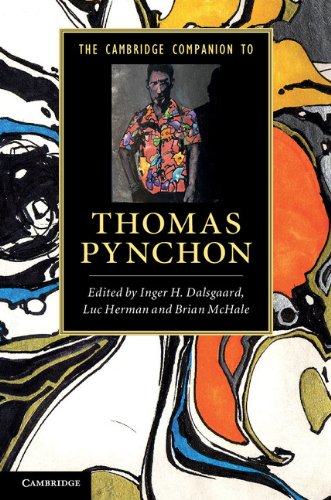
Ebook Info
- Published: 2011
- Number of pages: 205 pages
- Format: PDF
- File Size: 12.49 MB
- Authors: Inger H. Dalsgaard
Description
The most celebrated American novelist of the past half-century, an indispensable figure of postmodernism worldwide, Thomas Pynchon notoriously challenges his readers. This Companion provides tools for meeting that challenge. Comprehensive, accessible, lively, up-to-date and reliable, it approaches Pynchon’s fiction from various angles, calling on the expertise of an international roster of scholars at the cutting edge of Pynchon studies. Part I covers Pynchon’s fiction novel-by-novel from the 1960s to the present, including such indisputable classics as The Crying of Lot 49 and Gravity’s Rainbow. Part II zooms out to give a bird’s-eye-view of Pynchon’s novelistic practice across his entire career. Part III surveys major topics of Pynchon’s fiction: history, politics, alterity (‘otherness’) and science and technology. Designed for students, scholars and fans alike, the Companion begins with a biography of the elusive author and ends with a coda on how to read Pynchon and a bibliography for further reading.
User’s Reviews
Reviews from Amazon users which were colected at the time this book was published on the website:
⭐Great for scholars and enthusiasts.
⭐Comprehensive.
⭐This helpful compendium opens up for both specialists and generalists this “difficult” writer’s works. It encourages us to enter the discussion about them. My review sums up the contents of a compact but valuable resource. Given that the chronology of Pynchon’s life and works by John M. Kraft must be far sketchier than that for perhaps any other living author, Kraft sensibly concludes after summing up what can be verified: “We hardly need to know the life to appreciate the works.”As the introduction by editors Inger H. Dalsgaard, Luc Herman, and Brian McHale reminds us, their “Pyndustry” formed to dissect Pynchon’s fiction need not be as hermetic as it may seem to the outsider. “It is the sense of sharing in a collective enterprise of readers that transforms a cult of insiders into a community.” With only his works to study, the author absent, we are “left to our own devices”. This 2012 anthology aims at fellow academics, but it provides a more accessible guide to the canon, poetics, and issues than monographs devoted to recondite topics.Part I surveys the canon. “Early Pynchon” by Herman examines the first stories and racial themes and revision in V. It’s a limited look at that novel, but many contributors agree that Pynchon’s 1963 full-length debut represents but a frenetic trial run for the two “masterpieces” that would follow.Although dismissed by the author as a misfire, his first, The Crying of Lot 49, appears alongside Vineland and Inherent Vice as a California novel. (Pynchon’s newest, Bleeding Edge, reviewed by me on its appearance Sept. 17, 2013, burrows into congenial tales of attempts to break out of the “meatworld” and the crackdown that follows not only a counterculture but the start-ups. Bleeding Edge draws Pynchon back from his adopted Golden State to his native New York, but post-9/11, it entangles wired technology hatched and incubated in Silicon Valley.) Thomas Hill Schaub locates “New Age libertarianism” rather than “liberal pluralism” as the Californian novels’ political stance. He tracks the “consensus” for the 1964-71 period they evoke. Lot 49 traces a “secret withdrawal” from conformity, appearing in 1966’s flower-power promise. The other two novels track state backlash, and from the rueful benefit of hindsight, they from their publication in respectively 1990 and 2009 lament the passing of communal alternatives and individual initiative during the rise of Nixon and Reagan, as sinister forces regroup to compromise or marginalize those who tried to fight the power.Gravity’s Rainbow is rooted in Pynchon’s service to this same state, in his 1960-62 career as a technical writer in Seattle at Boeing. Steven Weisenburger documents Pynchon’s role in the bureaucratic complicity that enables the military and such corporations to ally with global economies and murderous technology. Rocket World’s domination, in Pynchon’s 1973 indictment of mass death, proves how the post-war national security state follows the Second World War’s operations, carried out by a “Power Elite’s relentless sovereignty”. Ethical or practical resistance by a few may be admirable, but given the fate of many in Gravity’s Rainbow it appears such stances remain quixotic.Certainly Mason & Dixon plots this tension between rationalization and imagination, the little guy versus the big picture. This relentless push of modernization and profit, as America championed in colonial times, captures a period which changed “all from subjunctive to declarative, reducing Possibilities to Simplicities that serve the ends of Governments”. Such an eighteenth-century style and orthography of this 1997 epic enlivens Pynchon’s exploration of another historical epoch. While less immediate than the mid-twentieth century, Kathryn Hume explains, this period also pits protagonists against a world-system of intricate “lines” laid down by mathematicians and surveyors to extend imperialist ambitions. Slavery, mystery, and science contend. Layers and networks, typical elements of Pynchon’s fiction, give clues and orient or disorient readers within such complex webs.Widening the rampage of overlying overlords in Against the Day to roam thirty years around the turn of the last century, the pre-WWI foundation for that similarly immense 2009 send-up of early twentieth-century literary genres defines Menippean satire. Bernard Duyfhuizen tallies 170 characters and at least a dozen pastiches of fictional categories in its sprawl. Its “dime novel” elements involving silent-era film in Los Angeles, as this critic astutely cites, anticipate the cinematic hard-boiled patter and louche gumshoe satire of Inherent Vice set fifty years later on the coast near that same city. They also, typical for Pynchon as his novels unfolded, overlap, as the Traverse family introduced in Vineland edges Against the Day into an earlier work as published, even as it hints ahead via its anarchistic struggles to hippie reactions against capitalism in the California novels, chronologically.After overviews of the major texts, Part II elucidates poetics. David Cowart’s investigation of literary history enlivens the author’s promise. “Pynchon seduces the reader with something like the big picture: read this and you’ll understand the age and its enormities.” Cowart wonders if Pynchon leads the way in innovation, away from modernist tropes, or whether he responds to endemic cultural trends. The evidence marshaled favors Pynchon as leading the way, although Cowart appears to strain credulity when attempting to attribute prescience to the appearance of Pynchon’s novels within years or stages of political upheaval or social unrest. What seems more convincing is that by Vineland the quest narrative–however unfulfilled–in his previous novels diminishes amid “increasing difficulty”. Pynchon while lightening his tone and intensity somewhat by the 1990s intensifies his range. His target widens as his novels grow encyclopedic. Melville created one such narrative; Pynchon, many.Delving into theory, the following essays prefer a more professorial, less playful stance. McHale sums up postmodernism adroitly. He links Christopher Jencks’ “double-coding” within architectural designs winking at those in the know while delighting or puzzling the general public to Pynchon’s blend of high-art themes and pop-culture references. McHale argues that postmodern ontology, a concern with being, replaces the modernist search for epistemology, to address meaning. Cowart concurs that the early quests of V. and Lot 49 have disintegrated by Gravity’s Rainbow; that work ends with explosions, dispersions, and reversions. Erasures, forking paths, nesting, layers all fool characters–and any who attempt to navigate and master the labyrinth.Pynchon’s intertexts, as David Seed charts, exhibit their own twists and turns. Characters and themes start to blur and shape-shift. The final essays gathered in Part III under Issues can drift into their own hermetic recesses. Sometimes theory overwhelms the application to specific passages in the texts. If a chapter on humor, which gains all but five citations in the index, might have substituted or supplemented this section, its inclusion would have leavened the seriousness of this section. Pynchon’s wordplay, songs, and slang, and his inherent vice that drives him to keep his awful or sly punchlines coming do not earn the depth they deserve here. Amy J. Elias for history, Jeff Baker for politics, Deborah L. Madsen for alterity, and Dalsgaard for science and technology, all the same, offer directions to suggest deeper pursuits for these respectable topics.In a coda of “how to read Pynchon”, Hanjo Berressem notes how readers responded critically during each stage of Pynchon’s trajectory. The prophet of doom and miscommunication appeared ready for the Space Age amidst its countercultural flight from the threats “slouching towards universal disorder, heat-death, noise and, ultimately, to near-static”. The post-structuralist craze found deconstructionists thrilled with a “violently centripetal” lurch into futility, disorder, and self-referential metafiction.By the 1990s, the changes during the Reagan administration may have tempered such critical frenzy. Pynchon’s sensitivity to the realities of contemporary life, beyond satire, puns, puzzles, and irony, turned some to reconsider the aesthetic arguments within his novels. The progression in the humanities over the next fifteen years towards New Historicism placed Pynchon’s fiction within the “complete counter-history of America” in its mission to (as Mason and Dixon dramatizes) “save the realm of the fictional from the forces of relentless factualization and rationalization”.Some critics here propose that reading Pynchon, we can follow his example to challenge the system that supplants our initiative with a perpetual commodification of our dreams and desires for fulfillment. Bleeding Edge continues this critique, but it too shrinks back from any clear resolution of its own shaggy-dog plot. Those who seek in Pynchon’s passages an escape from their mundane concerns may find that the paths fork and bend back into our own reality with its often elusive lack of lasting satisfaction. Like his protagonists, Pynchon appears to remind us, in his absence from advising us, that we must rely on our own smarts, arrayed against mystery and cynicism and corruption. As the editors of “A Cambridge Companion to Thomas Pynchon” conclude in their collective, even utopian, ambition to scope out this reclusive writer’s ascent and flight patterns: “We are all in this together.”
⭐If you are an arts student staring confusedly into space having read one of Pynchon’s doorstoppers and the essay is due tomorrow, then this may be the book for you. If you want to really get to grips with the slippery word eel of postmodernism, then you’d do better tracking down the essays of Tony Tanner in the college library (or, expensively, on Amazon). It’s a crying shame that Pynchon studies have made so little progress since TT’s death in 1998. The best essay in this book is McHale’s on “Pynchon’s Postmodernism”. I could have done with more from him. Overall, this is an unenlightening read for the non-student.
⭐Renowned Pynchon-scholars Dalsgaard, Herman and McHale have put together a formidable ensemble of contemporary voices on the field. Cambridge Companion to Thomas Pynchon comes across as something of an update of Mindful Pleasures – the influential 1970’s collection of scholarly writing published in the wake of Gravity’s Rainbow. This collection consists of short, approximately 10-page essays that are as palatable as they are professional. First part of the book introduces and analyses each of Pynchon’s novels. The rest of the essays concentrate on contextual reading of Pynchons oeuvre, each leaning either towards poetics or thematics – but without one excluding the other. Academic jargon is conspicuously absent for the most part, and when used, it is explained clearly enough as not to be overly obtrusive. The Cambridge Companion is eminently useful, a timely instant-access sourcebook on one of the most widely studied authors of the late 20th century. It is indispensable for students and scholars, but also highly recommended for those reading Pynchon with less sinister intent. For further reading and study, the book includes an extensive bibliography of printed and online sources.Unavoidably, the collection (much like its 1970’s predecessor)will canonize certain interpretations and emphasize certain thematics, theoretical approaches and contexts at the expense of others. Yet, such a lucid and versatile collection on Pynchon is long overdue. The editors are hardly at fault if their work is without competition in successfully addressing a dual audience of experts and enthusiasts, and in exhibiting a desire for clarity and ease of use.
⭐A good, comprehensive overview that feels too expensive. Academic writing on literature is a high-cost industry to be sure, but this is one the smallest books I’ve ever purchased for $40. I was also annoyed that “Vineland” etc. were appropriated into the author’s section on “The Crying of Lot 49 (and other California novels)”. This only drops my rating one star below the ideal, anyhow.
⭐as an amateur fanboy, I found it very stimulating and interesting. I’d recommend it as an essential in anyone who is interested in TRP
Keywords
Free Download The Cambridge Companion to Thomas Pynchon (Cambridge Companions to Literature) in PDF format
The Cambridge Companion to Thomas Pynchon (Cambridge Companions to Literature) PDF Free Download
Download The Cambridge Companion to Thomas Pynchon (Cambridge Companions to Literature) 2011 PDF Free
The Cambridge Companion to Thomas Pynchon (Cambridge Companions to Literature) 2011 PDF Free Download
Download The Cambridge Companion to Thomas Pynchon (Cambridge Companions to Literature) PDF
Free Download Ebook The Cambridge Companion to Thomas Pynchon (Cambridge Companions to Literature)