

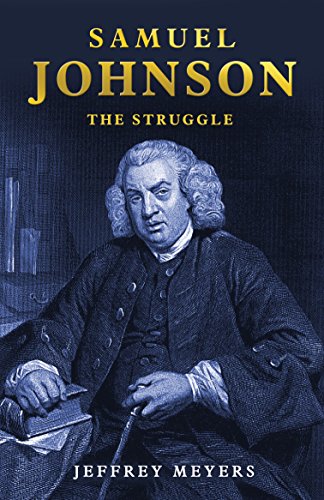
Ebook Info
- Published: 2015
- Number of pages: 552 pages
- Format: PDF
- File Size: 4.39 MB
- Authors: Jeffrey Meyers
Description
Jeffrey Meyers tells the extraordinary story of Samuel Johnson one of the most illustrious figures of English literary tradition. Johnson was famous as a poet, novelist, biographer, essayist, critic, editor, lexicographer, conversationalist and larger than life personality. After nine years of work Johnson’s, ‘A dictionary of the English Language, was published in 1755. He overcame great adversity to achieve success. ‘The Struggle’ is a masterful portrait of a brilliant and tormented figure.
User’s Reviews
Reviews from Amazon users which were colected at the time this book was published on the website:
⭐This is a readable and entertaining biography of Samuel Johnson. It is well written and expertly organized. As with other Meyers biographies, however, the research is sometimes sloppy. I suspect that Meyers does not do all his research himself but farms it out to others who are not that knowledgeable in the field. This results in the kinds of factual errors that crop up in this volume. I’ll cite just two examples.Meyers writes on page 293 that James Boswell met Johnson “in the back room of Tom Davies’ bookshop at 8 Great Russell Street, near what is now the British Museum.” The problem is, Davies’ bookshop was not in GREAT Russell Street near the British Museum, but in Russell Street, Covent Garden–similar names but entirely different streets about half a mile apart.On page 441 Meyers states that Johnson is buried in the Poets’ Corner of Westminster Abbey under Shakespeare’s monument, “[David] Garrick at his right hand and [Oliver] Goldsmith just opposite.” But Goldsmith is not buried in Westminster Abbey. He is buried in the Temple, just off Fleet Street, near the north-east side of Temple Church, under a white, weather-worn stone, shaped like a coffin lid. The stone bears the inscription “Here lies Oliver Goldsmith.”In the Poets’ Corner hangs a memorial tablet and portrait of Goldsmith executed in marble by Joseph Nollekens and containing an inscription in Latin by Johnson. Sir Joshua Reynolds had the memorial placed above the door leading into St. Faith’s Chapel, opposite to where Johnson and Garrick are buried. This cenotaph might lead the unsuspecting to think Goldsmith buried nearby, but he isn’t.
⭐Dr. Samuel Johnson deserves to be called a larger-than-life personality.Johnson was a man of many contrasts and these are exactly the things that make him the ideal man for this wonderful biography,written by Jefferey Meyers.Johnson was half-deaf and half-blind.He was both energetic and lazy ,aggressive yet tender.He suffered from bouts of melancholy (or what one would call “The Black Dog” -a term used by the great Churchill who was himself victim of this sort of depression)but waas also wiity and full of energy and zest for life.Johnson was extremely curious about anything and was generous to the poor and the homeless.He rescued prostitutes,defended condemned criminals and was against slavery ot the exploitation of indigenious peoples.Despite his mental and physical handicaps,Dr. Johnson became famous as poet,novelist,biographer, essayist,critic, editor and lexicographer.All his life to his last breath was a struggle-thus the subtitle of the book.Indolent and sloppy, he experienced humiliating povery at Oxford and left without a degree.At an older age he got married to a much older woman and after her death,he remained celibate for more than thirty years.He gave generously to homeless children and beggars,and also secured clothes for French prisoners of war.He saw life as an endless contest.This showed also in the way he battled from book to book and struggled against formidable obstructions.His violence and surprising athletic feats were essential outlets for his frustration,his anger and his sexual passion.He always enjoyed a fight.This biography offers new interpretations of Johnson’s life and works.Johnson’s two monumental projects, the Dictionary of the English Language and his eight-volume edition of Shakespeare’s plays had occupied him for twenty years.Meyers is extremely good and generous when describing Johnson’s friends in London-among them Burke,Gibbon,Sir Reynolds,Boswell,the actor Garrick and Oliver Smith.Boswell, for example, shaped Johnson’s life by luring him to Scotland.When in France, Johnson somehow admired the French but eventually came to the conclusion that”there is no happy middle state as in England”.After he returned to London he wrote that”the French have a clear air and a fruitful soil,but their mode of common life is gross,and incommodious, and disgusting.In short, he confirmed his belief in the superiority of the English.Johnson also wrote about famous English poets, among them:Milton,Pope,Dryden and Swift.He took care to deliniate each poet’s character and express authorittative judgement onn his poetry.Of “Paradise Lost” he wrote:”None ever wished it longer than it is”.This biography merits five points because it is written in a dynamic and interesting style,serious yey light, and the reader will get a panoramic picture not only of Johnson but also about the events and personalities and the common people that were part of the eighteenth century- one which considered among the best literary epoch of the English language.Highly recommended for the intelligent and curious reader,this biography will be the authoritataive one for years to come.
⭐When reviewing a biography such as this one, it seems to me that two questions have to be asked – and answered: 1.) Does the biographer give an accurate and readable account of his subject? 2.) Is the subject himself worth bothering about?Meyers – though his account has many factual flaws, pointed out by another reviewer here – does what I consider to be all too good a job of presenting the atrabilious lexicographer to those unfamiliar with him, his works or Boswell’s Life, or even to those, such as I, who studied him in graduate school, from cradle to grave. So, on the first question, point, to Meyers.The second question is the more tortured one. I have never fancied Johnson, anything about him. Boswell’s Life is the only readable thing concerning him because Boswell is always winking at the reader, so to speak, as if to say: “Look at this pompous, ill-natured homme de lettres whose company I’m enduring for the sake of posterity.” Boswell is sharp and wily. Johnson is, unfortunately, Johnson. I suppose Johnsonian scholarship still suffers from the divide of “Boswellians” and “anti-Boswellians” that it did back in the day. I wouldn’t know, not having followed the progress of the tempest in a teapot known as Johnsonian scholarship for years. I purchased and read this biography to see if – over the gulf of years – my take on Johnson had changed. After reading Meyers’s biography, I have assured myself that it most assuredly has changed, much for the worse.Reader, if you want to thoroughly enter into the world of a physical and intellectual bully, a man who feared life itself, a man who clung to religion so thoroughly only out of fear, a man whose psychopathic nature was almost entirely unleavened by anything truly endearing about him, then this is the book for you. Otherwise, please spare yourself the anguish of reading about him.Meyers says: “Ever since the Romantic period, our culture has valued imagination and associated it with creativity and innovation. But Johnson saw it as a perilous path to insanity, and his unwillingness to release his imaginative powers in Rasselas explains his inability to write convincing fiction.” To which I would only add: What imaginative powers? I truly don’t think that the “Great Cham” had any such powers to release, only tiresome moralistic platitudes.So, a competent biography, a loathsome subject. Johnsonians, you may have at me.
⭐An object lesson in how to turn a magnificent story into a dull, lifeless plod. I was spoilt: I came to this having just finished John Wain’s wonderful biography: Wain, as a novelist, with a deep, heartfelt commitment to Johnson, knows how to tell the great story, and how to set up an anecdote to best advantage. This person, however, doesn’t. He seems psychologically incurious, and oddly unwilling to follow up and evaluate and probe his own assertions towards any genuinely illuminating view of behaviour or motivation. He has little feel for C18th English culture, and writes without a sense of cultural nuance. Words presented in quotation marks go unreferenced, and assessments of motivation seem superficial or derivative. The great anecdotes are plonked down in a leaden, charmless style, as if just to tick them off the list and get through this 300th anniversary commission.I have no trust in this author, and no sense that one of the great life stories of any culture, one of almost archetypal force, that drew forth from Boswell the greatest biography ever written, is in a safe pair of hands. If you want one version, apart from Boswell, that gets to the heart and spirit of Johnson and tells the stories properly, go for John Wain’s.
Keywords
Free Download Samuel Johnson: The Struggle in PDF format
Samuel Johnson: The Struggle PDF Free Download
Download Samuel Johnson: The Struggle 2015 PDF Free
Samuel Johnson: The Struggle 2015 PDF Free Download
Download Samuel Johnson: The Struggle PDF
Free Download Ebook Samuel Johnson: The Struggle