Ebook Info
- Published: 2014
- Number of pages: 336 pages
- Format: PDF
- File Size: 1.02 MB
- Authors: Thomas C Foster
Description
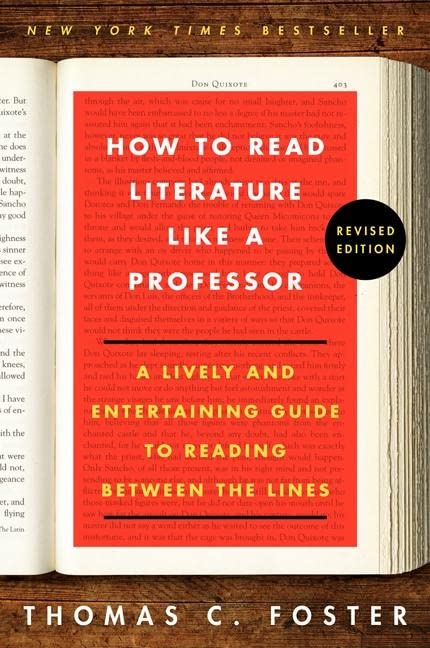
A thoroughly revised and updated edition of Thomas C. Foster’s classic guide—a lively and entertaining introduction to literature and literary basics, including symbols, themes and contexts, that shows you how to make your everyday reading experience more rewarding and enjoyable.While many books can be enjoyed for their basic stories, there are often deeper literary meanings interwoven in these texts. How to Read Literature Like a Professor helps us to discover those hidden truths by looking at literature with the eyes—and the literary codes-of the ultimate professional reader, the college professor.What does it mean when a literary hero is traveling along a dusty road? When he hands a drink to his companion? When he’s drenched in a sudden rain shower?Ranging from major themes to literary models, narrative devices and form, Thomas C. Foster provides us with a broad overview of literature—a world where a road leads to a quest, a shared meal may signify a communion, and rain, whether cleansing or destructive, is never just a shower-and shows us how to make our reading experience more enriching, satisfying, and fun.This revised edition includes new chapters, a new preface and epilogue, and incorporates updated teaching points that Foster has developed over the past decade.
User’s Reviews
Editorial Reviews: From the Back Cover A thoroughly revised and updated edition of Thomas C. Foster’s classic guide—a lively and entertaining introduction to literature and literary basics, including symbols, themes, and contexts—that shows you how to make your everyday reading experience more rewarding and enjoyable.While many books can be enjoyed for their basic stories, there are often deeper literary meanings interwoven in these texts. How to Read Literature Like a Professor helps us to discover those hidden truths by looking at literature with the eyes—and the literary codes—of the ultimate professional reader: the college professor.What does it mean when a literary hero travels along a dusty road? When he hands a drink to his companion? When he’s drenched in a sudden rain shower? Ranging from major themes to literary models, narrative devices, and form, Thomas C. Foster provides us with a broad overview of literature—a world where a road leads to a quest, a shared meal may signify a communion, and rain, whether cleansing or destructive, is never just a shower—and shows us how to make our reading experience more enriching, satisfying, and fun.This revised edition includes new chapters, a new preface, and a new epilogue, and incorporates updated teaching points that Foster has developed over the past decade. About the Author Thomas C. Foster, author of How to Read Literature Like a Professor and Reading the Silver Screen, is professor emeritus of English at the University of Michigan, Flint, where he taught classes in contemporary fiction, drama, and poetry, as well as creative writing and freelance writing. He is also the author of several books on 20th-century British and Irish literature and poetry.
Reviews from Amazon users which were colected at the time this book was published on the website:
⭐Bought this for my son for school.
⭐(Reviewed by Gwen’s 15-year-old son) “How to Read Literature Like a Professor,” in many respects, is very much like literature as a whole: broad and encompassing, yet concise and comprehensible. To most people, at least. It is an agreeable, strongly opinionated guide to the things that every reader may be thinking, but is greatly pleased to see written down to reinforce their own opinions. In this respect, it is nothing short of a great piece of analytical literature: it’s relevant (and most likely always will be), readable, and refreshing. Many main ideas expressed throughout Thomas Foster’s twenty-seven chapters are powerful, and communicate his ideas clearly. The ideas themselves are agreeable, as I found it hard to argue with his conjecture more than a few times. His statements about both the fruition and purpose of literary symbols and themes are insightful and well-read, and he gives many more examples than necessary to prove his point. The analytical nature of each individual chapter is invaluable for a great understanding of his arguments, while also helping the novice reader to find parallels within other works of literature. I myself experienced a few “aha moments” while doing nightly readings, and I cannot help but think of the biblical references or symbolic implications that Foster so aptly drilled into my skull whenever I watch T.V. or pick up a new book. So from the standpoint of the overall goal, Foster achieves it quite decisively. What else HTRLLP does well is to draw thematic evidence from literary sources that span over much of written human history. Homer, Shakespeare, Poe, and J.K. Rowling are all a part of Foster’s roster of famous writers, and they all contribute. This is what made reading the book enjoyable to me; knowing what he’s referencing is pivotal to understanding. However, I personally feel like there are a large number of disagreeable parts to this book that more than sap the potential in Foster’s arguments. As stated earlier, Foster’s arguments are well-read, with large, detailed anecdotes about novels with particular relevancy to each chapter. But that is just the issue. This book is a guide for a novice literary analyst and writer, but Foster expects the reader to know obscure novels that would not crop up in an average high school curriculum. Besides a quick detour on Shakespeare, almost every other reference in the entire book is a nod toward some random piece of literature. Granted, these random pieces of literature may be great ones, but it is hard to understand an argument when you have never read Going After Cacciato. And that book is referenced a lot. Although Foster does adequately to abridge the main points, a reader cannot connect on a deeper level with a novel if all they have to work with is the shallow summary of a book, and that is exactly what Foster intends for us, the reader, to do. Also, Foster falls short in that he provides his reader with a very narrow concept of literature as a whole. The first chapter was absolutely repugnant, and hearing the phrase “there’s only one story” drove me insane. Like language itself, literature is ripe with exceptions, and there is no instance where a situation is always or never true; it simply is not that black and white. On that same note, at any instance that Foster adds an infinitive like “always” or “never” into his bolded phrases, my mind would look for any example to prove him wrong. He himself stated that “`always’ and `never’ are not words that have much meaning in literary study” and his parallels to Jungian theory just beg for opposition. He may be saying it for the sake of clarity, which is necessary to any thesis, but using words as inflexible as “never” leads me to believe that Foster is making an opinion out of an unbiased analysis of literature. Chapter two resonated with me because of a single line on Sigmund Freud, “sometimes a cigar is just a cigar.” This idea, so simple, and yet pragmatic, could very well be applied to the remainder of Foster’s novel. In some instances, Foster has some very profound moments, like describing the mechanics of intertextuality and the pervasiveness of Shakespearean quotation. However, he has some low moments as well. The deeper the reader goes into the book, the less comprehensible his ideas become. While the single, bolded line is still there in every chapter, the analysis that follows gets longer, and above all, more singular in viewpoint. It is here where Foster has run the risk of overanalyzing his ideas, to a point where these ideas blur into nothing more than pure personal conjecture. While he promotes the free flow of individual significance to symbol and theme, his own ideas saturate the page so heavily that the reader gets bogged down with thoughts that they are not their own. And finally, the coup de grace is the “no duh” moment. For a 281 page guide to literature, you can expect it to cover quite a bit of ideas, archetypes, and popular allusions. But more often than not, this coverage is simply not the analysis one should expect from such an ambitious book. It has very casual, almost simple rhetorical questions like “Just what do up and down mean?” and “`Who ya gonna call?'” followed by similarly clichéd or skin deep analysis. When you remove all of the personal opinions Foster lets seep into his pages, as well as the content that is pure anecdote or ponderous questioning, you will usually end up with little more than that single bolded phrase that summarizes each chapter. While I praise Foster for his directness, I do not feel the same way about asserting author’s intent and conversing as if his readers could not possibly understand cultural reference. Overall, I feel as if “How to Read Literature Like a Professor” is an interesting mix of great accomplishment and crippling error. I learned, but I did not enjoy doing it. I put up with his banter and bad jokes and probably acquired a great tool for experiencing literature. But I cannot say that this book is a triumph or a nasty brown stain on the face of analytical literature. For all of its glaring faults and obvious ideas, what this book achieves will leave a more lasting impression than its pitfalls. Foster’s highly mythological analysis of literature and its origins may be out of most people’s capacity or patience, but it does have quite a bit to offer. But if I were to phrase all of this, I guess it would have to be as follows: you can’t enjoy “How to Read Literature Like a Professor” unless you are one.
⭐It’s a rare day that I’m willing to give a full five out of five stars to a book. It’s rarer still that I’ll give the five stars, and then put it back on my bed-stand for continual reference in my future reading.It’s just that kind of a book, and every bibliophile should read it.In “How to Read Literature like a Professor,” Thomas Foster has given us a delightful little romp through literature, producing a guide to the themes, symbolism, ironies, allusions, and plots that reoccur through-out almost all of the fiction we read. Whether it’s Charles Dickens or Charles Schulz or even Tom Clancy, Foster’s collection of essays are each a fun and enjoyable guide to what you’ve been reading, and what you will read, when you pick up a work of fiction.For example: in chapter 10, “It’s more than just rain or snow,” we read that “weather is never just weather. It’s never just rain.” Rather, Foster says, instead of providing just a setting, a backdrop to the story, weather in fiction is rooted in our fears and hopes. In addition to appearing as a feature character in the Judeo-Christian-Islamic biblical tale of the great flood, it makes notable and significant sightings in mythologies from all over the world, often, if not always, appearing and appealing to our fear of drowning. “Rain,” Foster says, “prompts ancestral memories of the most profound sort. So water in great volume speaks to us at a very basic level of being.So rain–and floods–signifies drowning? Kind of, but it doesn’t stop there. Citing D.H. Lawrence’s “The Virgin and the Gypsy” (1930), which I’ve not read yet, Foster sees it as a “big eraser that destroys but also allows a brand-new start.”Kind of like baptism? Yeah. If you’re part of that Christian tradition, this is what baptism is: death of the old, imperfect, and flawed man, and rebirth of a new man. And such is the role that this element–rain and floods–plays in literature. Well, most of the time. Fog can represent a lack of clarity, sunshine hope and clarity. In short, weather is rarely just setting.That’s rain and weather. Each chapter is a written with a quick and light wit that allows a reader, whatever his level of experience with literature, to follow along, see the theme, enjoy the examples, and find a taste for the point. Other chapter titles include the following:* “When in Doubt, It’s from Shakespeare…”* “…Or the Bible”* “It’s All Political”* “Marked for Greatness”* “Nice to Eat with You: Acts of Communion” and, of course,* “Nice to Eat You: Acts of Vampire.” (Stephanie Meyer ought to pick that one up to understand why people who love literature hate Twilight).Weighing in at just under three hundred pages, “How to Read Literature Like a Professor” doesn’t require deep commitment, deep concentration, or deep literature reading. My brain-candy of choice usually falls in the science-fiction or fantasy categories, and yet, I’ve started to find the themes and allusions and ironies that I saw in classics like “Howards End” and “Bleak House” appearing there, too. Whatever you read, it applies the symbolism that Foster walks through. As a result, my experience, whatever I’m reading, has been more enjoyable since I started it. It’s that moment of sudden realization when the whole theme of Steven Erikson “Book of the Fallen” subplot (and there are a lot of them) is an allusion, or imitation, to Spartacus (I think). Or that the journey (all journeys are quests) across the water is a journey of transformation, where the fallen man chooses to start a new life, emerging from the water, as it were, reborn.It’s fun. A lot of fun. Even just reading the book itself is fun. To boot, at the end Foster provides a list of all the books he refers to throughout his essays to allow you, the reader, to pick them up and read further. And what could be more fun about reading than delving into great fiction?Pick it up, start reading, and enhance your general reading experience. If you’re going to read fiction, and you should, you might as well get the most out of it.
⭐The most enlightening and entertaining book on understanding western literature indeed. In a way, it’s still daunting for someone from outside the Greek/ Christian tradition.
⭐Witty. It has changed the way I reflect about books that I read. Also, the bibliography in this book is a great catalogue of classics to read.
⭐it is little bit hard for me.
⭐Excellent read, not too heavy and very educational without being dry.
⭐Very pleased with purchase. As described. Many thanks
Keywords
Free Download How to Read Literature Like a Professor: A Lively and Entertaining Guide to Reading Between the Lines, Revised Edition in PDF format
How to Read Literature Like a Professor: A Lively and Entertaining Guide to Reading Between the Lines, Revised Edition PDF Free Download
Download How to Read Literature Like a Professor: A Lively and Entertaining Guide to Reading Between the Lines, Revised Edition 2014 PDF Free
How to Read Literature Like a Professor: A Lively and Entertaining Guide to Reading Between the Lines, Revised Edition 2014 PDF Free Download
Download How to Read Literature Like a Professor: A Lively and Entertaining Guide to Reading Between the Lines, Revised Edition PDF
Free Download Ebook How to Read Literature Like a Professor: A Lively and Entertaining Guide to Reading Between the Lines, Revised Edition