Ebook Info
- Published: 2010
- Number of pages: 218 pages
- Format: PDF
- File Size: 13.36 MB
- Authors: Christopher Norris
Description
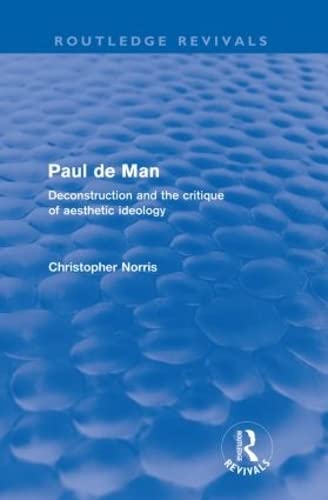
Paul de Man – literary critic, literary philosopher, “American deconstructionist” – changed the landscape of criticism through his rigorous theories and writings. Upon its original publication in 1988, Christopher Norris’ book was the first full-length introduction to de Man, a reading that offers a much-needed corrective to the pattern of extreme antithetical response which marked the initial reception to de Man’s writings.Norris addresses de Man’s relationship to philosophical thinking in the post-Kantian tradition, his concern with “aesthetic ideology” as a potent force of mystification within and beyond that tradition, and the vexed issue of de Man’s politics. Norris brings out the marked shift of allegiance in de Man’s thinking, from the thinly veiled conservative implications of the early essays to the engagement with Marx and Foucault on matters of language and politics in the late, posthumous writing. At each stage, Norris raises these questions through a detailed close reading of individual texts which will be welcomed by those who lack any specialised knowledge of de Man’s work.
User’s Reviews
Editorial Reviews: Review ‘His grasp of the historical and philosophical dimensions of the styles and arguments of contemporary literary theory is quite extraordinary and illuminating.’ – N. Lukacher, University of Illinois at Chicago
Reviews from Amazon users which were colected at the time this book was published on the website:
⭐Literary criticism is not often an occasion for one to get emotionally involved. The critic ought to either write his own criticism dispassionately or to read the ideas of others equally so. I have read theories that I found eminently commonsensical and others simply ludicrous. Regardless of their merits, I always maintained an emotional distance, an equilibrium that I found necessary to pass judgment. However, in PAUL DE MAN: DECONSTRUCTION AND THE CRITIQUE OF AESTHETIC IDEOLOGY, Christopher Norris has succeeded in getting me to cross the line between detachment and spleen. Except for his last chapter–a postscript on de Man’s early writings in Nazi-held Belgium of 1941–Norris has sought to explain how deconstruction can be used fruitfully to account for the hidden aporias in literature. In this, at least, he is successful. In his chapter “The Critique of Romantic Ideology,” he persuasively analyzes how the totalizing claims of Hegel’s AESTHETICS are deconstructively seen as not as so totalizing at all. And again, in “Aesthetic Ideology and the Ethics of Reading,” Norris uses deconstruction to point out how so beatific a novelist like Trollope yet writes book after book that are a “kind of contagious ambivalence, a generalized doubt that affects Trollope’s fiction not only in its ethical but also in its mimetic or representational aspect.” Now I can appreciate how any theorist, including one of deconstruction, can cause a reader to view a text in a new way. But as long as that critic stays in the realm of dispassionate critiquing, then all is well. However, in the tangible world, where the lines of fictionality and cold realism occasionally blur over even as do the deconstructive tenets that seek to produce that blurring, the result is to show the dirty and disturbing underbelly of a theory that tosses gasoline onto a wretched tangle of text and tormented humanity and watches calmly while someone else tosses in a lit match of deconstruction.Norris’ last chapter “Postscript: On de Man’s Early Writings in Le Soir,” is a lamentable and ultimately irritating coda to a book that began with much promise. Most informed readers now well know that when de Man died, he was lionized as a Titan of the Twentieth Century, second only to Jacques Derrida in the deconstructive pantheon. However, a Belgian graduate student named Ortwin de Graef was doing research on de Man’s early career as a writer in Belgium for the Nazi newspaper Le Soir. What de Graef found were dozens of previously buried essays, many of which were virulently anti-Semitic, including one called “The Jews in Contemporary Literature.” In this essay, written in 1941, de Man describes a Europe that would benefit if all Jews were to go elsewhere. De Man accuses European Jews of “meddling in all aspects of European life. Moreover, one thus sees that a solution to the Jewish question that envisions the creation of a Jewish colony isolated from Europe would not involve deplorable consequence for the literary life of the West.” This was not the only published essay critical of Jews and laudatory of Nazi Germany that appeared in Le Soir. In another article, de Man praises Hitler for defeating a debilitated French society and for reinvigorating it with a similar set of racial purity laws then prevalent in Germany.One might think that when these articles were published for all the world to see as Wartime Journalism in 1989, the majority of thinkers, writers, philosophers, and professors would have loudly and immediately denounced de Man for his radical views. One would, unfortunately, be wrong. What happened instead is that a surprisingly vocal group of supporters rushed to his defense. Even prior to the publication of Wartime Journalism, a duo of de Man’s colleagues planned a spirited counterattack: J. Hillis Miller and Jacques Derrida, both noted deconstructionists. Their plan was to use the very tenets of deconstruction to present de Man’s activities as subject to contextualization, obfuscation, the indeterminacy of language, and the omission of human values as the “core” of Western culture–all of which are the trademarks of deconstructive thought. These two were soon joined by two other writers who used similar linguistic legerdemain to portray de Man as being no worse than any of his contemporaries. James Atlas, in “The Case of Paul de Man,” writes that he cannot think of even one person who ever heard de Man utter just one word against Jews. And this brings me to Christopher Norris, who argues that de Man’s “youthful thinking” surely should mitigate his dastardly writings or that “de Man’s later writings grew out of an agonized reflection on his wartime experience, and can best be read as a protracted attempt to make amends (albeit indirectly) in the form of an ideological auto-critique.” Well, excuse me, but Norris has just exposed the often hidden debased underside of deconstruction–that any act however heinous–can be contextualized, rationalized, or otherwise relativized such that the finger of blame need not be pointed at any one miscreant. Mr. Norris and any others who side with de Man ought to be ashamed of themselves. But clearly they are not and that is why I give his book one star.
Keywords
Free Download Paul de Man (Routledge Revivals): Deconstruction and the Critique of Aesthetic Ideology 1st Edition in PDF format
Paul de Man (Routledge Revivals): Deconstruction and the Critique of Aesthetic Ideology 1st Edition PDF Free Download
Download Paul de Man (Routledge Revivals): Deconstruction and the Critique of Aesthetic Ideology 1st Edition 2010 PDF Free
Paul de Man (Routledge Revivals): Deconstruction and the Critique of Aesthetic Ideology 1st Edition 2010 PDF Free Download
Download Paul de Man (Routledge Revivals): Deconstruction and the Critique of Aesthetic Ideology 1st Edition PDF
Free Download Ebook Paul de Man (Routledge Revivals): Deconstruction and the Critique of Aesthetic Ideology 1st Edition