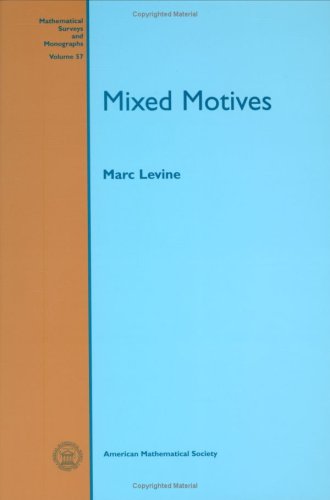
Ebook Info
- Published: 1998
- Number of pages: 515 pages
- Format: PDF
- File Size: 3.56 MB
- Authors: Marc Levine
Description
This volume combines foundational construction in the theory of motives and results relating motivic cohomology to more explicit constructions. Prerequisite for understanding the work is a basic background in algebraic geometry. Most of the classical constructions of cohomology are described in the motivic setting, including Chern classes from higher K-theory, push-forward for proper maps, Riemann-Roch, duality, as well as an associated motivic homology, Borel-moore homology nd cohomology with compact supports.
User’s Reviews
Reviews from Amazon users which were colected at the time this book was published on the website:
⭐Loosely speaking, the theory of motives can be regarded as a kind of “grand unified theory” of the cohomology of algebraic varieties or schemes. Such a viewpoint is brought out in this book by the in-depth discussion of the various realizations of the motivic category, such as the Betti, etale, Hodge, and motivic realizations. Readers will need a deep knowledge of algebraic geometry, the theory of schemes, and the various cohomology theories associated with algebraic varieties to approach this book, and also some category theory, but the latter is developed in detail in Part 2 of the book, and modulo some awkward choices of notation, is fairly straightforward to follow.The author motivates the subject of mixed motives very well, both from an historical point of view and from the standpoint of what kinds of properties one should expect if some of the “standard” constructions of algebraic topology are to be respected. He also explains just how various strategies for constructing the category of motives can falter if some care is not taken. This kind of explanation is just what readers need if they are to really understand, and not just formally manipulate, the mathematical constructions that take place in the book. The approach to the construction of the category of mixed motives in this book is one that does not depend explicitly on rational equivalence for defining pull-backs of cycles. A good understanding of cycles of course is what has stymied the development of the theory of motives, and in this book, as in others, cycles are for the most part formulated in the context of the Chow group.The starting point is the category L(V) of equivalence classes of pairs (X, f), where X is an object in the symmetric monoidal subcategory of the category of schemes and f is a map in the subcategory of localizations of schemes. The map f also has the property of having a smooth section. Two maps f and g are equivalent if one can find an isomorphism h on their domains and f can be written as the composition of g and h. The fiber product exists in L(V) and is a symmetric monoidal category. From L(V) the category L(V)* is formed from the cross product of the integers with the opposite category of L(V) by adjoining certain morphisms and relations, and by extending its symmetric monoidal structure.The main object of interest is the differential graded tensor category Amot(V), which is accomplished in five steps. First, a free additive category A1(V) on L(V)* is constructed with a product descended from the product on L(V)*, this product making A1(V) into a tensor category. Then a universal external product is put on A1(V), giving A2(V), which is shown to be a differential graded tensor category without unit. In step three, using the resulting coproduct of A2(V) and via the adjunction of certain maps, one obtains a differential graded tensor category A3(V). Then by adjoining homotopies to the category A3(V) in order to obtain meaningful notions of cycle maps, along with certain morphisms, the differential graded category A4(V) is formed. Finally a category A5(V) is obtained from A4(V) by adjoining certain morphisms, and the category Amot(V) is defined as the full additive subcategory of A5(V) generated by tensor products of its objects of a particular form.With the construction of Amot(V) completed, the author then constructs a triangulated tensor category from it via the homotopy category Kbmot(V) of bounded complexes on Amot(V). Homotopies, excision maps, the Kunneth and Gysin isomorphisms, and the unit map are then inverted to obtain a triangulated tensor category Dbmot(V). Using a commutative ring R that is flat over the integers, tensoring Kbmot(V) with R, localizing Dbmot(V) with respect to the homotopy, excision, etc morphisms, and taking the pseudo-abelian hull gives finally the triangulated motivic category DM(V, R) with coefficients in R.Computing Chern classes for mixed motives requires a discussion of their K-theory, and this is done in the third chapter of the book by first defining Chern classes of vector bundles on (N-truncated) simplicial schemes. Having such a notion of a vector bundle allows the usual definition of the Grothendieck group (zeroth K-group) to go forward without too much modification. As expected, in the derived (triangulated tensor) category of motives D(b, mot, V) for a vector bundle p: E-> X, the map p*: Z(X) -> Z(E) is an isomorphism. The first Chern class of a line bundle on an N-truncated simplicial object is defined as an element of the second (motivic) cohomology class with coefficients in Z(1) that corresponds to particular morphism in D(b, mot, V). The usual behavior under pull-backs and the additivity property hold for the first Chern classes of line bundles. General Chern classes are defined via the Grothendieck splitting principle and the author proves the Whitney product formula.Note: The reviewer studied this book between the dates of February 2013 and February 2016.
Keywords
Free Download Mixed Motives. in PDF format
Mixed Motives. PDF Free Download
Download Mixed Motives. 1998 PDF Free
Mixed Motives. 1998 PDF Free Download
Download Mixed Motives. PDF
Free Download Ebook Mixed Motives.