Ebook Info
- Published: 2013
- Number of pages: 130 pages
- Format: PDF
- File Size: 16.58 MB
- Authors: A. Ya. Khinchin
Description
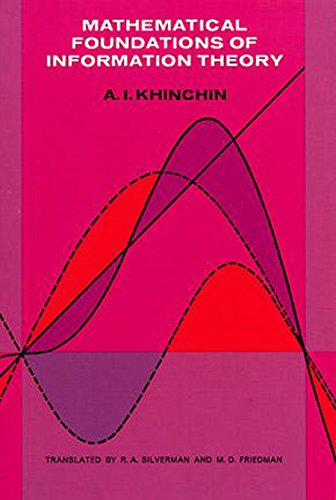
The first comprehensive introduction to information theory, this book places the work begun by Shannon and continued by McMillan, Feinstein, and Khinchin on a rigorous mathematical basis. For the first time, mathematicians, statisticians, physicists, cyberneticists, and communications engineers are offered a lucid, comprehensive introduction to this rapidly growing field.In his first paper, Dr. Khinchin develops the concept of entropy in probability theory as a measure of uncertainty of a finite “scheme,” and discusses a simple application to coding theory. The second paper investigates the restrictions previously placed on the study of sources, channels, and codes and attempts “to give a complete, detailed proof of both … Shannon theorems, assuming any ergodic source and any stationary channel with a finite memory.”Partial Contents: I. The Entropy Concept in Probability Theory — Entropy of Finite Schemes. The Uniqueness Theorem. Entropy of Markov chains. Application to Coding Theory. II. On the Fundamental Theorems of Information Theory — Two generalizations of Shannon’s inequality. Three inequalities of Feinstein. Concept of a source. Stationarity. Entropy. Ergodic sources. The E property. The martingale concept. Noise. Anticipation and memory. Connection of the channel to the source. Feinstein’s Fundamental Lemma. Coding. The first Shannon theorem. The second Shannon theorem.
User’s Reviews
Reviews from Amazon users which were colected at the time this book was published on the website:
⭐A concise and rigorous derivation of classical Shannon information theory for discrete distributions.
⭐Khinchin’s work is very rigorous and thorough, albeit a bit dry and scarce on intuition (I believe the assumption is that most readers will already have an intuitive understanding of the theorems, but as I went in “blind,” as it were, this slowed me down a fair bit).The typesetting is rather poor and there are quite a few typos throughout – almost all are easy to catch and correct if one is paying attention and making sense of the material, however.Overall, a great summary of the mathematics behind the subject, and lucid enough for a reader without much background to get a clear picture of what the field is about by the time they’ve read it through.
⭐Shannon’s paper is great. Easy to read (though many people misunderstand many concepts – I may too) but lacks mathematical rigor. This book has redone several points that Shannon made but more accurately. It requires ergodic theory and measure theory to follow every detail, but some parts may be usable even without much background. I don’t think the book is perfectly edited, but I know I paid too little for the knowledge I gained from this book.
⭐the proof on the uniqueness theorem is awesome. It shows why the formula of entropy is “destined” to be that way, i.e. being the expected value of log(p)
⭐good
⭐Even though the book was written long time ago, the interpretation of information theory is still good! I like the description of channels with memory in particular.
⭐The main advantage of the book is that it covers the info theory corresponding to different fields of science and art. This is rather interesting and surprizing for EE students and scholars. The mathematics therein however is not rigorous.
⭐A Y Khinchin was one of the great mathematicians of the first half of the twentieth century. His name is is already well-known to students of probability theory along with A N Kolmogorov and others from the host of important theorems, inequalites, constants named after them. He was also famous as a teacher and communicator. The books he wrote on Mathematical Foundations of Information Theory, Statistical Mechanics and Quantum Statistics are still in print in English translations, published by Dover. Like William Feller and Richard Feynman he combines a complete mastery of his subject with an ability to explain clearly without sacrificing mathematical rigour.In his “Mathematical Foundations” books Khinchin develops a sound mathematical structure for the subject under discussion based on the modern theory of probability. His primary reason for doing this is the lack of mathematically rigorous presentation in many textbooks on these subjects.This book contains two papers written by Khinchin on the concept of entropy in probability theory and Shannon’s first and second theorems in information theory – with detailed modern proofs. Like all Khinchin’s books, this one is very readable. And unlike many recent books on this subject the price is very cheap. Two minor complaints are: lack of an index, and typesetting could be improved.
⭐It certainly covers the ground. But even with a mathematical training (UCL BSc Maths) I found myself wishing it weren’t quite such a thin book. A little more expansion of reasoning here and there would not have gone amiss. Still at least there are some amusing mistranslations to hold interest.
⭐This little book is an exposition on the mathematics behind information theory as understood by Khinchin himself. Contains a wealth of material in this area, with original insights from one of the main contributors. The way he introduces entropy and its physical intuition (which is often absent in most of the mathematics literature in this field) is special. Equally revealing is Shanon’s theorem …
⭐buon prodotto come descritto.consiglio questo prodotto
⭐
Keywords
Free Download Mathematical Foundations of Information Theory (Dover Books on Mathematics) in PDF format
Mathematical Foundations of Information Theory (Dover Books on Mathematics) PDF Free Download
Download Mathematical Foundations of Information Theory (Dover Books on Mathematics) 2013 PDF Free
Mathematical Foundations of Information Theory (Dover Books on Mathematics) 2013 PDF Free Download
Download Mathematical Foundations of Information Theory (Dover Books on Mathematics) PDF
Free Download Ebook Mathematical Foundations of Information Theory (Dover Books on Mathematics)