

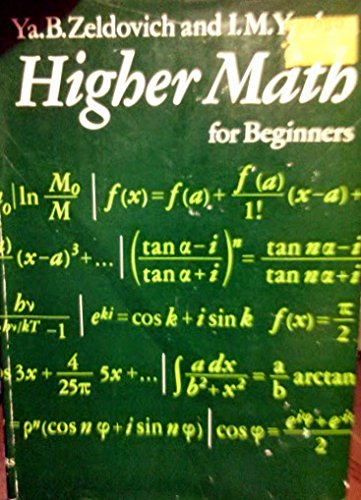
Ebook Info
- Published: 1988
- Number of pages: 560 pages
- Format: PDF
- File Size: 63.40 MB
- Authors: Y. B. Zeldovich
Description
User’s Reviews
Reviews from Amazon users which were colected at the time this book was published on the website:
⭐Never seen such one of a kind book by a renowned mathematician. Absolutely a gem of a kind. Good for anytime read.
⭐Read here the “Teaching Notes”: “We feel that, as the case in the 19th Century and will probably be the case in the 21st Century, too, the main stress should be put on the elements of mathematical analysis, differential and integral calculus, and the simplest differential equations” and ” …it can be used in teaching mathematics or physics to students in high school, vocational school, or college.” Those words describe the content of this text alongside the prospective audience. To say this book will prove useful is an understatement. Here we have a masterwork of pedagogy. Whether you are an instructor for a high school course, or at university, the text will be an invaluable asset for learning to apply calculus to physical problems. That this text is not presently so utilized is, simply put, a travesty of epic proportions ! Three sprawling parts comprise the entirety of the enterprise:(1) The elements: numbers, functions, derivatives and integrals, series and geometric applications conclude.(2) The applications: radioactivity, mechanics, oscillations, thermal motion, light, lasers, circuits. Two- hundred pages !(3) Additional topics: complex numbers, Dirac delta function, there follows an amalgamation of the two ! (fifty pages).Let us look at a few specifics:(1) Part One contains a nice exposition of “integrating functions dependent on a parameter” (pages 173-176). You will be entertained with an exposition of “differential equation for water flow from a vessel.” (pages 203-206). Conclusion to part one (chapter seven) is, without a doubt, one of the finest elementary presentations of maxima and minima and convexity, ever put to the written page. (pages 214-341).(2) Part Two: physical applications. Radioactivity and nuclear fission. Presented Both physically and mathematically–through qualitative analysis, then through solution of differential equations, beautifully expounded (pages 281-303).Delight in the wonderful, accurate, pronouncement of equations of jet propulsion (“rocket equation”)–much too often muddled in introductory courses (pages 334-337). Fluid motion, both simple and complex, gets an equally thoughtful discussion (pages 346-353). Again, physics and mathematics in tandem. Read: “Of particular importance to students are cases where it is possible to obtain and compare both solutions, exact and approximate.” A highlight: emission probability and the conditions for thermodynamic equilibrium (pages 410-414). For the introductory physics student, we read: “Let us point out some similarities and differences between capacitance and inductance.” (page 437). Nice !(3) Part Three: this may be the simplest and clearest exposition of Dirac delta function I have seen. This occupies your attention throughout chapters sixteen and seventeen (pages 486-513), including computing simple contour integrals !(4) There you have brief compass of the textbook. Exercises enrich the text. You will get hints and solutions to many of the exercise problems. Your progress is thus kept in-check. Historical asides enliven the prose. Do not fail to read the beginning of the book, where we find notes to the reader and notes to the teacher. These “notes” answer… the who, the how, the why? Reference to the wonderful calculus text of Lax is made (Rightly, so !) Useful references conclude the textbook. Concluding:You are a beginning student in physics or mathematics. You are an instructor searching for applications and problems.You are both looking for innovative pedagogy in physics and mathematics. Physicist Zeldovich and Mathematician Yaglom are your trusted guides. No better exists at this (truly elementary) level of instruction that I am aware of.A fine mixture of applicable mathematics and physical intuition.
⭐It’s a great book for self study! Who the heck are these @$#holes asking over $800 for this book?! Psst, you can down it legally for on many archive sites!
⭐This book is a priceless pearl. A rare jewel. I was most fortunate to find this book in the early 1990’s in sort of a book/textbook closeout outlet. It is the best math book I have ever seen. It is my favorite and I have always prized it. With this clear and lucid book, you could teach higher math to grade schoolers. It is a joy to read. The authors make the subjects so much more readily accessible and adsorbable. It is not really a text book, but the authors must have been incredible math and physics teachers. I would have liked to have been in some of their lectures. Just note the number of four and a half and five star books by each of the authors. I collected many books on application of higher math to engineering and science. This is my favorite and the best I ever found. It is a shame you cannot find a math book written in the west that is as clear and lucid. I know part of the answer is in the way textbooks are sold to colleges in America. What does that say about the progression of math, engineering and science education in America? The book provides a good survey from basic calculus to higher order math. Few math books that start at basic underlying math, derivatives and integrals go as far as this one in higher math, and as compactly, densely and succinctly. I highly recommend this book. It needs to be in print.
⭐if you,like me are trying to jump in to grad school and you need a deeper understanding of math,this book will totally help you.side-note:this book was originally published in “soviet communist Russia” 1982,and in the american edition is stated “first published in the soviet republics” which is a tell tale:the soviet system was great to promote mathematics and engineering,and they really worked it to make it accessible to the massesyou will not be disappointed,the price tells you how much people value this work,I know I do.
⭐Cover page is not the same as shown in photo and binding of the book is modified otherwise quality of pages is good except some markings of pen on few pages
Keywords
Free Download Higher Math for Beginning Physicists and Engineers in PDF format
Higher Math for Beginning Physicists and Engineers PDF Free Download
Download Higher Math for Beginning Physicists and Engineers 1988 PDF Free
Higher Math for Beginning Physicists and Engineers 1988 PDF Free Download
Download Higher Math for Beginning Physicists and Engineers PDF
Free Download Ebook Higher Math for Beginning Physicists and Engineers