

Ebook Info
- Published: 2011
- Number of pages: 352 pages
- Format: PDF
- File Size: 10.21 MB
- Authors: Everitt
Description
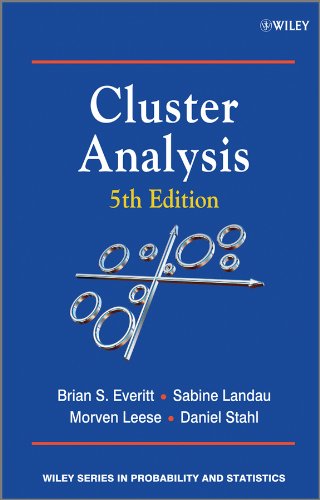
Cluster analysis comprises a range of methods for classifying multivariate data into subgroups. By organizing multivariate data into such subgroups, clustering can help reveal the characteristics of any structure or patterns present. These techniques have proven useful in a wide range of areas such as medicine, psychology, market research and bioinformatics.This fifth edition of the highly successful Cluster Analysis includes coverage of the latest developments in the field and a new chapter dealing with finite mixture models for structured data.Real life examples are used throughout to demonstrate the application of the theory, and figures are used extensively to illustrate graphical techniques. The book is comprehensive yet relatively non-mathematical, focusing on the practical aspects of cluster analysis.Key Features:Presents a comprehensive guide to clustering techniques, with focus on the practical aspects of cluster analysisProvides a thorough revision of the fourth edition, including new developments in clustering longitudinal data and examples from bioinformatics and gene studies./li>Updates the chapter on mixture models to include recent developments and presents a new chapter on mixture modeling for structured dataPractitioners and researchers working in cluster analysis and data analysis will benefit from this book.
User’s Reviews
Editorial Reviews: From the Inside Flap Cluster Analysis: 5th EditionBrian S. Everitt, Professor Emeritus, King’s College, London, UK Sabine Landau, Morven Leese and Daniel Stahl, Institute of Psychiatry, King’s College London, UKCluster analysis comprises a range of methods for classifying multivariate data into subgroups. By organizing multivariate data into such subgroups, clustering can help reveal the characteristics of any structure or patterns present. These techniques have proven useful in a wide range of areas such as medicine, psychology, market research and bioinformatics.This 5th edition of the highly successful Cluster Analysis includes coverage of the latest developments in the field and a new chapter dealing with finite mixture models for structured data.Real life examples are used throughout to demonstrate the application of the theory, and figures are used extensively to illustrate graphical techniques. The book is comprehensive yet relatively non-mathematical, focusing on the practical aspects of cluster analysis.Key Features:• Presents a comprehensive guide to clustering techniques, with focus on the practical aspects of cluster analysis. • Provides a thorough revision of the fourth edition, including new developments in clustering longitudinal data and examples from bioinformatics and gene studies • Updates the chapter on mixture models to include recent developments and presents a new chapter on mixture modeling for structured data.Practitioners and researchers working in cluster analysis and data analysis will benefit from this book. From the Back Cover Cluster Analysis: 5th EditionBrian S. Everitt, Professor Emeritus, King’s College, London, UK Sabine Landau, Morven Leese and Daniel Stahl, Institute of Psychiatry, King’s College London, UKCluster analysis comprises a range of methods for classifying multivariate data into subgroups. By organizing multivariate data into such subgroups, clustering can help reveal the characteristics of any structure or patterns present. These techniques have proven useful in a wide range of areas such as medicine, psychology, market research and bioinformatics.This 5th edition of the highly successful Cluster Analysis includes coverage of the latest developments in the field and a new chapter dealing with finite mixture models for structured data.Real life examples are used throughout to demonstrate the application of the theory, and figures are used extensively to illustrate graphical techniques. The book is comprehensive yet relatively non-mathematical, focusing on the practical aspects of cluster analysis.Key Features:• Presents a comprehensive guide to clustering techniques, with focus on the practical aspects of cluster analysis. • Provides a thorough revision of the fourth edition, including new developments in clustering longitudinal data and examples from bioinformatics and gene studies • Updates the chapter on mixture models to include recent developments and presents a new chapter on mixture modeling for structured data.Practitioners and researchers working in cluster analysis and data analysis will benefit from this book. About the Author Brian S. Everitt, Head of the Biostatistics and Computing Department and Professor of Behavioural Statistics, Kings College London. He has authored/ co-authored over 50 books on statistics and approximately 100 papers and other articles, and is also joint editor of Statistical Methods in Medical Research.Dr Sabine Landau, Head of Department of Biostatistics, Institute of Psychiatry, Kings College London.Dr Morven Leese, Health Service and Population Research, Institute of Psychiatry, Kings College London.Dr Daniel Stahl, Deptartment of Biostatistics & Computing, Institute of Psychiatry, Kings College London. Read more
Reviews from Amazon users which were colected at the time this book was published on the website:
⭐Diligents, the book was sent in a timely manner and in good conditions.
⭐I read this book as the text in a four-week online class on cluster analysis. I learned a great deal and do not regret purchasing this book. It has several strengths and some weaknesses as an introduction to this statistical technique.There is a good introduction to the unsupervised learning problem of classifying objects into meaningful groups with no basis for validating these classifications. The authors’ decision to focus on graphical methods early in the text is a good one and lays an intuitive foundation for their more technical presentation later in the book. The discussion of similarity measures at the core of cluster analysis is a good overview and prepares readers for more advanced discussions elsewhere.The book closes with the highly useful and practical chapter “Some final comments and guidelines.” It lists and describes nine steps in a typical cluster analysis and refers readers back to sections of the book which inform the decisions at each step. It’s coverage of methods for testing cluster quality and the likelihood of no structure in a dataset is also accessible and of practical value. Readers might consider looking through this material before reading the previous chapters to help organize the information more meaningfully.The middle chapters are worth reading, but suffer from a few problems. In general, these chapters are better at describing the boundaries of current research in clustering techniques than they are in describing typical applications. There are too many research results and not enough examples. The examples that are included are described too briefly, making it difficult to follow how the analysis was carried out. Better integration of citations in the body of the text would be a key improvement. As would inclusion of sample exercises with worked-out solutions in an appendix.Recognizing the difficulty of making a statistics text accessible to readers using a variety of software packages, I still believe this was not done well in this book. See Iain Pardoe’s
⭐for one example of how to do this very well. I will hope for improvements in a later edition of this book.This book has challenges as a text, but was worth the price and the time spent with it. Still, I will be on the lookout for a better alternative.
⭐I’m a frequent user of SPSS software, including cluster analysis, and I found that I couldn’t get good definitions of all the options available. I chose this book because I jotted down the terms that were poorly described in SPSS help, and then looked them up in the index of this book in the book description. I found several, so I bought the book.I was pleased with the result. It put cluster in a much broader context than SPSS classes or user’s guides do. It talks about techniques that SPSS can’t do. If obviously goes into greater detail including more than a few formulas, but it reads fairly well. I still don’t think that more than a handful of the folks I work with in need this much detail, and a serious practitioner might need even more. Kachigan’s chapter on this topic would be more relevant to a wide audience.
⭐Note that you won’t find any explicit references except for an appendix which lists stats software and the related cluster features. This part is quite out of date. There are no SPSS pictures or examples. Still, if you want the whole story, this is a fine choice.
⭐Was trying to learn more about unsupervised learning. I’ve been through the tutorials at the various online academies, but this book gave me a better depth of understanding.
⭐I really enjoyed this book. The structure of the book is great. The examples are very good, and the references really help the reader. The book helps the further research on cluster analysis. I recommend it to anyone who is interested in cluster analysis.
⭐Good book on clustering.
⭐Rich information, but really hard to read. It’s more suitable for academia than it’s for practical. YOu will have to have rich stat background to understand everything on this book. Great for Master’s and PHD students who are still workin on their programs.
⭐Book arrived perfectly.
⭐A acquérir si on veux procéder à des analyses en clusters sérieuses. A compléter néanmoins avec un ouvrage de Latent Class/Profile Analysis afin d’opposer les modèles mathématico-géométriques avec des solutions probabilistes.
⭐
Keywords
Free Download Cluster Analysis, 5th Edition 5th Edition in PDF format
Cluster Analysis, 5th Edition 5th Edition PDF Free Download
Download Cluster Analysis, 5th Edition 5th Edition 2011 PDF Free
Cluster Analysis, 5th Edition 5th Edition 2011 PDF Free Download
Download Cluster Analysis, 5th Edition 5th Edition PDF
Free Download Ebook Cluster Analysis, 5th Edition 5th Edition