

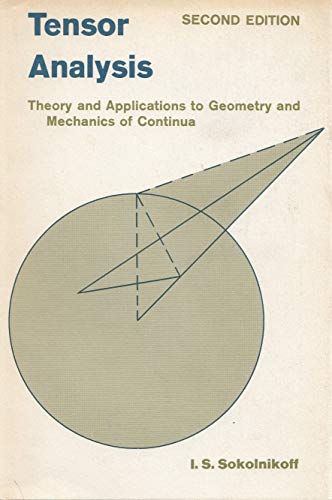
Ebook Info
- Published: 1964
- Number of pages: 361 pages
- Format: PDF
- File Size: 26.31 MB
- Authors: Ivan S. Sokolnikoff
Description
100% on condition.
User’s Reviews
Reviews from Amazon users which were colected at the time this book was published on the website:
⭐This is not a book for beginners, it’s somewhat hard to understand, it’s relatively small, but you have to read it 2 or 3 times to understand what the author its saying…. So if you don’t have a good mathematical background, this is not the book for you. And even if you have it… this is not a book to read, it’s a book to study. I have trouble with some parts of the book where the author uses super indices and sub indices for the summation convention… it’s somewhat confusing… The book it’s great, but you will need time to study, anyway this its tensor analysis… what else could one spect?
⭐I taught myself Tensor Analysis when I was working on my thesis on General Relativity.I fell in love with the book.It explains everything the way it should be: coordenate based implementation.It does not use the more confusing exterior algebra or Cartan Theory , even thoug , every nouvelle exposition follows it.In particular , it presents an excellent example to see how curvature brings in non-euclidean spaces, in the case of a R2 sphere: excellent.I left my country Cuba, and went to Africa.I have been out for over 25 yeras. I have plans of going back to my country , since I miss so many things..One of them , is my old (blue and gray Sokolnikooff book).Well, I am having this copy too , just in case.
⭐I used this book in 1982 for class and I kept it as proof of the initiation. But now I’m thinking about taking it off my bookcase as a prophylactic for keeping Alzheimer’s at bay. Maybe I’ll finish my final exam question “calculate the universe”.
⭐Sokolnikoff, coauthor of the fine text, Mathematics of Physics and Modern Engineering, here presents an accessible introduction to the more classical aspects of tensor analysis. One turns elsewhere for expositions which introduce differential forms (Lovelock and Rund, Bishop and Goldberg). However, as point of departure for those more advanced (more modern) textbooks, this tome contains much of lasting value. If one has requisite background (that is, a bit of advanced calculus and mathematical maturity), then there will be little problem in assimilating its contents. The book (1964, Second Edition) begins with review of linear algebra (fifty pages). Preliminaries aside, chapter two introduces the tensor concept: “….properties independent of the reference frames,” Coordinate transformations , local linearity and Jacobians are the motivating factors. Sokolnikoff discusses scalars, contravariance, covariance and quotient laws. Metric and Christoffel symbols introduced next. Tensors of Riemann, Ricci, Bianchi, Einstein, and properties thereof, introduced in succession. Two proofs of Ricci’s theorem (“….that the fundamental metric tensor behaves in covariant differentiation as though they were constants”) prove illuminating. The chapter ends with a leisurely discussion of Kronecker deltas and determinants. Useful, indeed. If one has mastered the first two chapters (100-pages) and solved a reasonable number of the straightforward problems, completing this textbook should present few issues. The third chapter will provide applications to geometry, a nice exposition, of 100-pages, which will do more than prepare the student for more advanced texts of differential geometry. (as preliminary to O’Neill or Spivak’s Volumes).Highlights: Gaussian curvature is met on more than one encounter. Initially, an elementary exposure, then on a more advanced level. Gauss-Bonnet theorem and brief discussion of n-dimensional manifolds conclude the chapter.Next, analytical mechanics. No physics background needed. The treatment is self-contained. This chapter provides mathematical supplement to Goldstein’s treatment of classical mechanics. Frankly, the chapter should be required reading for its astute discussion of variational symbolism, Lagrange and Hamiltonian formulations, and applications of Green’s functions. Following, is a chapter of relativistic mechanics. The chapter is brief, almost skeletal. It will need additional support from other source material (say, Bergmann or Weinberg). Final chapter is a delightful elaboration: “… a general formulation of the mechanics of continua… with …emphasis on the unified formulation of equations of mechanics of continua in the most general tensor form.”Concluding with the author’s words: “The history of science abounds in attempts to imbed the laws of nature in the structure of theology.” (page 229). Whether, or not, one agrees with that statement (it being located in the section on the principle of least action), it can be agreed that this text is as lucid and introductory as can be found elsewhere.The textbook authored by Sokolnikoff and Redheffer will provide adequate background !Recommended for its classical approach to a classical topic.
⭐I studied this book when I was 17. It is the book I have most often carried with me, like a bible. It is my all time favorite book, and I am indebted to professor Sokolnikoff for this masterpiece. It is very thorough. It is not a basic text, but…well, can I say easy?; no, this is tensor analysis, after all. But it has been a great joy to learn tensor analysis from this book. My previous knowledge had been calculus and matrice’s. I came here in search of a replacement, as my books binding is split. Sorry, this book is out of print. Perhaps Wiley & Sons will bring it back some day.
⭐Solkolnikoff made it easy and simple to get your hands on the tensor area. I’ve browsed quite a number of tensor books before picking up this one. Few books have the clarity combined with simplicity as Solkolnikoff’s does. It is absolutely a good choice for both beginners and researchers alike.Another word: I like this first edition better than the second edition, because there are some severe typos in the latter, while there is almost none in the first edition.
Keywords
Free Download Tensor Analysis: Theory and Applications to Geometry and Mechanics of Continua in PDF format
Tensor Analysis: Theory and Applications to Geometry and Mechanics of Continua PDF Free Download
Download Tensor Analysis: Theory and Applications to Geometry and Mechanics of Continua 1964 PDF Free
Tensor Analysis: Theory and Applications to Geometry and Mechanics of Continua 1964 PDF Free Download
Download Tensor Analysis: Theory and Applications to Geometry and Mechanics of Continua PDF
Free Download Ebook Tensor Analysis: Theory and Applications to Geometry and Mechanics of Continua