

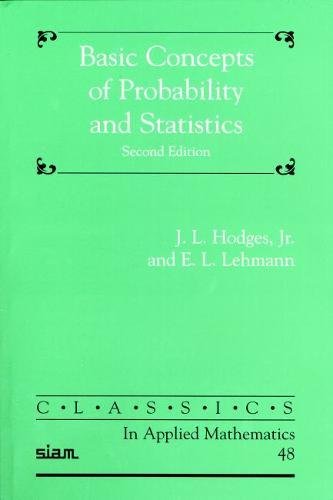
Ebook Info
- Published: 2004
- Number of pages: 460 pages
- Format: PDF
- File Size: 43.73 MB
- Authors: J. L. Hodges Jr
Description
Basic Concepts of Probability and Statistics provides a mathematically rigorous introduction to the fundamental ideas of modern statistics for readers without a calculus background. It is the only book at this level to introduce readers to modern concepts of hypothesis testing and estimation, covering basic concepts of finite, discrete models of probability and elementary statistical methods. Although published in 1970, it maintains a modern outlook, especially with such topics as models and model building, simple random and stratified survey sampling, experimental design, and nonparametric tests and its discussion of power. The book covers a wide range of applications in manufacturing, biology, and social science, including demographics, political science, and sociology. Each section offers extensive problem sets, with selected answers provided. Among the topics covered that readers may not expect in an elementary text are optimal design and a statement and proof of the fundamental (Neyman-Pearson) lemma for hypothesis testing.
User’s Reviews
Editorial Reviews: Book Description This book provides a mathematically rigorous introduction to the fundamental ideas of modern statistics for readers without a calculus background. About the Author J. L. Hodges, Jr. (19222000), formerly of the University of California at Berkeley, pioneered nonparametric density estimation. He also invented the Hodges bivariate sign test and, with Lehmann, the HodgesLehmann estimator. E. L. Lehmann, a professor emeritus of the University of California at Berkeley, is a member of both the American Academy of Arts and Sciences and the National Academy of Science.
Reviews from Amazon users which were colected at the time this book was published on the website:
⭐It is often pointed out that the modern theory of statistics requires probability theory, which in turn rests upon measure theory. As a result, all the “calculus-based” statistics textbooks known to me – like Bartoszynski/Niewiadomska-Bugaj 1996, Berger/Casella 2002, Hogg/Craig 1995, Rohatgi 1976, Roussas 1973, to name just a few – always gloss over various essential points because their rigorous exposition usually requires measure theory and nobody has yet succeeded in devising alternative “elementary” proofs for them based on calculus alone. I have therefore always considered it a thankless task to seriously explain statistics while not even invoking calculus. Nevertheless, the reading of Hodges/Lehmann’s remarkable book has opened my eyes on how much meaningful statistical thinking is already possible by utilizing only high school algebra! Added to my embarrassment is the fact that the fist edition of their book was published in 1964 and that in the last five years I have taught various introductory statistics courses without the benefit of knowledge of Hodges/Lehmann.To be sure, there are lots of statistics textbooks in the market (both in English and in Chinese, in case you can also read in my native language) without using calculus. But, as far as I have read, all of them except Hodges/Lehmann are essentially “cookbooks” which are more suitable for training robots rather than inquisitive minds eager to follow careful reasoning whenever available. Not surprisingly, to make their book honest and rigorous Hodges and Lehmann restrict themselves to discrete random phenomena. But it is surprising that their treatment is not thereby made shallow. There is no point for me to recapitulate the book’s contents as the interested reader can easily obtain fuller information via Amazon’s superb “search inside the book” option. It suffices to say that I’m most impressed by its Part II on estimation and hypotheses testing. Every topic is gently but thoroughly presented through carefully designed examples which pave the way for the elegant proofs of all the book’s formulas so well that those great intellectual achievements like the Neyman-Pearson Fundamental Lemma begin to appear like something which every person accustomed to careful reasoning should have been able to discover by himself/herself. Moreover, even practitioners and teachers of statistics might occasionally find something unexpected in the author’s numerous remarks on various statistical fine points and pitfalls which could also mislead the relatively experienced. These clarifications will remind us that the authors are not only excellent educators but also eminent statisticians in the first place. And the beginning student should consider it a good fortune that a world-acclaimed author of advanced books on estimation and testing like Lehmann should so seriously take this elementary work that “each section, nearly each sentence, was vigorously debated, drafted, and subjected to additional debate” with his Berkeley colleague J.L.Hodges. And the result is a masterly exposition with amazing clarity.Currently I’m teaching some four hundred business-school students introductory statistics out of a textbook in Chinese which is vastly inferior to that of Hodges/Lehmann. After reading the masters’ work, I really feel sorry for my students. Not only it is too late to change the textbook but also there is no Chinese translation of Hodges/Lehmann (it has been translated into Italian, Hebrew, Danish and Farsi ). And unfortunately most of my students will fear reading an English text no less than studying statistics itself. So I couldn’t resist giving an advice to the lucky English-speaking beginning statistics students: study calculus and even measure theory if you can, for that will enormously help your statistics education. But if you are anxious to understand the fundamental concepts of statistics right now without already equipping yourself of a working knowledge in calculus, then it is hard to imagine what could be a better source than Hodges/Lehmann.
⭐In un’altra recensione, quella dell’agile volume di Fabio Corradi, “Statistica”, ho premesso una serie di considerazioni su pensiero critico, importanza della probabilità e statistica, nonché della logica nel mondo incerto e (mal)informato d’oggi, considerazioni che valgono anche per il libro qui recensito (vd. https://www.amazon.it/Statistica-Con-e-book-aggiornamento-online/dp/8823827477/ref=sr_1_1?s=books&ie=UTF8&qid=1494503323&sr=1-1&keywords=fabio+corradi). Ho anche accennato alla scarsa fortuna della disciplina presso le scuole (insegnamento secondario) e il vasto pubblico (comprensione e mentalità).In particolare, in quella recensione ho citato diversi manuali di grado universitario ormai diventati veri e propri “classici”. (Se ne avete uno o più, vi consiglio di tenerli con cura e di non imprestarli a chicchessia). Fra questi, il trattato “Basic Concepts etc.” di J.L. Hodges, Jr., e E.L. Lehmann è forse quello di livello più introduttivo – anche se di impostazione matematica e analitica – perché spiega i concetti fondamentali della probabilità e della statistica, presupponendo soltanto la conoscenza dell’algebra, al livello di come è (o dovrebbe essere) insegnata nelle scuole medie superiori. Poiché non fa uso dell’analisi infinitesimale e della geometria analitica, l’esposizione si limita a casi e modelli discreti e finiti.Questa in considerazione è la pregevole riedizione da parte della Society for Industrial and Applied Mathematics (SIAM) della seconda edizione del compendio, risalente al 1970 e che, nonostante l’età, mantiene una prospettiva moderna nell’impianto e nei contenuti. Riporta infatti un gran numero di esempi tratti dai campi applicativi più disparati, quali industria, biologia, sociologia, politica. Ogni capitolo offre un insieme di problemi, la soluzione di molti dei quali è riportata alla fine del libro. Il manuale è infine corredato di ben due indici analitici, uno per la materia trattata e uno per gli esempi proposti; entrambi utilissimi per orientare i neofiti in una materia così articolata e, in alcuni casi, fuorviante rispetto all’intuizione comune. (Di questo testo posseggo anche i due tomi dell’ormai fuori catalogo edizione italiana, parzialmente insoddisfacente non per la traduzione in sé, bensì per la mancanza tanto dei preziosi indici analitici quanto delle soluzioni dei problemi suggeriti).La copia nuova che ho ricevuto da Amazon.it era incellofanata e in condizioni perfette, cosa che non sempre succede per gli acquisti online.
Keywords
Free Download Basic Concepts of Probability and Statistics (Classics in Applied Mathematics, Series Number 48) 2nd Edition in PDF format
Basic Concepts of Probability and Statistics (Classics in Applied Mathematics, Series Number 48) 2nd Edition PDF Free Download
Download Basic Concepts of Probability and Statistics (Classics in Applied Mathematics, Series Number 48) 2nd Edition 2004 PDF Free
Basic Concepts of Probability and Statistics (Classics in Applied Mathematics, Series Number 48) 2nd Edition 2004 PDF Free Download
Download Basic Concepts of Probability and Statistics (Classics in Applied Mathematics, Series Number 48) 2nd Edition PDF
Free Download Ebook Basic Concepts of Probability and Statistics (Classics in Applied Mathematics, Series Number 48) 2nd Edition