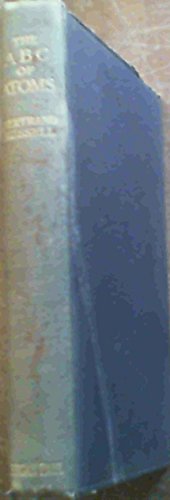
Ebook Info
- Published: 1923
- Number of pages:
- Format: PDF
- File Size: 3.71 MB
- Authors: Bertrand Russell
Description
User’s Reviews
Reviews from Amazon users which were colected at the time this book was published on the website:
⭐The A B C of atoms, by Bertrand Russell.Bertrand Russell is one of those rare intellectuals who covered several disciplines. I always had an interest in his work since I discovered he was born in Monmouthshire. I recently acquired a short book by Bertrand Russell, ‘The A,B, C of atoms’. A small hard covered book, and the paper is of that pale cream stiff variety associated with old books. It was published in 1923. The copy I have belonged to the library of one R.C. Trevelyan, who has a wiki page of his own. He was a friend of Russell, so fortuitously I have a copy of the book that is linked to Bertrand himself.One of Trevelyan’s brothers was the famous historian G.M. Trevelyan, a somewhat notorious figure in some circles within Wales because of his indirect connection with the Pen-y-berth arson in 1936. Saunders Lewis, one of the arsonists, bemoaned the decision to build a bombing school in North Wales and he summarised how other locations were dismissed as possible sites. ‘Then came Holy Island in English Northumberland. Mr G. M. Trevelyan wrote a letter to the Times on January 13th to explain that Holy Island was a sacred region: it was a holiday resort for city workers; it had historical associations with Lindisfarne and St. Cuthbert; it was the most important home of wild birds in England. He argued that the Northumberland duck were no less sacred than Dorset swans. He was supported by leaders of English scholarship and letters. The Air Ministry summoned a public conference to consider the matter, and the Bombing Range was withdrawn’.Back to the book on atoms. It is mostly easy reading and something of a time-capsule which records the state-of-play in physics at that time.Russell was an astonishing polymath, but he resists the temptation to overwhelm his audience. For example, in describing electron orbits, he notes that:‘…it seems that they (electrons) are arranged in successive rings around the nucleus, all revolving round it approximately in circles or ellipses. An ellipse is an oval curve, which may be described as a flattened-out circle…’Nowadays, we take it for granted that transitions occur between electron orbits, as when an electron is promoted to a higher level. But Russell recognises this as quite remarkable:‘One of the most astonishing things about the processes that take place in atoms is that they seem to be liable to sudden discontinuities, sudden jumps from one state of continuous motion to another. The motion of an electron round its nucleus seems to be like that of a flea, which crawls for a while, and then hops…. The hops are a new phenomenon…’ [p.15]The nature of the atomic transition is further examined in chapter V. Russell starts by comparing the predictions made by Newtonian physics and electrodynamics:‘According to Newtonian dynamics, the electron ought to be capable of revolving in any circle which had the nucleus in the centre, or in any ellipse which had the nucleus in a focus; the question what orbit it would choose would depend only upon the velocity and direction of its motion at a given moment. Moreover, if outside influences increased or diminished its energy, it ought to pass by continuous graduations to a larger or smaller orbit, in which it would go on moving after the outside influences were withdrawn. (see also reference to p.63 below).As for electrodynamics, Russell notes that ‘According to the theory of electrodynamics….an atom left to itself ought gradually to radiate its energy into the surrounding aether, with the result that the electron would approach continually nearer and nearer to the nucleus’. In other words, the electron would fall into the nucleus.Russell then describes Bohr theory in terms of ‘circles’ (orbits), stating that Bohr ‘holds that, among all the circles that ought to be possible on Newtonian principles, only a certain infinitesimal selection are really possible’. [p.61].Once again, the mysterious ‘electron jumps’ within atoms attracts further attention. ‘When an electron jumps from one orbit to another, this is supposed to happen instantaneously, not merely in a very short time. It is supposed that for a time it is moving in one orbit, and then instantaneously it is moving in the other, without having passed over the intermediate space’. He then introduces one of his famous metaphors. ‘An electron is like a man who, when he is insulted, listens at first apparently unmoved, and then suddenly hits out’. He adds ‘The process by which an electron passes from one orbit to another is at present quite unintelligible, and to all appearance contrary to everything that has hitherto been believed about the nature of physical occurrences. [p63].Russell introduces quantisation on p.63. ‘It used always to be supposed that the energy in a body could be diminished or increased continuously, but now it appears that it can only be increased or diminished by jumps of a definite amount’. Russell also noted that Poincare had suggested that even time might discontinuous. (Historical background. Planck wrote his first paper on quantisation in 1900 and won the Nobel Prize for his work in 1918. Einstein’s idea that light was quantised was not accepted until 1919, having been previously rejected by Planck and Bohr. Russell presumably reflected the length of time it had taken for the idea of quantisation, and quantisation of light in particular, to be universally accepted).Planck’s revolutionary work is reported as a principle as follows, with the exposition clearing displaying the classical roots of Planck’s work:‘If a body is undergoing any kind of vibration or periodic motion of frequency , then there is a certain fundamental constant h such that the energy of the body owing to this periodic motion is h or some multiple of h. That is to say, h is the smallest amount of energy that can exist in any periodic process’.Russell was a consummate mathematician and although the book is largely non-mathematical he exudes the confidence of an authorative reviewer. He gives quite a lot of detail of the quantum theory as applied to atoms and goes so far as showing the mathematics of the hydrogen atom in an appendix to the book. Chapter VII is entitled ‘Refinements of the Hydrogen Spectrum’. Einstein’s Theory of Relativity is also discussed (p.92) in the context of the relativistic mass of the electron.Russell also speculates that the nucleus of the atom contains hydrogen nuclei (protons) and electrons. This is referred to on p.137. The neutron would not be discovered for another five years.In explaining that some atoms are bigger and more complex than others, Russell makes an analogy of his time:‘…until we come to uranium, like the Grand Turk, with ninety-two consorts revolving round him’.Russell mentions electricity, defusing further queries as to its nature:‘Some readers may expect me… to tell them what electricity “really is.” The fact is that I have already said what it is. It is not a thing, like St.Paul’s Cathedral; it is a way in which things behave. When we have told how things behave when they are electrified, and under what circumstances they are electrified, we have told all there is to tell’.On the aether, it may have been that Russell was out of date (the Michelson-Morley experiment was carried out in 1887) or that he is simply reflecting the opinion of many physicists even in the 1920s:‘People have invented a medium, the aether, for the express purpose of transmitting light-waves. But all we really know is that waves are transmitted…We know the mathematical properties of light-waves…but we do not know what it is that undulates. We only suppose that something must undulate because we find it difficult to imagine waves otherwise.’In the last chapter of the book, Russell notes that ‘The aether, which used to play a great part in physics, has sunk into the background, and has become as shadowy as Mrs Harris’ (p.152). But he goes on to say that the Aether might yet make a comeback and that it would be found that ‘…hydrogen nuclei are merely states of strain in the aether, or something of that sort’. He refers to the electron as being a disturbance in the aether later, p.154.Russell elaborates on what we now call spectroscopy with wonderful accuracy, perceptiveness and simplicity. “It was obvious from the first that, when light is sent out of a body, this is due to something that goes on in the atom, but it is used that, when the light is steady, whatever it is that causes the emission of light is going on all the time in all atoms of the substance from which light comes’. [P.58]. Russell notes that existence of spectral lines proves this to be untrue. ‘Each of the lines is a statistical phenomenon: a certain percentage of the atoms are making the transition that gives rise to this line’. He then assigns line intensity to the probability that transitions take place. He expresses atomic emission in a memorable way: ‘[When] the atom loses energy, but the energy is not lost to the world: it spreads through the surrounding medium in the shape of light-waves’.The element name niton is used in the book. Nitron was the IUPAC-accepted name in the 1920s but they changed their mind later and renamed the element radon.The last five chapters are devoted to X-rays; radio-activity; the structure of nuclei, and ‘The New Physics and the wave-theory of light’; and ‘the new physics and Relativity’ respectively. Russell makes an interesting comment on radio-activity: ‘Radio-activity is one of those processes of degeneration to which no converse process of regeneration is known’.On nuclei, Russell chides us for wanting to revert to thinking of things too pictorially (p.153): ‘Our imagination is so incurably concrete and pictorial that we have to express scientific laws, as soon as we depart from the language of mathematics, in language which asserts much more than we mean to asser. We speak of an electron as if it were a little hard lump of matter, but no physicist really means to assert that. We speak of it as if it had a certain size, but that also is more than we mean. It may be something more analogous to a noise, which is spread throughout a certain region, but is spread throughout a certain region, but with diminished intensity as we travel away from the source of the noise. So it is possible than an electron is a certain kind of disturbance in the aether…’In summary, this small, largely illustration-free volume is an historical and literary delight to any scientist who is familiar with atomic structure and modern physics. It may have been intended for a wider audience in its time, and it is difficult to gauge how big that audience was. Perhaps it may be likened to the ‘coffee table’ scientific works of today?
⭐good
Keywords
Free Download The ABC of atoms, in PDF format
The ABC of atoms, PDF Free Download
Download The ABC of atoms, 1923 PDF Free
The ABC of atoms, 1923 PDF Free Download
Download The ABC of atoms, PDF
Free Download Ebook The ABC of atoms,