Ebook Info
- Published: 2008
- Number of pages: 416 pages
- Format: PDF
- File Size: 7.24 MB
- Authors: Doug McCune
Description
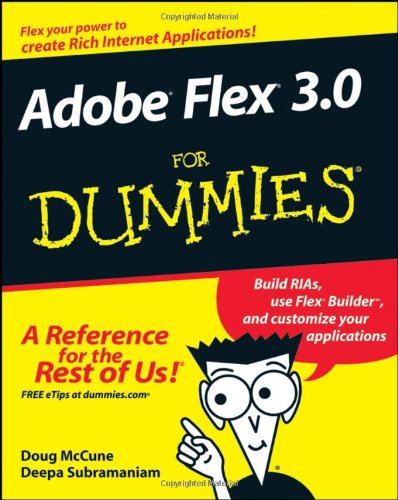
Ready to flex your Web development muscles and start building rich Internet applications? With Flex 3.0, you can create great RIAs that perform like desktop applications using Adobe Flash Player, which is already installed on more than 95 percent of Internet-connected computers. And the fun and easy way™ to get up to speed on Flex is with Adobe Flex 3.0 For Dummies.This friendly guide shows you how Flex lets you leverage the power of Adobe’s ubiquitous Flash technology to build large applications. If you’ve written code in any language, Adobe Flex 3.0 For Dummies will get you started, introduce you to FlexBuilder and the Flex framework, and have you building some really “flashy” stuff before you know it. You’ll find out how to:Develop interactive applications without worrying about browser differencesUse the Event ModelWork with ActionScript and MXMLBuild simple user interface controls and data-driven controlsSet up data bindingFormat and validate user dataCreate, run, and clean a projectExplore Flex manager classesWork with styling and skinning Flex componentsAll the code used in the book is on the companion Web site to save you that much more time. Adobe Flex 3.0 For Dummies helps you become Flex-literate in a flash!Note: CD-ROM/DVD and other supplementary materials are not included as part of eBook file.
User’s Reviews
Editorial Reviews: From the Back Cover Get going with Flex, and create RIAs in a Flash!Develop interactive applications without worrying about browser differencesFlex lets you leverage the power of Adobe’s ubiquitous Flash technology to build large applications. If you’re eager to create Flex apps and you’ve written code in any language, this book will get you started, introduce you to Flex Builder and the Flex framework, and have you building some really flashy stuff before you know it!Discover how to:Use the event modelWork with ActionScript® and MXMLCreate, run, and debug a projectBuild simple user interface controlsSet up data bindingExplore styling and skinning About the Author Doug McCune is a passionate Flex developer, consultant, and community contributor. He has been developing Flex applications since 2004 and is currently a Principal Software Engineer at Universal Mind. Doug received a Bachelor of Arts degree in Science, Technology, and Society from Stanford University. Doug is active in the Flex open-source community and maintains a blog of his thoughts, code samples, and tutorials at www.dougmccune.com. He co-founded FlexLib, a leading resource for open-source Flex components created by community developers. Doug also enjoys speaking at Flex and Flash conferences — he has spoken at 360|Flex and Flash on the Beach.Deepa Subramaniam is a Computer Scientist working on the Flex Framework team at Adobe. She joined Macromedia/Adobe in 2003, straight out of University of California, Berkeley where she received her Bachelor of Arts degree in Computer Science (Go Bears!). Deepa joined the early efforts that culminated in Flex 1.0 and has been working on Flex ever since. She might be described as one of the most enthusiastic Flex team members and is thrilled to be working with such bright engineers on such a cool product. Deepa is an active member of the Flex community, often speaking at large Flex and RIA conferences like Adobe MAX and 360|Flex. You can learn more about Deepa at her Web site, which includes her popular Flex blog, at www.iamdeepa.com.
Reviews from Amazon users which were colected at the time this book was published on the website:
⭐The authors have done a superb job creating Flex for Dummies 3.0. It will be a great asset for beginning Flex developers. The book can be read from front to back – giving an over view of all that Flex has to offer – or as a desk reference to be used while working. I particularly appreciate the ‘Remember’ and ‘Warning’ sections, since they point out some of the nuances of working with such a powerful language.While most likely regarded as a beginners book, there is probably plenty here for a moderately experienced developer to work with. Chapter 16, on Custom Components and Component Architecture has been invaluable while trying to build more complex components.As Flex grows in popularity, there are more and more resources popping up. While this is great, it is also becoming more difficult for developers to sift through it all and find the answers to their questions – Flex 3.0 for Dummies can provide many of these answers… on your REAL desktop.
⭐When I found out Doug and Deepa were writing the Flex book for Dummies, I’ll admit I was shocked. These two people could easily write the most advanced book on Flex, but a book that by default of its expert level would have been accessible by few.With so much Flex knowledge in their heads, can this really be a book for dummies? Yes, it can. I’ll prove it with a quote from the book. In Chapter 16 (Custom Components and Component Architecture), Doug and Deepa explain how to make a custom component in MXML, not ActionScript. You’ll find this little gem in the “Choosing between MXML and ActionScript” section:”Because creating ActionScript components is an advanced topic (we could write a book on it!), we cover only MXML components in this chapter.”They know their audience and thankfully take it easy on them. The writers gives a taste of Flex’s greatness, without getting too deep into all the complex magic that happens behind the scenes.Anyone looking to get up to speed on Flex would do good to pick this up. After you get comfortable with the basics, go check out the authors individual blogs for more advanced information.I took my copy of the book into the office, where it was rather quickly “borrowed” by a coworker. I’ll likely have to buy another copy just to have at home, where no one can “borrow” it. :)I want to be clear that I know Doug and Deepa on a personal level. They speak at my conferences and participate in my user group. Does this make my review biased? No. Instead, it gives me insight into their personalities. It helps me understand why they spent so much of their precious time to make life easier for those just getting started with Flex vs those advanced enough to find their own way. Although, I say they still should write an advanced book. If they get started now, it should be done when the buyers of this book are ready for something a bit more advanced.
⭐Don’t let the “for Dummies” title fool you. This book is designed to teach the most important parts of the Adobe Flex framework in a clear, efficient manner.Maybe this unparalleled clarity and quality is because one of the authors is part of the Adobe Flex team or maybe it is just because the other author is one of the most prolific, dynamic, sought after Adobe Flex developers. Either way, this book will get you up to speed on Adobe Flex development.The book develops in a clear, uncluttered style for which the Dummies franchise is known. Also, scattered through the writings at appropriate times are callouts for Tips, Points to Remember, Technical Details and Warnings. These features will help you retain important parts of the teachings by reinforcing the principles.My top two favorite parts of this book were Part 5 “Exploring Advanced Flex Topics” and Part 6 “The Power of Tens”. This book is worth the cover price if only for those two chapters.In short, if you want to learn to program using the Adobe Flex framework, or want to be more proficient at programming with the Adobe Flex framework, order this book.
⭐Flex covers a very broad set of functionality which can lead to a lot of confusion. Unfortunately, this book adds to that confusion.Regrettably, while the authors of this book come across as very knowledgeable and experienced there message is garbled and convoluted by the format. I think books on software are better suited to color (like IDE’s) and not trying to covering everything in a set number of pages (seems like all dummies books are 340 pages).All that aside, if you are really interested in learning Flex, here is my suggestion of what to read and the order to read it in:Basics in an intuitive form:- Learning Flex 3: Getting up to Speed with Rich Internet Applications, by Alaric Cole- On-line Video Training >[…]Intermediate:- Adobe Flex 3: Training from the Source by Jeff TapperGreat Reference (when you need boost)- Programming Flex 3: The Comprehensive Guide to Creating Rich Internet Applications with Adobe Flex by Chafic Kazoun- Flex 3 Cookbook: Code-Recipes, Tips, and Tricks by Joshua NobleNiche Uses:AdvancED Flex Application Development by R BlankGood luck!(my apologies if some how I am posting a duplicate review – I could have sworn I already wrote a review for this book)
⭐Deepa and Doug, good job.I’ve just recently started with Flex 3 and I must say there are some beginner books that I’ve wasted money on. Not with this book. I already feel like I’m out of that “beginner” phase and on to more intermediate projects. This was money well spent.The chapters are extremely easy to follow. Some of the other books have fluff and it’s easy to lose focus. The examples in the book are precise and very helpful to a beginner like me. I had a few of those “it just clicked” moments where things just became clear. The way things are explained make it very easy to learn quickly.If you’re a beginner, this book is a very good starting point.
⭐I have three excellent Dummies on my shelf (WordPress & ASP.Net 2.0 & VWD 2005 Express), but I was very disappointed with this one.I have long experience as a web site developer, HTML, ASP, ASP.NET, VBscript & Javascript. Although VBScript/ASP are my strongest, however I stuggled to apply Flex concepts using this book, whereas the Adobe ‘Flex in a week’ videos are superb, so I know it is not me being thick!Specifically: The downloadable examples are just snippets and the book does not descibe haw to incorporate them into a project. Chapters 1,2 & 3 regarding Flex Builder are repetitive. Chapter 4 introduces several concepts that have no examples and are not refered to again. The integrated debugger is only touched on even though it is invaluable for debugging remote data connections.I shall use the Adobe online tutorials and buy a Flex reference book.
Keywords
Free Download Adobe Flex 3.0 For Dummies 1st Edition in PDF format
Adobe Flex 3.0 For Dummies 1st Edition PDF Free Download
Download Adobe Flex 3.0 For Dummies 1st Edition 2008 PDF Free
Adobe Flex 3.0 For Dummies 1st Edition 2008 PDF Free Download
Download Adobe Flex 3.0 For Dummies 1st Edition PDF
Free Download Ebook Adobe Flex 3.0 For Dummies 1st Edition