

Ebook Info
- Published: 2015
- Number of pages: 550 pages
- Format: PDF
- File Size: 123.86 MB
- Authors: Jason Jerald
Description
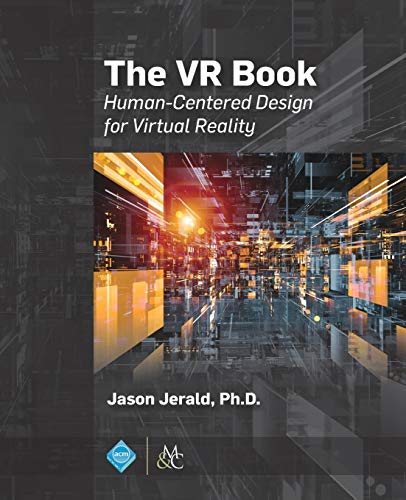
Without a clear understanding of the human side of virtual reality (VR), the experience will always fail. The VR Book bridges this gap by focusing on human-centered design. Creating compelling VR applications is an incredibly complex challenge. When done well, these experiences can be brilliant and pleasurable, but when done badly, they can result in frustration and sickness. Whereas limitations of technology can cause bad VR execution, problems are oftentimes caused by a lack of understanding human perception, interaction, design principles, and real users. This book focuses on the human elements of VR, such as how users perceive and intuitively interact with various forms of reality, causes of VR sickness, creating useful and pleasing content, and how to design and iterate upon effective VR applications. This book is not just for VR designers, it is for managers, programmers, artists, psychologists, engineers, students, educators, and user experience professionals. It is for the entire VR team, as everyone contributing should understand at least the basics of the many aspects of VR design. The industry is rapidly evolving, and The VR Book stresses the importance of building prototypes, gathering feedback, and using adjustable processes to efficiently iterate towards success. With extensive details on the most important aspects of VR, more than 600 applicable guidelines, and over 300 additional references, The VR Book will bring a strong foundation for anyone and everyone involved in creating VR experiences.
User’s Reviews
Editorial Reviews: Review “The definitive guide for creating VR user interactions.” – Amir Rubin, CEO of Sixense “Conceptually comprehensive, yet at the same time practical and grounded in real-world experience.” – Paul Mlyniec, President of Digital ArtForms “The summative guidelines provide quick access with back references for further understanding.” – Chris Pusczak, Creative Director of SymbioVR “I was able to briefly preview it at SIGGRAPH this last summer and it seemed like it would be a good fit for my class. Now that have had a chance to take a deeper dive, I am even more certain I will be using the book. I am looking forward to using this as a required text when I teach the course again.” – Dr. David Whittinghill, Purdue University About the Author Jason Jerald, Ph.D., is Co-Founder and Principal Consultant at NextGen Interactions. In addition to primarily focusing on NextGen Interactions and its clients, Jason is Chief Scientist at Digital ArtForms, is Adjunct Visiting Professor at the Waterford Institute of Technology, serves on multiple advisory boards of companies focusing on VR technologies, coordinates the Research Triangle Park-VR Meetup, and speaks about VR at various events throughout the world. Jason has been creating VR systems and applications for approximately 20 years. He has been involved in over 60 VR-related projects across more than 30 organizations including Valve, Oculus, Virtuix, Sixense, NASA, General Motors, Raytheon, Lockheed Martin, three U.S. national laboratories, and five universities. Jason’s work has been featured on ABC’s Shark Tank, on the Discovery Channel, in the New York Times, and on the cover of the MIT Press Journal Presence: Teleoperators and Virtual Environments. He has held various technical and leadership positions including building and leading a team of ~300 individuals, and has served on the ACM SIGGRAPH, IEEE Virtual Reality, and IEEE 3D User Interface Committees. Jason earned a Bachelor of Computer Science degree with an emphasis in Computer Graphics and Minors in Mathematics and Electrical Engineering from Washington State University. He earned a Master and a Doctorate degree in Computer Science from the University of North Carolina at Chapel Hill with a focus on perception of motion and latency in VR. The graduate work consisted of building a VR system with under 8ms of end-to-end latency; the development of a mathematical model relating latency, head motion, scene motion, and perceptual thresholds; and validation of the model through psychophysics experiments. Jason holds over 20 publications and patents directly related to VR.
Reviews from Amazon users which were colected at the time this book was published on the website:
⭐Get ready to dive deep into how humans sense and perceive our enviroment and what parts of the brain process’ different types information. Also, goes equally deep into every aspect of VR, different techniques tried and tested, what works, what doesn’t and why.
⭐i spent $6k on a film course at the NY film academy and they spent four weeks discussing everything in this book; you can read it for much less. many of the issues will be outdated in 2 years but overall the best source for anyone looking to enter this field or exploit the medium in any capacity
⭐The bible of VR… it has a bit of everything and goes into good to great depth. I am sure this will be a college textbook in this area if it is not already. Easy to read and is a great place to get a solid understanding of the tech, and the space. VR’s implications are also included here and is a also a great jumping off place to learn more…. No an inexpensive book by any means but you do get what you pay for.
⭐This book is both informative and inspirational. It is exhaustive and yet pedagogically sensitive to readers on all levels of VR understanding and foreknowledge.
⭐THE VR BOOK is a great resource for anyone interested in virtual reality. Jason Jerald comprehensively covers the history, considerations and potential of the medium.
⭐Totally Awesome and informative
⭐I recommand this book its goog
⭐Informative, deep and accessible read. Highly recommended.
⭐V GOOD
⭐Ho acquistato il libro per preparare un esame all’università. Il testo copre bene l’argomento VR.Excellent resource. I had the privilege of listening to Jason Jerald speak at Immersed VR here in Toronto and I was blown away by the quality of information presented… So, of course, I had to buy his book. If you’re getting into VR and I would absolutely recommend reading this. It’s going to save you a lot of problems.
⭐Apresenta realidade virtual e esmiúça seus conceitos, desde o histórico às teorias envolvidas no funcionamento, como o cérebro interpreta e as consequências negativas do uso equipamentos de realidade virtual.Para quem quer entender e mesmo se aprofundar (de fato este último) na área nao somente de VR mas de HCD é uma preciosidade
⭐
Keywords
Free Download The VR Book: Human-Centered Design for Virtual Reality (Acm Books, 8) in PDF format
The VR Book: Human-Centered Design for Virtual Reality (Acm Books, 8) PDF Free Download
Download The VR Book: Human-Centered Design for Virtual Reality (Acm Books, 8) 2015 PDF Free
The VR Book: Human-Centered Design for Virtual Reality (Acm Books, 8) 2015 PDF Free Download
Download The VR Book: Human-Centered Design for Virtual Reality (Acm Books, 8) PDF
Free Download Ebook The VR Book: Human-Centered Design for Virtual Reality (Acm Books, 8)