

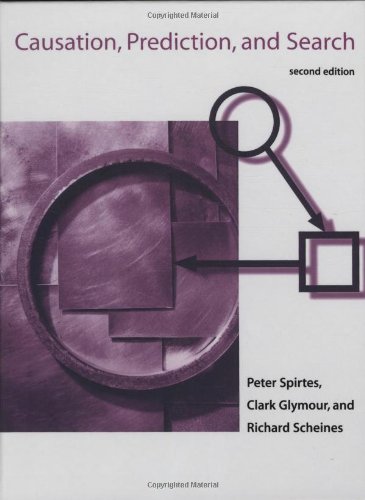
Ebook Info
- Published: 2001
- Number of pages: 568 pages
- Format: PDF
- File Size: 3.11 MB
- Authors: Peter Spirtes
Description
What assumptions and methods allow us to turn observations into causal knowledge, and how can even incomplete causal knowledge be used in planning and prediction to influence and control our environment? In this book Peter Spirtes, Clark Glymour, and Richard Scheines address these questions using the formalism of Bayes networks, with results that have been applied in diverse areas of research in the social, behavioral, and physical sciences.The authors show that although experimental and observational study designs may not always permit the same inferences, they are subject to uniform principles. They axiomatize the connection between causal structure and probabilistic independence, explore several varieties of causal indistinguishability, formulate a theory of manipulation, and develop asymptotically reliable procedures for searching over equivalence classes of causal models, including models of categorical data and structural equation models with and without latent variables.The authors show that the relationship between causality and probability can also help to clarify such diverse topics in statistics as the comparative power of experimentation versus observation, Simpson’s paradox, errors in regression models, retrospective versus prospective sampling, and variable selection.The second edition contains a new introduction and an extensive survey of advances and applications that have appeared since the first edition was published in 1993.
User’s Reviews
Editorial Reviews: About the Author Clark Glymour is Alumni University Professor in the Department of Philosophy at Carnegie Mellon University and Senior Research Scientist at Florida Institute for Human and Machine Cognition. He is the author of The Mind’s Arrows: Bayes Nets and Graphical Causal Models in Psychology (MIT Press), Galileo in Pittsburgh, and other books.
Reviews from Amazon users which were colected at the time this book was published on the website:
⭐This is no doubt one of the key books on causality. The authors developed various search algorithms to determine structure and directions of a causal diagram. They programmed them in their software Tetrad and this book is about the techniques. This one in conjunction with Judea Pearl’s Causality are the two most important texts on causality using Bayesian networks/AI. However, I have found Pearl’s book more structured and easier to understand than this – partially because of the printing and formatting quality and partially because of the flow.
⭐The authors of this book are arguably among the pioneers of the causality discovery topic. The book is a well written, precise, and clear. In comparison with Pearl’s book, this book is mainly concerned with causality discovery rather than coping with spurious causation. Note that many algorithms have been developed during the decade after publication of it; so it mainly serves as establishing the foundations of causality discovery. The audience interested in causality discovery algorithms must check the recent literature.
⭐
Keywords
Free Download Causation, Prediction, and Search, Second Edition (Adaptive Computation and Machine Learning) in PDF format
Causation, Prediction, and Search, Second Edition (Adaptive Computation and Machine Learning) PDF Free Download
Download Causation, Prediction, and Search, Second Edition (Adaptive Computation and Machine Learning) 2001 PDF Free
Causation, Prediction, and Search, Second Edition (Adaptive Computation and Machine Learning) 2001 PDF Free Download
Download Causation, Prediction, and Search, Second Edition (Adaptive Computation and Machine Learning) PDF
Free Download Ebook Causation, Prediction, and Search, Second Edition (Adaptive Computation and Machine Learning)