

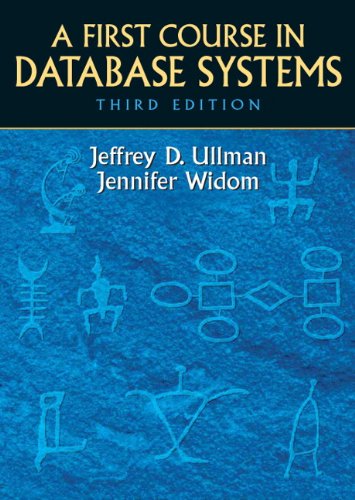
Ebook Info
- Published: 2007
- Number of pages: 600 pages
- Format: PDF
- File Size: 38.44 MB
- Authors: Jeffrey Ullman
Description
For Database Systems and Database Design and Application courses offered at the junior, senior, and graduate levels in Computer Science departments.¿Written by well-known computer scientists, this accessible and succinct introduction to database systems focuses on database design and use. The authors provide in-depth coverage of databases from the point of view of the database designer, user, and application programmer, leaving implementation for later courses. It is the first database systems text to cover such topics as UML, algorithms for manipulating dependencies in relations, extended relational algebra, PHP, 3-tier architectures, data cubes, XML, XPATH, XQuery, XSLT.¿Supplements:¿ Access Student and Instructor Resources at www.prenhall.com/ullman Author Website (Open Access) ¿ http://infolab.stanford.edu/~ullman/fcdb.html¿¿
User’s Reviews
Reviews from Amazon users which were colected at the time this book was published on the website:
⭐I bought this book to refresh my DB knowledge learnt during university years. Chapter 1-5 has made an excellent description regarding the theory and DB design principles. The examples are crystal clear, and more importantly, they are very concise and to the point unlike many other DB books that are very wordy. However, this book failed to introduce many basic terms and concepts such as surrogate keys, candidate keys, 1NF, 2NF etc.Starting from Chapter 6 till chapter 10, it focuses on SQL. This portion seems to be an SQL reference manual rather than a college level course book. The SQL grammar and usage are explained very well. But the academic and practical discussions on the advantages, benefits of Views, Stored Procedures etc are missing. These topics I believe are very fundamental to the DB users. I end up reading other two books “Fundamentals of Database Systems” and “Introduction to database systems” to complement this book. Additionally, when discussing Index, the author does not explain the potential underlying structures for better usage of index. I understand that the author’s complete book might contain details on indexing. However, simply from a DB user perspective, it will still be helpful to learn the basics of index internals as a first course on DB.All in all, this book is a good introductory book though lacks some basic concepts and fundamental coverage. Based on the content and book price comparing with other DB books, I rank this book 3.5 star.
⭐The book is excellent for beginners in the field of Databases. SQL is covered very good. The examples, (based on beer, bars, sells, drinkers, likes and …) are also very good (although I do not like beer or alcohol in particular), explained in detail and the students understand them very well.I am using it for the English speaking group of computer science at our University, and so far (we have covered almost half of the book), everything is going rather well. Thank you Mr.Ullman.
⭐This is not the worst textbook I’ve ever encountered, but it is seriously outdated. Granted I’m no database expert and while the mathematics may not have changed, the representation that I’ve experienced in other courses seems to have been modernized, especially when considering entity relationships diagrams. This makes it very difficult to apply a brand new subject in a modern context.My biggest gripe, however, is the missing answers to practice problems. One of the ways that I best learn is by first attempting the problem, arriving at a solution, then checking my solution against the correct one. Would then work on more problems that are akin to the original problem. As the book becomes invariably more difficult this becomes a bigger problem.
⭐I’ve had little experience with database concepts, but this book helped introduce them pretty well. Some of the explanations are convoluted and unclear, but after a couple read-overs, they become pretty clear. Good for intro database courses.
⭐I have read several database textbooks and have yet to find one that breaks from the “dry but informative” mold. This book was no exception. However, there are plenty of diagrams to help hammer in the abstract concepts of database design.
⭐Structural problems: Chapters not written on top of each page, difficult to navigate.Content: I think for a first course, it could be a little clearer. The book implies too much knowledge of certain things, and the solutions are not even online for the third edition. It seems too varied in its goals.
⭐a very good book . the exercises given are tough and requiregood amount of research.
⭐While this book is nothing special, it certainly isn’t poor either. A First Course in Database Systems is highly lacking in colour, which would have greatly improved the readability. Nevertheless, the text itself is written such that it is easy-to-understand and the concepts are described neatly and concisely.Due to the lack of colour in this book, I recommend that you use post-it notes in conjunction with this text.
⭐Very informative if you need to know this stuff. I got it for a class and aced the class. Straight forward and easy to understand.
⭐Only just started it. Seems fine so far, big book though.
⭐Perfect and fast shipping
⭐very satisfied by the quality of the book
Keywords
Free Download First Course in Database Systems, A 3rd Edition in PDF format
First Course in Database Systems, A 3rd Edition PDF Free Download
Download First Course in Database Systems, A 3rd Edition 2007 PDF Free
First Course in Database Systems, A 3rd Edition 2007 PDF Free Download
Download First Course in Database Systems, A 3rd Edition PDF
Free Download Ebook First Course in Database Systems, A 3rd Edition